Artemis 2 Successfully Launched This Morning After Repeated Delays, Marking Humanity's Return to the Moon After 54 Years
At 6:35 PM Eastern Time on April 1st, the Orion spacecraft, carrying four astronauts, launched from Launch Complex 39B at the Kennedy Space Center in Florida. With the successful launch of Artemis 2, they have embarked on a journey to fly around the moon for the first time since 1972.
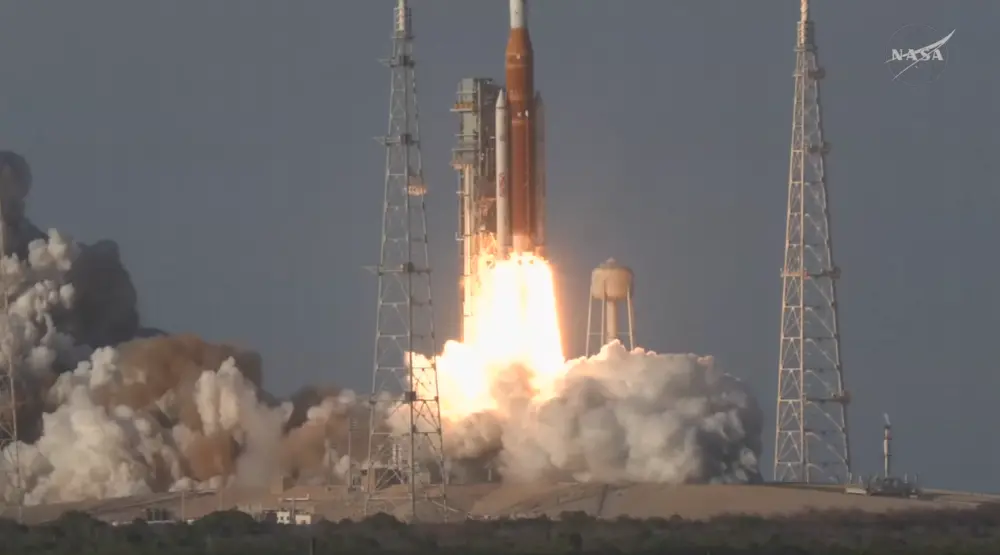
Artemis 2 launch moment | Source: NASA Live Broadcast
The planned launch window for Artemis 2 opened at 6:24 PM Eastern Time on April 1st, and the rocket successfully launched shortly after. It can be said that the execution process of this launch mission was very smooth – except for a hardware issue related to flight termination system communication that occurred at 5 PM, which was quickly resolved by NASA engineers.
According to NASA, 2 minutes after liftoff, the Space Launch System (SLS) solid rocket boosters completed separation.
3 minutes later, the fairing containing the flight termination system completed separation from the Orion spacecraft.
8 minutes later, the SLS core stage main engine shut down and separated from the Orion spacecraft. This marked the completion of the first stage propulsion task of the Artemis 2 mission and the transition to the upper stage operation phase.
24 minutes later, the Orion spacecraft's solar array wings (SAW) were fully deployed, completing a key configuration step for the Artemis 2 mission. All four solar array wings deployed, locked into place, and began powering on as planned.
The next major milestone is the Perigee Raise Maneuver (PRM) and Distant Apogee Ignition (ARB), which will increase the lowest and highest points of the Orion spacecraft's orbit and prepare the spacecraft for deep space operations.
After ignition, NASA will hold a post-launch press conference at the Kennedy Space Center in Florida at 9 PM Eastern Time.
The four astronauts of Artemis 2, from left to right, are Reid Wiseman, Victor Glover, Christina Koch, and Jeremy Hansen | Source: NASA
In December 1972, Apollo 17 commander Eugene Cernan left the lunar surface, and for more than half a century since, no human has flown past near-Earth orbit again. This Artemis 2 mission aims to end that record.
Although this mission will not land on the moon, it will be the first time humans have truly reached near the moon since 1972. The spacecraft uses a "free-return trajectory," utilizing the moon's gravity to naturally return to Earth, with a total duration of about 10 days, of which about 4 days are required to fly to the moon.
Around the 6th day of the mission, the spacecraft will fly over the far side of the moon, entering a 30- to 50-minute radio blackout zone. The four astronauts will have to independently deal with any emergencies while completely disconnected from Earth, and then, driven by the moon's gravity, will turn and begin their return journey, eventually re-entering the atmosphere at speeds exceeding 30 Mach and splashing down in the Pacific Ocean.
It must be emphasized that the Artemis 2 mission is a lunar flyby, only a lunar flyby, and will not enter lunar orbit.
Artemis 2 mission diagram | Source: NASA
Repeated Delays
The launch of this rocket has been fraught with twists and turns, and has been repeatedly postponed. It was originally planned to launch at the end of 2024, and was subsequently pushed back to the end of 2025, February 2026, until April 1st.
The delays were mainly due to three failures: after Artemis 1's unmanned lunar return, engineers discovered asymmetric ablation of the Orion spacecraft's heat shield that exceeded theoretical models. After several months of thermodynamic model reconstruction, an improved solution was provided; during the spacecraft's final assembly, a critical circuit component buried deep within the life support system (ECLSS) was found to have a hidden danger, and dismantling and troubleshooting the failure directly led to a delay of several months; in February 2026, liquid hydrogen leaked again during refueling tests (the same problem had plagued the program for three years), and engineers even had to continue testing while liquid hydrogen continued to leak, and then discovered a blockage in the upper stage helium pressurization pipeline, forcing the rocket to be returned to the vertical assembly bay for inspection.
Not until mid-March 2026 did NASA confirm that all system data met the standards, and the rocket was re-transported to the launch pad. Even so, limited by technology, liquid hydrogen leakage still existed in subsequent tests, but was maintained within a controllable range.
This long and tortuous troubleshooting process reflects the structural challenges of the Artemis program at the engineering level. According to an audit by NASA's Office of Inspector General, from fiscal years 2012 to 2025, the Artemis-related projects have accumulated approximately $93 billion in expenditures, with a single launch costing more than $4 billion.
Behind these numbers is a system based on "heritage hardware": the four RS-25 engines of the SLS rocket core stage all come from retired space shuttles, and the Orion spacecraft's main engine is also recovered from the Atlantis. These hardware that were once reusable will now be directly destroyed at sea after a one-time mission. In recent years, the US Government Accountability Office (GAO) has repeatedly issued risk warnings regarding frequent plan changes and inadequate management oversight.
It is worth mentioning that the four astronauts performing this mission will create a series of records. Commander Reid Wiseman has spent 165 days on the International Space Station and is responsible for overall command; pilot Victor Glover participated in the SpaceX Crew-1 mission and will become the first African American astronaut to enter deep space; mission specialist Christina Koch holds the record for the longest single space stay for a woman at 328 days and will become the first woman to fly beyond near-Earth orbit. The fourth is Jeremy Hansen of the Canadian Space Agency (CSA), who will become the first Canadian astronaut to enter deep space – Canada has pledged to provide the new generation robotic arm Canadarm3 for the Gateway space station in exchange for this seat, but the latest news is that NASA is canceling the construction of that space station.
Main Mission Objectives
So, what are the main mission objectives of Artemis 2?
NASA's statement on this is clear and limited: to verify the Orion spacecraft's life support capabilities in a real deep space radiation environment; to test the O2O laser communication system; and to collect complete physiological data of astronauts after leaving the Earth's magnetosphere protection. These three verifications will directly determine the safety assessment and design parameters of subsequent missions.
The upgrade of the communication system is particularly noteworthy. In the Apollo manned spaceflight era, limited by the bandwidth limit of the S-band radio, the lunar images received on the ground were highly compressed and had extremely limited clarity. The Orion optical communication system (O2O) carried on this mission will use a 100 mm aperture telescope to conduct infrared laser communication with ground optical terminals in California and New Mexico, with a downlink rate of 260 Mbps, which can support real-time transmission of 4K video.
The significant improvement in image quality and transmission speed means that deep space missions can transmit high-resolution scientific images and spacecraft telemetry data in near real-time. This will be the information foundation upon which humanity relies to build long-term deep space infrastructure, and an early verification of the communication pipeline necessary for future Mars missions.
The accumulation of medical data is also indispensable. The ARCHeR experiment will continuously collect data on the sleep quality, cognitive performance, and social dynamics of the four astronauts in the deep space radiation environment through wristbands. Humanity has accumulated a lot of experience in long-term stays in near-Earth orbit, but the impact of deep space radiation on the human body lacks systematic data from actual manned missions. The data collected by Artemis 2 will directly serve the planning of subsequent deep space manned missions.
Artemis 1-5 mission goals | Source: NASA
From the roadmap of the entire Artemis program, this flight is in a pivotal position. Artemis 1 verified the overall performance of the spacecraft and rocket in an unmanned state, Artemis 2 is the first time to put humans into this system for a comprehensive stress test, and the Artemis 3 mission has been adjusted to a commercial lander rendezvous and docking exercise in near-Earth orbit, to step-by-step verify the docking processes and system compatibility that future lunar landings rely on.
The United States' true manned lunar landing mission is currently planned to be realized in Artemis 4 no earlier than 2028. Every step of this roadmap accumulates technical reserves for the longer-term goal of "long-term stay on the moon."
Currently, the lunar south pole is likely to be the preferred area for future manned lunar landings, because its permanently shadowed areas may contain water ice. Water is a basic life resource for astronauts and a potential source of liquid hydrogen and liquid oxygen propellant through electrolysis, which is crucial for establishing a self-sufficient lunar base. Based on data from the Lunar Reconnaissance Orbiter (LRO), NASA has identified 13 candidate areas for subsequent landing missions, including the edge of Shackleton Crater, Haworth, and Nobile Rim, which combine water ice resource accessibility and continuous illumination conditions, and are currently ideal locations for long-term base construction.
China and the US Lunar Plans: Different Considerations
Just as Artemis 2 launched, another lunar plan on the other side of the ocean is progressing at its own pace.
China has made clear its timetable of "manned lunar landing by 2030," and the lunar exploration project is steadily advancing, having completed multiple rounds of unmanned lunar landing exploration missions. The most recent was the developmental flight test completed on February 11, 2026. In Wenchang, Hainan, the Long March 10A rocket, carrying a prototype of the Mengzhou spacecraft, completed two core verifications: escape and rescue during the maximum dynamic pressure phase, and the spacecraft successfully separated and splashed down safely during the flight phase with the most severe aerodynamic load – this was also China's first completion of escape and sea landing of a large-scale test.
China's technical route designed for the 2030 lunar landing is "dual-star launch, lunar orbit rendezvous": two rockets will send the Mengzhou manned spacecraft and the Tengyue lander into the Earth-Moon transfer orbit respectively, they will complete automatic rendezvous and docking in lunar orbit, astronauts will transfer to the lander to descend to the moon, complete the mission and then return to rendezvous in the ascent stage, and be carried back to Earth by the Mengzhou spacecraft.
According to Xinhua News Agency, the Long March 10 series carrier rockets are a new generation of manned carrier rockets developed by China for manned lunar exploration missions, including two configurations: the Long March 10 and the Long March 10A. The Long March 10 is a three-stage rocket with boosters, 5 meters in diameter and a maximum height of 92.5 meters, bundled with two boosters, which will be responsible for launching the Mengzhou Y manned spacecraft and the Tengyue lander in the manned lunar landing mission. The Long March 10A is a two-stage rocket, 5 meters in diameter and a maximum height of 67 meters, with a first stage that can be recovered and reused, which will be responsible for launching the Mengzhou manned spacecraft and the Tianzhou cargo spacecraft in the space station application and development engineering.
Comparing the two lunar plans of China and the United States side by side, the difference lies in where each compresses complexity.
According to plan, the United States will outsource the landing system to SpaceX's Starship HLS and Blue Origin's Blue Moon, and plans a Gateway space station as a transfer node in lunar orbit. Starship HLS, due to its enormous weight, needs to complete propellant transfer with 10 to 20 supply spacecraft in near-Earth orbit before each lunar landing, relying on the maturity of microgravity cryogenic fluid in-orbit transfer technology and the frequency of fault-free commercial launches. Both of these technologies are currently in the early stages of verification. A bigger problem is that NASA recently announced the cancellation of the Gateway space station construction, and has not proposed a new transfer station plan, which may affect the progress of the US's subsequent lunar landing plans.
China's dual-star architecture eliminates the intermediate layer of the lunar orbit space station, and the mission risk is mainly concentrated on the stability of the Long March 10 and the automatic rendezvous and docking in lunar orbit – the former can accumulate experience through multiple test flights, and the latter has been verified in the Chang'e 5 and Chang'e 6 sampling return missions. The execution certainty of this route is relatively high.
The significance of the Artemis 2 mission is more like marking a restart node on humanity's deep space exploration path.
Humanity stopped going to the moon in 1972, the fundamental reason being the lack of sustained political will and resource investment, not the technical ability itself. What Artemis 2 undertakes is to re-establish the accumulation of engineering experience in deep space after half a century of blankness.
If the Apollo era solved "whether it can reach," the current stage is closer to answering "how to exist for a long time." What unfolds around the moon is no longer a one-time landing, but a system engineering about energy acquisition, in-situ resource utilization, communication networks, and human survival capabilities. The answers to these questions will not be given in one mission, but will gradually take shape in repeated verifications.