Claude Revives a Legendary Game from 30 Years Ago in Just One Weekend
A post went viral on Reddit! Claude resurrected a legendary game from 30 years ago with just a few clues. The post has garnered over a hundred comments, with netizens agreeing it’s a legendary feat. The poster, Jon Radoff, CEO of game developer Beamable, used Claude to revive his MUD (Multi-User Dungeon) game, which he developed when he was 19 – and it only took a weekend.
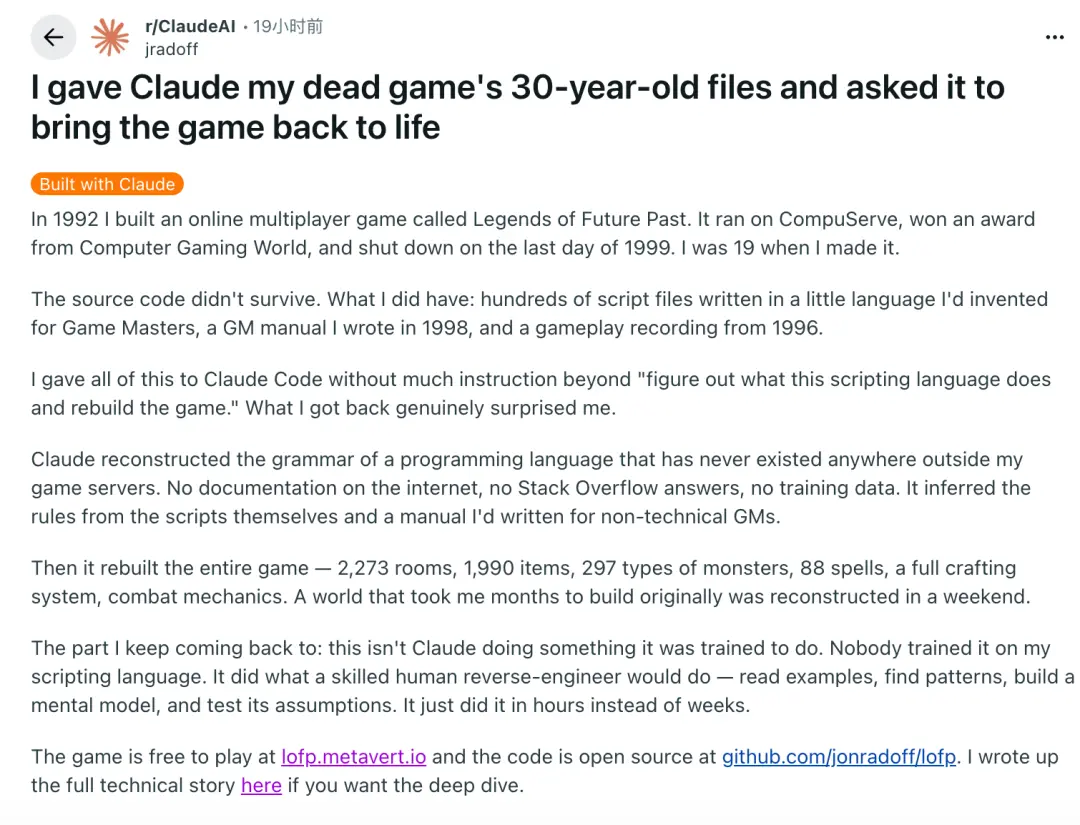
The game, called "Legends of Future Past," was developed in 1992 and had been "dead" for 27 years, with no source code available.
Jon spent 6 months writing the code back then, using a custom scripting language he invented himself.
Surprisingly, Claude Code reverse-engineered his 30-year-old custom scripting language. And with just a little information, it completely rebuilt the game world.
Now the entire Reddit post is buzzing, turning into a grand nostalgia trip.
Many netizens are sharing memories of MUD and BBS games, and some even remember playing this game.
One netizen shared that they also used a similar method to revive their 90s DOS application.
Requirements that the original team spent twenty years trying to achieve can now be demonstrated in just two hours with Claude.
Claude Revives Legendary Game
"Legends of Future Past," developed by Jon Radoff, was one of the earliest commercial massively multiplayer online role-playing games.
It had no graphical interface, relying on text to depict scenes, characters, and plot, leaving a vast space for imagination.
Players communicated with the server by entering specific commands, such as moving (n/s/e/w), fighting, and chatting.
The game was initially released on CompuServe servers and later migrated to the public internet after commercial access opened in 1994.
It won a Special Award for Artistic Excellence from Computer Gaming World in 1993 and was a precursor to MMO games like World of Warcraft and EverQuest.
After 7 years of operation, "Legends of Future Past" shut down in 1999 and disappeared completely – no save files, no emulators, only memories.
Looking back, Jon was 19 years old and developed the game on a 486 computer with 16MB of memory.
He spent 6 months writing the code, and the game content was built over several years by a team –
but Claude revived it in just one weekend.
[Image: Left: Replicated game; Right: Magazine advertisement from the 1990s]
At the time, Jon only had the following materials:
A complete script file – written in a custom scripting language he invented when he was 19, defining every room, monster, item, spell, and interactive event in the game world;
A 1996 game recording, a 1998 first-generation GM script manual, and some player documentation.
But there was no source code for the game engine.
Jon fed these materials to Claude Code, asking it to figure out what the game was and rebuild it.
Then he spent the entire weekend working closely with Claude Code: providing background information, guiding its decisions, correcting it when it went off track, and making technical judgments.
Jon admitted:
AI programming is not self-driving; it’s more like guiding a tireless, talented collaborator, and you need to pay attention to it at all times.
Surprisingly, without the source code, Claude Code was able to recreate the core experience simply by observing the output and interactions of the original game:
It reverse-engineered Jon’s invented custom scripting language, parsed DOS-era script files, and decoded combat formulas from game administrator documents;
And it inferred monster behavior patterns from strategy fields (which encoded AI configurations as integer ranges);
Then it built a complete game engine in Go, a React frontend, a WebSocket multiplayer layer, and a MongoDB persistence system.
Finally, it was deployed on the Fly.io platform.
Reverse Engineering a 30-Year-Old Scripting Language
Jon’s scripting language at the time was, frankly, not very good.
It was quite primitive, and he feels ashamed to look at it now.
To fit the game into a computer with only 16MB of memory, he took various "memory-saving" shortcuts in the script.
It used imperative syntax with conditional statements like IFVERB and IFVAR; it was case-insensitive and used DOS encoding.
[Image: Original scripting language]
Jon joked – “it was really terrible” and apologized to the game administrators who used it to write scripts back then.
But this “bad code” actually worked back then – people with average technical skills could learn it to write complex storylines, puzzles, and events.
What amazed Jon the most was that there were no formal specifications (no language manual), only a GM manual and a pile of example scripts.
Claude Code completely reconstructed the language interpreter from these materials.
The original script had several technical challenges:
It used DOS encoding, and filenames were case-insensitive, which would immediately cause errors on case-sensitive file systems;
Script blocks could terminate implicitly – this pattern required the parser to infer the structure rather than follow explicit delimiters;
Variables existed in multiple namespaces (player attributes, item attributes, environment data) and had to be parsed at runtime based on context.
But Claude managed to parse conditional logic, decode the definition system for nouns and adjectives, and figure out how room descriptions were divided.
It also reconstructed the entire execution model of the script triggers – entry scripts, verb scripts, verb pre-validation, voice processors –
everything was there.
Jon himself exclaimed:
A language designed thirty years ago has been completely reconstructed by an AI that has never seen it before.
[Image: Comparison of technology stacks in 1992 and 2026]
The final remake includes:
2273 rooms, 1990 items, 297 monsters, 88 spells, and 30 psychic disciplines.
There’s also a complete crafting system (mining, smelting, forging, alchemy, weaving), 8 playable races, and a 12-month in-game calendar.
After this experience, Jon felt that what happened this weekend completely overturned his imagination:
If he had to go back to the 90s and develop a game like "Legends of Future Past," writing the game engine alone would take one person months;
Plus a team spending years building the game world: writing a custom game engine in C, manually coding thousands of rooms and items, managing server infrastructure –
and the cost of this infrastructure was higher than a car.
Now, people only need to provide game creative materials, and the AI can completely handle the engineering parts that used to require huge investment.
Jon exclaimed:
How many lost online worlds could be revived if all you needed was creative material and a weekend?
How many games that only existed in people’s imaginations could become reality today?
Who is Jon Radoff
The protagonist who revived his own game, Jon Radoff, also has an impressive background.
He is an entrepreneur, game designer, and CEO and co-founder of Beamable.
Beamable is an online game service platform based on the Unity engine and was acquired by the game competition platform Skillz in January of this year.
He started developing BBS games in high school and founded NovaLink in 1991, where he created the game "Legends of Future Past."
After that, he founded Eprise, GamerDNA, Disruptor Beam, and other companies.
His developed games include Final Frontier, Cyber Corp, True Pirates, Game of Thrones Ascent, and Star Trek Timelines.
Currently, the Claude-remade game is online, with the address below, and the code repository is also completely open-sourced.
Interested friends can take a look~
Game address:
lofp.metavert.io
Code repository:
https://github.com/jonradoff/lofp/tree/main/original/scripts