IPv6 Usage Breaks 50% for the First Time After 28 Years, Finally Catching Up to IPv4
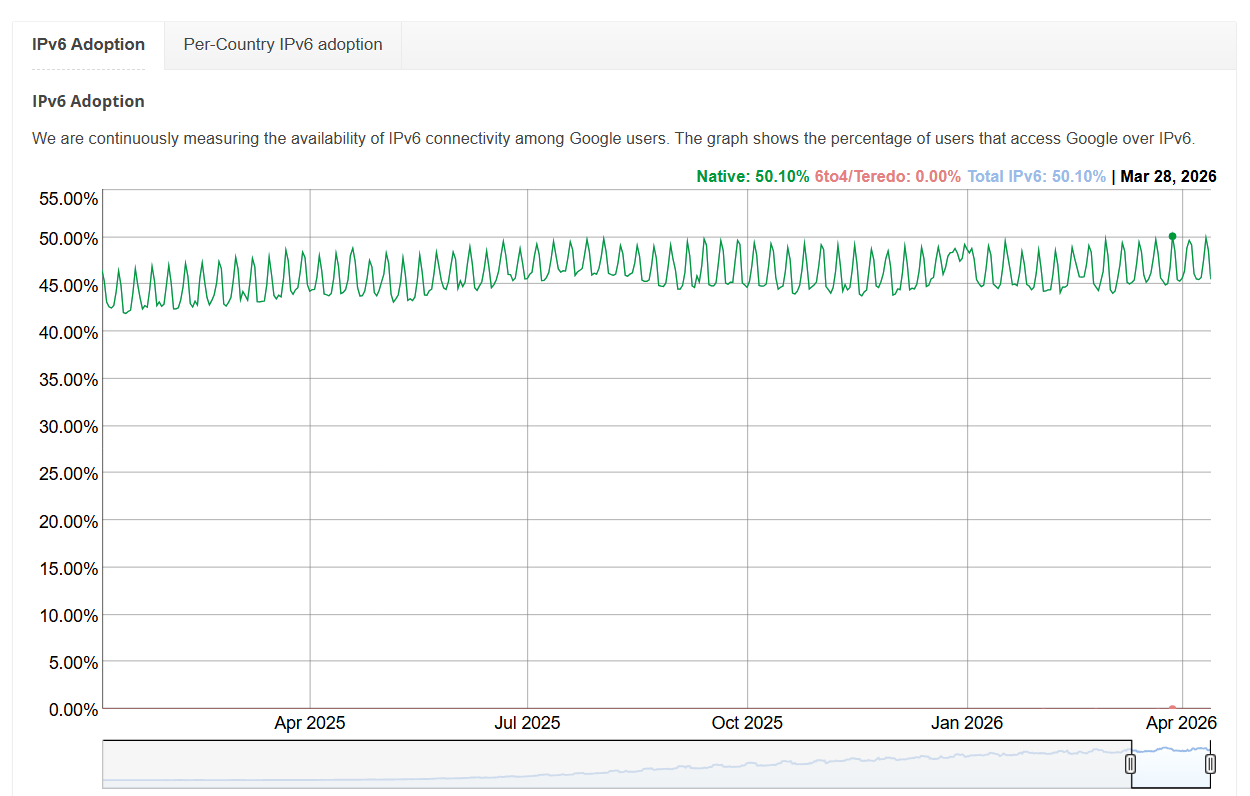
Google traffic monitoring data shows that on March 28th, the proportion of users globally accessing Google services via IPv6 connections reached 50% for the first time, marking a historic milestone for the protocol born in 1998 after 28 years. APNIC statistics show a global IPv6 usage rate of 43%, while Cloudflare data indicates that IPv6 accounts for 40% of actual transferred traffic. Considering Cloudflare statistics are based on actual data packets transferred rather than simple counts, this figure carries more weight.
IPv4, enabled in 1980, provides approximately 4.3 billion addresses (with about 3.7 billion actually usable), which has long been insufficient in the face of the explosive growth of the internet.
The IANA North American address pool was exhausted in 2011, followed by the European RIPE NCC in 2019. Regions in Asia, Africa, and Latin America also announced exhaustion around the same time. IPv6, in theory, provides 2^128 addresses, solving the address shortage problem.
Early IPv6 was once considered a transitional solution by the industry due to its complex deployment and poor compatibility. However, technological advancements have significantly lowered the migration barrier, and more and more companies are seeing it as the direction for network infrastructure.
Notably, the IETF recently released a draft of the IPv8 core protocol, adopting a 64-bit address space and achieving 100% backward compatibility with IPv4, allowing existing devices to connect without modification.
However, this protocol is still in the draft stage, and IPv6 remains the mainstay of internet address evolution in the short term.