52 Cores + 288MB Cache: Intel Nova Lake Desktop CPU Fully Revealed
Recent reports have fully revealed the chip configuration and SKU planning for Intel's next-generation desktop processor, NovaLake (Core Ultra 400). This product will feature a new architecture, up to 52 cores, a new LGA1954 platform, and will introduce large cache versions for the first time to compete with AMD's X3D technology.
In terms of architecture, Nova Lake's P-cores adopt the Coyote Cove architecture, while the E-cores and low-power E-cores (LP-E) use the Arctic Wolf architecture, with the integrated graphics upgraded to Xe3/Xe3P.
The NPU is upgraded to NPU6, with AI performance reaching 74 TOPS, a significant improvement compared to the 13 TOPS of the Arrow Lake desktop version and the 50 TOPS of the Panther Lake mobile version.
According to current rumors, Nova Lake's single-threaded performance will be approximately 10% higher than AMD's upcoming Zen 6 architecture, while multi-threaded performance will have a larger gap thanks to its core count advantage.
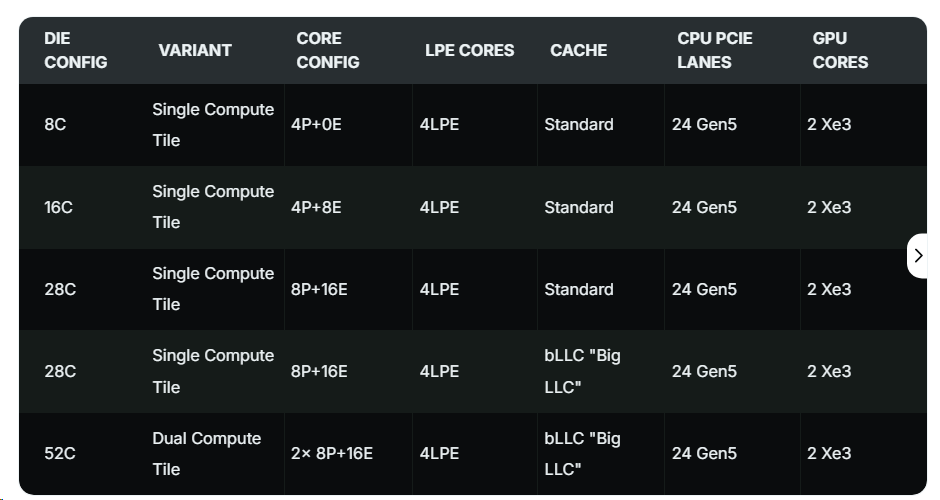
The chip configurations range from 6 cores to 52 cores. The entry-level configuration is 8 cores (4P+4LPE), followed by 16 cores (4P+8E+4LPE). The mid-range includes two 28-core configurations (8P+16E+4LPE), one standard version and another with a large bLLC cache, reaching 144MB of on-chip cache.
The flagship version is a dual-chip version, with each chip equipped with 8P+16E, and 4 LPE cores not belonging to the computing chips, so they will not double with the dual-chip configuration. The total is 52 cores, with the bLLC version cache reaching 288MB. The standard computing chip area is 98mm², and the bLLC version is 154mm².
bLLC is Intel's counterpart to AMD's X3D technology, but it does not use the same chip stacking method as AMD. Instead, it increases the last-level cache capacity to improve gaming performance. The scale of 144MB per chip and 288MB for the dual-chip configuration is unprecedented in desktop processors.
At least 13 models are currently known, covering 35W to 175W, with product lines divided into Core Ultra 9, Ultra 7, Ultra 5, and Ultra 3 levels.
The flagship 52-core and 44-core models are aimed at enthusiast markets, with a TDP of up to 175W. The entry-level Ultra 3 and Ultra 5 are 35W, unlockable to 65W. Mainstream models are 125W, with some offering 65W optimized versions. The entire line includes models with an F suffix, indicating no integrated graphics.
In terms of integrated graphics, standard Nova Lake models are all equipped with 2 Xe3 graphics cores. However, the latest news indicates that Intel is also planning a super-strong graphics version, equipped with up to 12 Xe3P cores, with the CPU portion being 16 cores (4P+8E+4LPE), positioned at the Core Ultra 7 level.
For reference, the Panther Lake mobile Core Ultra 300 series' strongest integrated graphics is 12 Xe3 units. The performance of the desktop version after upgrading to Xe3P is worth looking forward to. To support this strong integrated graphics, the motherboard needs to provide independent two-phase VCCGT power supply.
The platform adopts a new LGA 1954, codenamed Socket V. Intel has promised to extend the interface support cycle, and the three generations of processors after Nova Lake – Razor Lake, Titan Lake, and Hammer Lake – will use the same package.
High-end LGA 1954 motherboards will adopt a dual-layer ILM design, equipped with two pressure rods, providing stronger cooling pressure and achieving efficient heat dissipation without the need for third-party contact frames.
In terms of memory, DDR5 defaults to supporting up to 8000 MT/s, and overclocking kits can further improve it. Intel will focus on promoting CUDIMM and CQDIMM memory standards, breaking the 256GB capacity limit on 4-slot or even 2-slot motherboards.
The processor natively integrates Wi-Fi 7, Thunderbolt 5.0, low-power audio, and ECC memory support, providing an x16 Gen5 PCIe channel for discrete graphics cards, which can be divided into four x4 groups to support four AI GPU parallel processing.
In terms of storage, it supports up to 8 SSDs, with three Gen5 x4 channels coming from the chipset and the rest being Gen4 channels.
Nova Lake is expected to be Intel's important counterattack in the desktop market, but its actual performance still needs to be verified by official release and third-party reviews.