Astronomers Reconstruct the Life History of an Entire Galaxy from a Single Observation
Astronomers have, for the first time, demonstrated the ability to reconstruct the multi-billion-year "life history" of a galaxy from a single observation. This new method, termed "Extragalactic Archaeology," utilizes artificial intelligence and the "fingerprints" of chemical elements within galaxies to write "biographies" spanning the age of the universe for galaxies beyond our own.
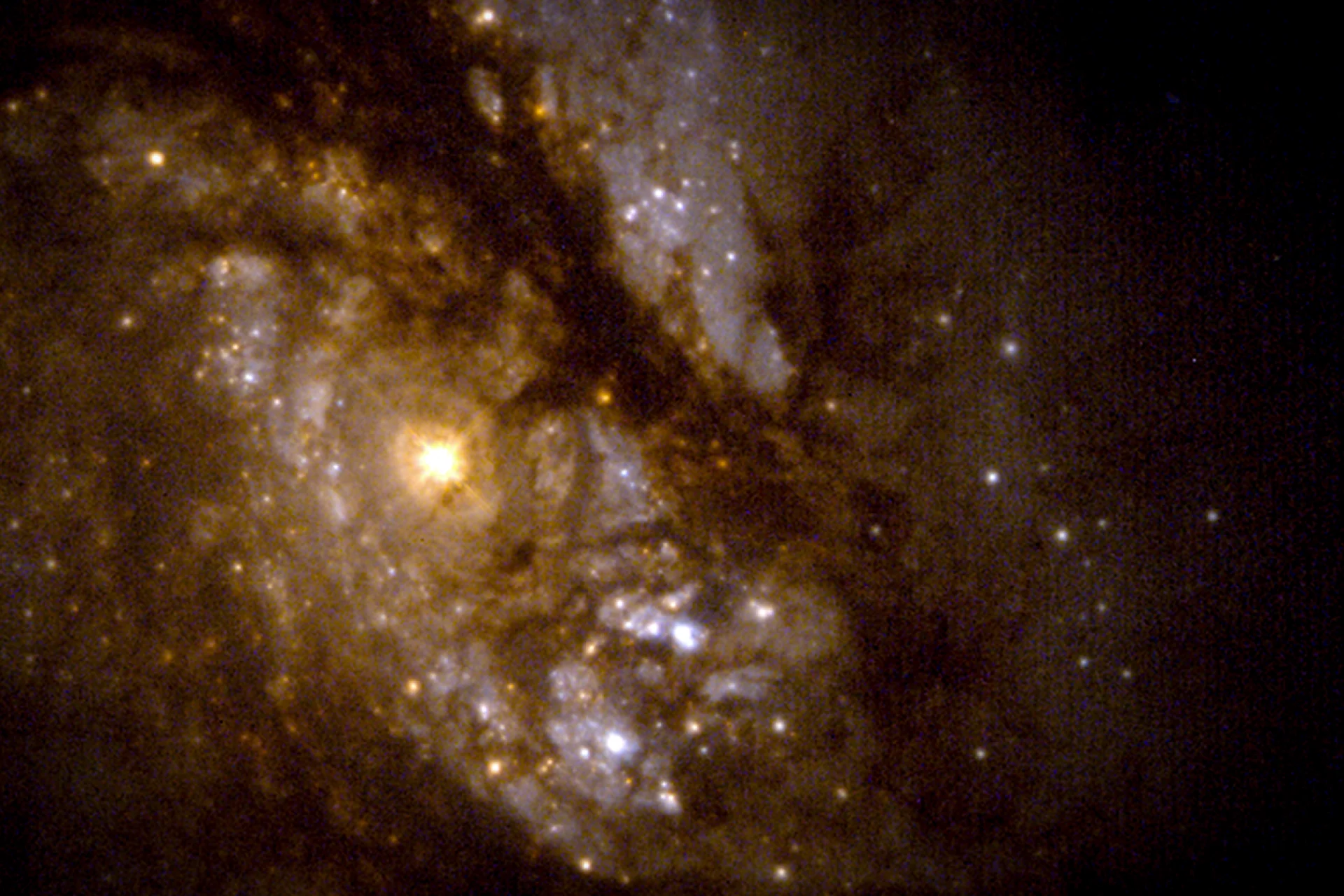
Recent research published in *Nature Astronomy* suggests this work could serve as the foundation for a new "field guide" to understanding how galaxies form, merge, and evolve over cosmic time. Researchers began with a specific case: analyzing the subtle differences in oxygen element distribution within the spiral galaxy NGC 1365.
Generally, the oxygen content is highest in the central region of a galaxy, gradually decreasing outwards – a typical distribution gradient for heavier elements. However, anomalies in this gradient may indicate significant "life events" in the galaxy's history: such as the birth of new stars or black holes, supernova explosions of old stars, or collisions and mergers between galaxies.
The research team constructed approximately 20,000 simulations of different types of galaxies, covering various "growing pains" a galaxy might experience, including star formation, black hole activity, gas movement, and the evolution of different chemical elements. They also assigned complete "family backgrounds" to these simulated galaxies. Subsequently, the team used artificial intelligence to compare these simulation data with the real observed NGC 1365, searching for scenarios that highly matched the galaxy's chemical fingerprint, thereby inferring its evolutionary path.
“We reconstructed its detailed growth history based solely on the current chemical fingerprint of a spiral galaxy,” said Lisa Kewley, first author of the paper and director of the Harvard-Smithsonian Center for Astrophysics, in an interview with Refractor.
The team’s analysis reveals that the central region of NGC 1365 formed early in the universe, almost tracing back to the beginning of the universe 13.7 billion years ago, and produced oxygen during this phase. Over the subsequent approximately 12 billion years, gas from the galaxy’s surroundings was continuously replenished through collisions and mergers with dwarf galaxies, gradually accumulating and driving the growth of the galaxy. The stars of these merging dwarf galaxies also brought new material to the outer regions.
This is just one galaxy’s story, but the goal of “Extragalactic Archaeology” is to reconstruct the “life histories” of the vast number of galaxies beyond the Milky Way. Researchers hope to find the “fossil records” of these galaxies in this way: although galaxies do not have skeletons like Earth life, their internal gas, dust, stars, and dark matter structures have left traceable marks throughout their long evolution.
In traditional research, astronomers typically rely on “redshift” to characterize the distance and age of galaxies – the more pronounced the shift towards the red end of the spectrum, the farther the galaxy and the earlier the observed cosmic stage. This is because the universe is expanding overall, and the earliest formed galaxies are moving away from each other at faster speeds.
Redshift remains an important tool for measuring galaxy age, but “Extragalactic Archaeology” seeks to answer a different type of question: how galaxies merged, exchanged gas and other matter, and how these processes shaped their current form over billions of years. Fortunately, the combination of new technologies such as artificial intelligence, large-scale numerical simulations, and high-resolution telescope observations is gradually making this ambitious research path feasible.
In Kewley’s view, NGC 1365 is an ideal case for conducting this type of “archaeological” research. “This study shows that a detailed image of the oxygen elements within a galaxy, when systematically compared to thousands of simulated galaxies, can significantly narrow down its possible evolutionary paths,” she said.
Of course, NGC 1365 is just one galaxy among billions in the universe, and researchers emphasize that the next step is to apply the same method to more types of galaxies, covering different merger sequences and evolutionary branches. If all goes well, they hope to eventually compile a “field guide to typical galaxies”: just as people can not only describe the current shape of a bird on Earth but also infer its growth environment and evolutionary history, astronomers will also be able to infer when and how stars and gas converged to form today’s appearance through the galaxy’s “chemical fingerprint” and structural “appearance.”
As a research direction still in its early stages, Kewley points out that “Extragalactic Archaeology” still has many areas for improvement. “As we incorporate more chemical elements, more galaxy samples, and more refined simulations, this method will become more powerful,” she said, adding that the research team’s long-term expectation is to use this new tool to better reveal the history of distant galaxies, helping humanity understand the evolution of the entire universe and gain a clearer understanding of the location and origin of our own Milky Way galaxy in the universe.