Ukrainian Army Accelerates Deployment of Battlefield Robots, Employing Human-Machine Teams to Reduce Risks to Soldiers on the Drone Battlefield
Ukrainian President Zelenskyy recently claimed that there have been instances of Ukrainian ground robots and drones independently cooperating to attack Russian positions and force Russian soldiers to surrender. While this claim hasn't been independently verified, if true, it would mark a significant step in the application of battlefield robots in a war already profoundly changed by drones, and provide a real-world example for how armies can utilize robots and drones to undertake the dirtiest and most dangerous tasks.
Zelenskyy released information on social media accompanied by a promotional video, in which he stated that various Ukrainian military robots have completed over 22,000 missions in the past three months. The Ukrainian Ministry of Defense also recently stated that the number of Ukrainian Unmanned Ground Vehicle (UGV) missions has tripled in the past five months, with over 9,000 robot missions completed in March of this year alone. This rapid increase in ground robots is seen as a new trend in the evolution of battlefield forms, compared to the previous perception of the war being marked by aerial drones.
According to British media citing the Ukrainian Third Assault Brigade, the case mentioned by Zelenskyy likely occurred in the Kharkiv region of northeastern Ukraine last year. At that time, the brigade used integrated reconnaissance and strike drones, along with “kamikaze” ground robots, to attack heavily fortified Russian positions on the front lines. The brigade claims that after the positions were severely hit, some Russian soldiers ultimately chose to “surrender” to a Ukrainian robot, abandoning their positions and being recorded by camera equipment.
Previously, footage of individual or small numbers of Russian soldiers surrendering to Ukrainian drones or even single robots has appeared in public videos multiple times. Therefore, the scenario of a small garrison surrendering collectively to robots in a battered fortification is not entirely unimaginable. United24, a platform operated by the Ukrainian government, recently released a video showcasing a similar (or possibly the same) operation, highlighting that the performance of these robots on the front lines has become part of official external propaganda.
The Ukrainian army’s emphasis on robots is closely related to the current battlefield environment, which is dominated by drones and extremely unfavorable to frontline infantry. Continuously hovering reconnaissance and attack drones have created a “kill zone” approximately 20 kilometers long in the direction of advance, forcing individual soldiers to lie prone, conceal themselves, or move under the cover of night, thermal cloaks, or fog to avoid being exposed to aerial strikes. Multiple analyses indicate that drones have now become the primary source of casualties on both the Russian and Ukrainian sides. At the same time, the Ukrainian army is testing a new generation of military drones on the battlefield, integrating a higher degree of autonomous software and artificial intelligence capabilities, allowing them to continue tracking and attacking targets even when encountering strong enemy electronic interference and losing contact with ground operators.
In contrast, the total number of Unmanned Ground Platforms in the Russo-Ukrainian War is still far less than that of flying drones. The number of ground robot missions executed by Ukraine each month is in the “thousands,” while aerial drone sorties have long reached the “tens of thousands.” However, the latest data shows that the Ukrainian army is deliberately accelerating the deployment of ground robots in both non-combat and combat scenarios: on the one hand, for frontline supply and casualty evacuation, to reduce the exposure time of personnel within the “kill zone”; and on the other hand, they are increasingly being directly deployed in combat, equipped with machine guns, grenade launchers, or even acting as mobile explosive devices, taking on a role similar to “kamikaze vehicles.”
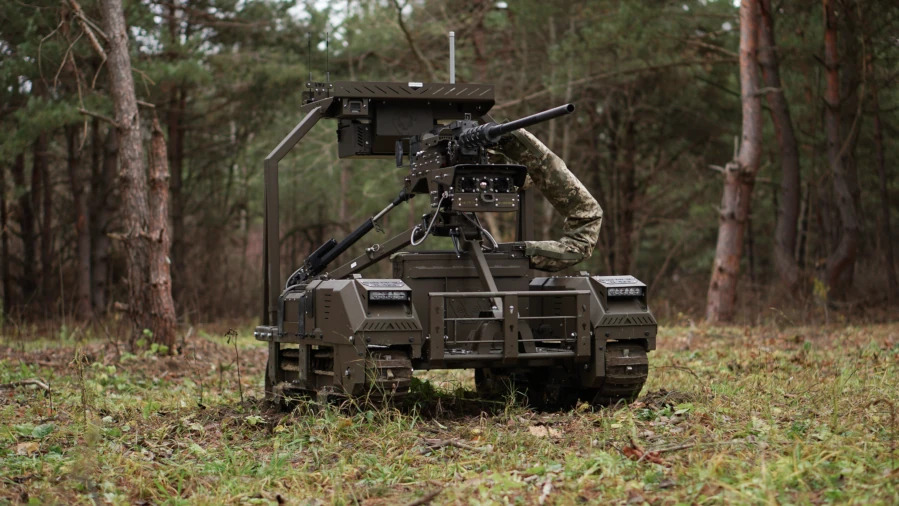
A representative platform is the “Droid TW 12.7” tracked combat robot developed by the Ukrainian company DevDroid. According to publicly available company information, the robot is equipped with a .50 caliber M2 Browning heavy machine gun mounted on a remotely controlled turret, with a maximum range of approximately 25 kilometers and a maximum speed equivalent to that of an adult walking. Operators can maintain contact with the platform via radio, and can also access Starlink satellite communication services to enhance connectivity in the complex electromagnetic environment on the front lines.
However, battlefield robots are not “invulnerable.” A battalion deputy commander of the Ukrainian 38th Naval Infantry Brigade told the media that when attempting to use robots to transport wounded personnel, four out of five missions failed to reach their destination, due to reasons including severe terrain damage, dense obstacles, enemy fire, and drone threats. In other words, even if ground platforms can replace some personnel exposure, their mobility and survivability face huge challenges in the front-line environment filled with craters, rubble, and abandoned equipment.
Similar to drones, robots also face the test of communication link stability. Under enemy electronic warfare interference, signal loss and link interruption will directly affect their real-time remote control and data transmission effects. A think tank analysis pointed out that while Ukraine is advancing its own robot applications, it is also engaged in an “arms race” with the Russian army, which is also strengthening its robot applications. Throughout the past winter, the number of various ground unmanned systems deployed by the Russian army on the front lines has also shown a significant increase, and the competition between the two sides in unmanned and intelligent equipment is accelerating.
In the view of many military observers, the large-scale deployment of Ukrainian ground robots is not about hoping to gain a decisive “overwhelming advantage” with the current generation of technology, but rather seeing it as a tool to reduce personnel casualties and open up new tactical space in extremely harsh battlefield conditions. A commander of the Ukrainian 3rd Army Corps once stated that if the proportion of robots in the troop structure can be continuously increased, by the end of this year, it is hoped to reduce the frontline strength of some infantry units by about 30%. If this goal is achieved, it will mean that the presence of robots on the battlefield has risen to another level, and will further promote the future of warfare towards “human-machine teaming” and “robot-first” evolution.