Unisoc to Complete IPO Guidance Acceptance, Ranking Fourth Globally in Market Share and Shipments
Recently, the China Securities Regulatory Commission disclosed the third progress report on the IPO guidance for Unisoc. The company is expected to complete the IPO guidance acceptance this quarter and subsequently submit an IPO application to the STAR Market, striving to become the first publicly listed domestic mobile phone chip company. According to the guidance report, the guidance period was from January to March 2026, with Guotai Junan and CITIC Securities as the guidance institutions.
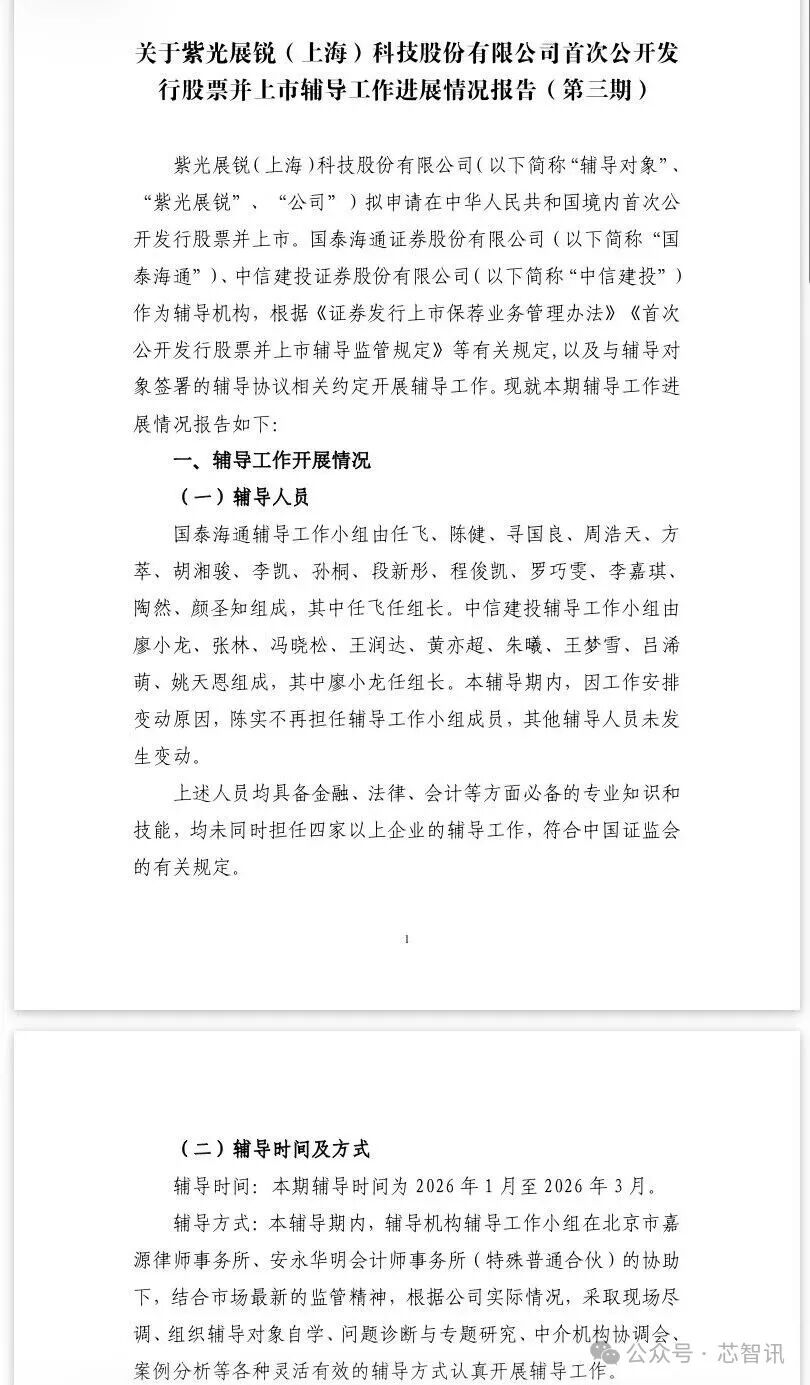
During the guidance period, Unisoc has completed a number of standardization rectifications and verification works: the company’s governance, operation of the three meetings, and internal control systems have all been comprehensively standardized and rectified;
Comprehensive verification has been carried out on financial accounting, revenue recognition, related party transactions, and peer competition; a systematic review of the historical evolution of equity and shareholder qualifications has been conducted;
Verification and validation have been completed item by item in accordance with the five major conditions for listing on the STAR Market.
Currently, the company has completed the framework of the IPO prospectus and a complete set of supporting documents, and has fully launched preparations for the guidance acceptance, which is expected to be completed in the second quarter of 2026. After the acceptance is passed, Unisoc will officially submit the IPO application to the STAR Market.
Previously, Unisoc completed the share reform and industrial and commercial change on March 31, 2025, changing its name from “Unisoc (Shanghai) Technology Co., Ltd.” to “Unisoc (Shanghai) Technology Co., Ltd.” with a registered capital of approximately 5.532 billion yuan.
On June 27 of the same year, the company completed the guidance filing at the Shanghai Securities Regulatory Bureau, officially launching the STAR Market IPO process.
It is understood that Unisoc was established on August 26, 2013, by the merger of two Shanghai-based chip design companies, Spreadtrum and RDA. It is currently the world’s fourth-largest mobile phone chip manufacturer and the first-ranked mobile phone chip design company in mainland China.
The official website introduces that Unisoc is one of the few global companies that comprehensively masters 2G/3G/4G/5G, Wi-Fi, RedCap, Bluetooth, TV FM, and satellite communication technologies across all scenarios.
In addition, it has over 500 brand customers including Xiaomi, Honor, vivo, Meizu, Samsung, ZTE, JD.com, and UnionPay.
It is worth mentioning that Unisoc is the only company in mainland China, apart from Huawei, that possesses complete independent research and development capabilities for 2G to 5G baseband technology, and is in the first echelon of global baseband chip companies alongside Qualcomm, Apple, Samsung, and MediaTek.
According to Counterpoint Research data: In the 2025 global smartphone SoC market, MediaTek ranked first with a 34.4% share, followed by Qualcomm 25.1%, Apple 18.1%, Unisoc 12.1%, and Samsung 5.7%. Unisoc’s share is expected to be approximately 11.2% in 2026;
Also according to Counterpoint Research data, in the fourth quarter of 2024, Unisoc’s global market share of smartphone chips reached 14%, ranking fourth globally;
It is understood that in terms of shipments, the company’s total chip sales exceeded 1.6 billion in 2024, with 5G chips increasing by 82% year-on-year, becoming the core engine of growth.
According to Tianyancha APP, its shareholders include state-owned assets from Beijing and Shanghai, financial institutions, and integrated circuit industry companies such as Intel.
Market analysis believes that if Unisoc successfully lands on the STAR Market, the raised funds will be mainly invested in the research and development of cutting-edge 5G/6G technologies, the layout of advanced manufacturing capacity, and global market expansion, further amplifying its technological advantages and helping Chinese chip companies gain greater influence in the global market competition.