AI Ignites a New "App Gold Rush" as the App Store Returns to High Growth
Mobile applications, once thought to be obsolete in the age of AI, are experiencing an unexpected resurgence. According to the latest analysis by market research firm Appfigures, global new app launches on Apple's App Store and Google Play increased by approximately 60% in the first quarter of 2026, with the iOS app store seeing an even higher increase of 80%.
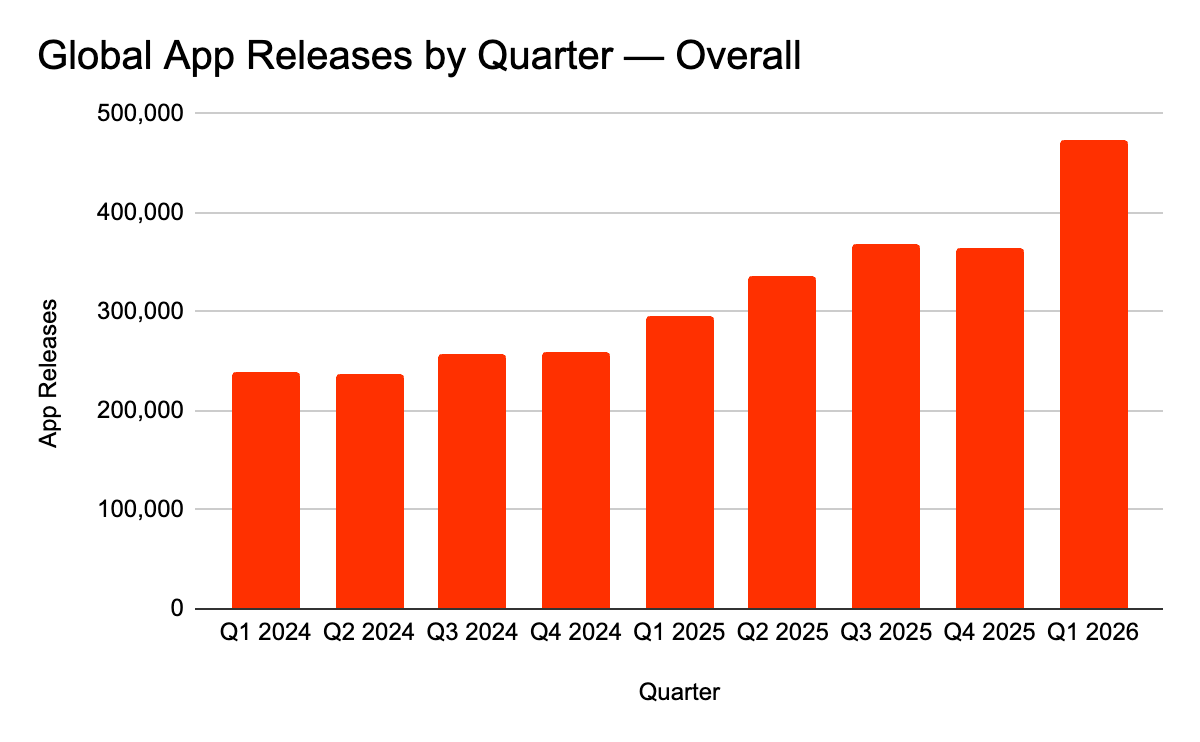
Since April, the number of new app releases in both major app stores has continued to climb compared to the same period last year—an overall growth of about 104%, with the iOS platform rising approximately 89%. All of these data points point to the same fact: the App Store is not only not "dying" but is returning to a high-growth trajectory.
In response to the claim that "AI will end the app store," Apple's Senior Vice President of Worldwide Marketing, Greg “Joz” Joswiak, recently joked in an interview that rumors of the App Store's demise in the AI era were "probably greatly exaggerated." Previously, many in the industry believed that as AI chatbots and intelligent agents rose in prominence, users would gradually abandon traditional apps in favor of interacting with systems through natural language. Some entrepreneurs, including Nothing CEO Carl Pei, even publicly bet on a new paradigm of smartphones "without apps, only agents." Last year, there was also the view that the next generation of computing platforms might appear on smart glasses, ambient computing devices, or redefined AI smartwatches, thereby weakening the central position of smartphones and app stores.
But reality has taken a different turn: AI is not an "app terminator" but an "app production accelerator." Data from Appfigures and industry observations both point to the same trend—AI-assisted development tools are significantly lowering the barriers to software creation, allowing more creators without traditional programming backgrounds to participate in mobile app development. Tools like Claude Code and Replit allow people to describe their needs in natural language, then have AI generate code, combined with readily available templates and components, quickly creating apps that can be launched. This "AI-assisted app writing" model is bringing a wave of new apps driven by "long-tail creators" to the App Store.
Structurally, this surge in new apps is not evenly distributed across all categories. In the first quarter of 2026, mobile games remain the category with the largest number of new apps launched globally, continuing the dominance of games in the app ecosystem. However, some non-traditional "hot" categories are beginning to rise significantly: productivity apps entered the top five for the first time this year; utility apps rose to second place; "lifestyle" jumped from fifth place last year to third place, and health and fitness-related apps made up the last category in the top five. These changes to some extent echo the use cases of AI tools—many creators are trying to use AI to create personal productivity assistants, collections of small tools, life logging, or habit-building apps, quickly turning "what they want but doesn't exist on the market" into products.
While AI lowers the barriers to creation, it also places higher demands on the app store's review and security systems. Recently, Apple has experienced two high-profile incidents on the App Store: one is the removal of the reward app Freecash for violating rules, after the app had been consistently ranked high on the charts; the other is a cryptocurrency app that mimicked Ledger Live infiltrating the store, ultimately resulting in approximately $9.5 million in crypto assets being stolen. Against the backdrop of a surge in new app numbers, these cases have exacerbated external discussions about the App Store's review pressure and risk control capabilities.
Apple emphasizes that while such incidents are "highly publicized" in public opinion, they still account for a small proportion of the overall volume. The company invests significant resources in daily operations to filter out dangerous or junk apps. According to Apple's 2024 Security Report, the company removed or rejected over 17,000 apps last year for violations such as "deceptive content changes"; more than 320,000 app submissions were rejected for suspected spam content, plagiarism, or misleading users; and over 37,000 potential fraudulent apps were blocked from entering the store. However, industry commentators like John Gruber have consistently called for the App Store to have a dedicated "fraud squad" to focus on monitoring suspicious apps with rapidly increasing downloads or revenue.
As AI-assisted development becomes more widespread, a creative approach dubbed "vibe coding" is spreading—creators are increasingly starting from the perspective of "what kind of experience, what kind of atmosphere do I want," and then handing over the specific implementation details to AI. If this trend is indeed the core driver of the current app surge, it is foreseeable that the App Store and the entire mobile software market will be flooded with a larger number of new apps, including creative gadgets, but inevitably mixed with more complex fraud, phishing, and gray monetization attempts. Under this new round of AI-driven "app gold rush," finding a balance between encouraging innovation and preventing risks will be a long-term challenge for platforms and regulators.