Blue Origin Prepares to Reuse New Glenn Booster to Challenge SpaceX
Blue Origin is preparing to launch a flown New Glenn first-stage rocket, a crucial test for the future of commercial spaceflight. Successful and regular reuse of the first stage would directly challenge SpaceX's leading position in high-frequency, low-cost orbital launches.
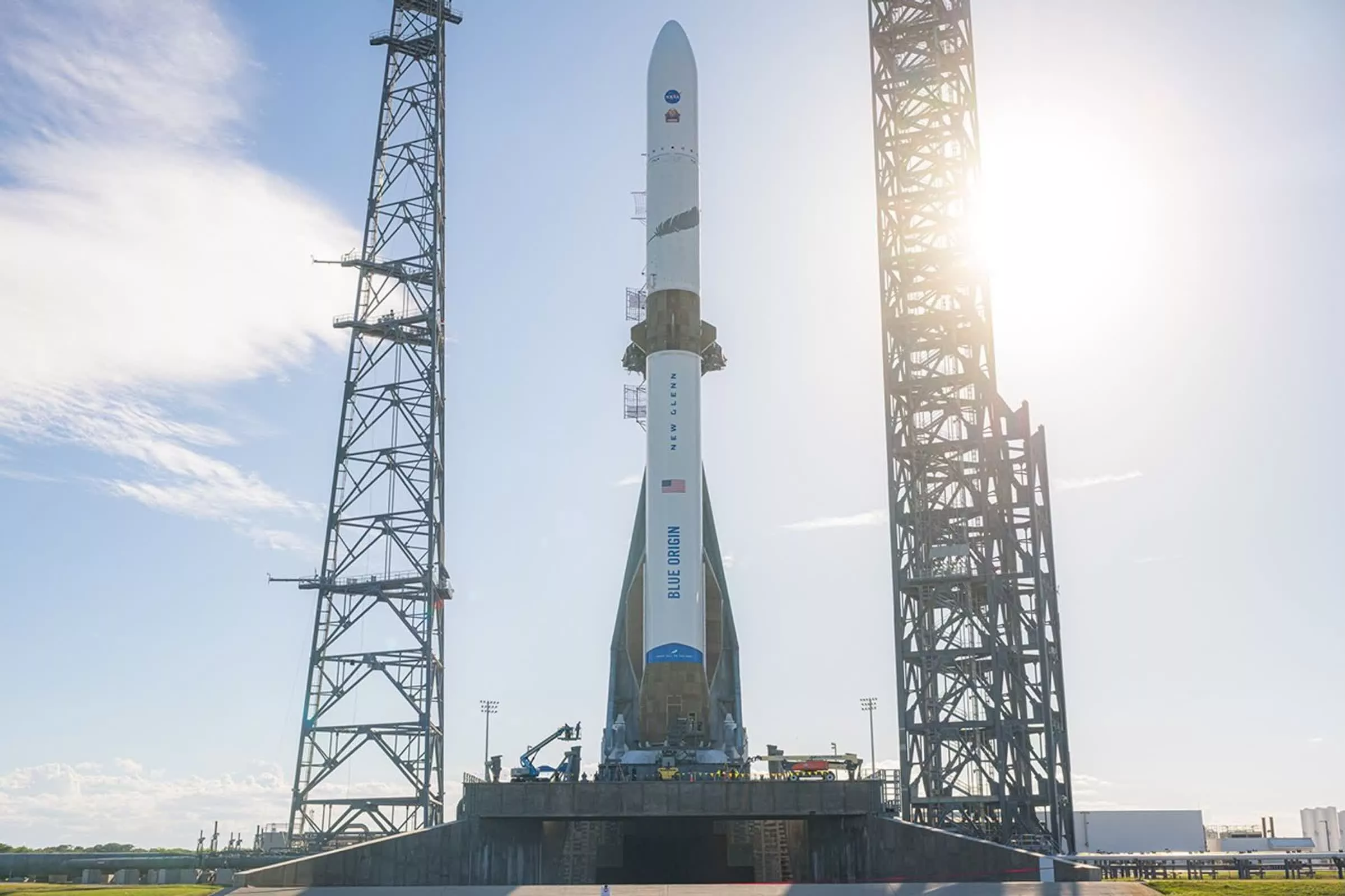
This New Glenn mission is scheduled to launch on Sunday morning, using a first-stage rocket from its second mission last November, which successfully completed flight and recovery. The focus of this flight is to validate reusability, not just to deliver a payload. Currently, first-stage reusability has become a core variable in launch economics and is key to SpaceX's ability to frequently launch the Falcon 9 and control costs; any company wanting to compete on a large scale in the launch market must approach this level of reusability.
For Blue Origin, this timing is also closely linked to Amazon's broader satellite plans. To date, its satellite constellation deployment has been slower than initially planned, with most launches still relying on expendable rockets. Statistics show that Amazon has only sent 241 near-Earth orbit satellites into space, while SpaceX launched over 1500 satellites for Starlink via Falcon 9 in a comparable 12-month period, a significant difference in launch pace.
The payload on this mission is also ambitious. New Glenn will carry AST SpaceMobile's "BlueBird 7" satellite, representing a satellite communication path that differs significantly from traditional large constellations. AST is not deploying a large number of small satellites, but rather choosing to deploy a smaller number of platforms with very large per-satellite capacity. BlueBird 7 is a representative of this strategy, equipped with a phased array antenna of approximately 2400 square feet, the largest commercial communication antenna array deployed in near-Earth orbit to date.
AST's design philosophy is to make each satellite a high-power node that can directly connect to ordinary mobile phone terminals. BlueBird 7 is the second satellite in its second-generation "Block 2" series, aiming to provide 4G and 5G broadband rates exceeding 120Mbps to standard smartphones without modifying phone hardware. The focus is on compatibility with existing ground mobile devices and network standards, avoiding reliance on dedicated receiving terminals or complex ground station equipment.
According to plans, AST SpaceMobile plans to expand the number of satellites in orbit to 45 to 60 by the end of 2026. Once operational, this system will enter a "direct-to-cell" field where the competitive landscape is already taking shape. SpaceX has already begun testing its Starlink service, which "connects directly to phones," in collaboration with US T-Mobile; meanwhile, Globalstar, which has become an important satellite partner for Amazon, is providing satellite emergency communications and remote area connectivity support for Apple devices.
The simultaneous advancement of multiple companies indicates that the telecommunications industry is moving towards a new hybrid network form by using satellites to fill coverage gaps: no longer relying solely on high-density ground base stations, but viewing orbital systems as an "extension layer" of traditional cellular networks. Companies have different approaches—some build high-frequency coverage with a large number of small and medium-sized satellites, while others pursue direct connection capabilities with a small number of high-capacity platforms—but the common goal is to eliminate "signal dead zones" in ground networks.
At a more macro level, this New Glenn reusability test is also seen as a potential key node in breaking the long-term "monopoly" of SpaceX in reusable heavy-lift rockets. If the launch is successful and sustainable reuse is achieved, it will not only provide the market with another operational reusable heavy-lift launch option, but will also directly affect Amazon's satellite deployment pace and the launch capacity supply on which AST SpaceMobile's network construction depends.
Currently, the launch window for this mission is set for 6:45 AM to 8:45 AM (Eastern Time) on Sunday. Within this time frame, Blue Origin will showcase the latest progress of New Glenn in engineering reusability, and will also provide an opportunity for the outside world to observe whether it can truly challenge SpaceX's launch dominance.