DESI Completes Largest 3D Map of the Universe
The Dark Energy Spectroscopic Instrument (DESI) has completed its planned 3D mapping of the universe ahead of schedule, creating the largest and highest-resolution map of the universe's large-scale structure to date. This provides an unprecedented level of precision in depicting the universe's expansion history over the past 11 billion years and allows for the direct testing of the true nature of dark energy.
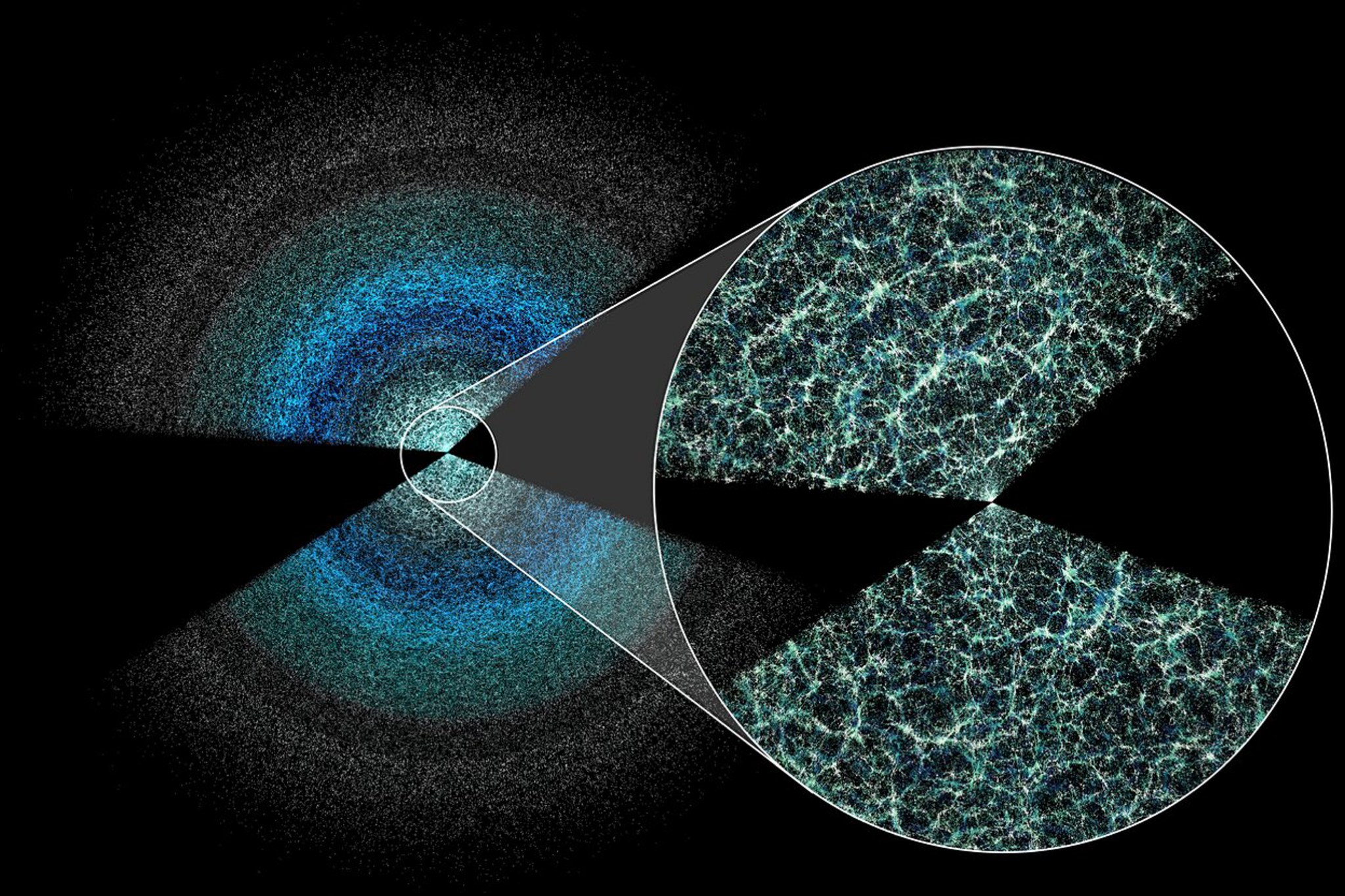
DESI is installed on the Mayall 4-meter telescope at Kitt Peak National Observatory in Arizona, equipped with a system capable of simultaneously observing the spectra of 5000 celestial objects. By measuring the redshifts of galaxies and quasars, it reconstructs the three-dimensional distribution of the universe. During its five-year survey plan, DESI made significant progress, completing observations of approximately 15 million celestial objects in the first three years, exceeding the original target data volume. This allowed astronomers to clearly present the filamentary structures and vast voids formed by gravity, truly transforming past planar star charts into a measurable, distance- and time-evolving three-dimensional cosmic structure. This method, based on large-sample statistics, allows scientists to compare the clustering of galaxies in different cosmic eras, thereby retroactively inferring the influence of dark energy on the rate of cosmic expansion.
Early results released so far suggest that dark energy may not be a constant “cosmological constant,” but rather a physical quantity that evolves over time. This indication has attracted widespread attention. If this conclusion is confirmed with the complete five-year data, it will mean that the current standard cosmological model needs to be revised, and may even force the physics community to reconsider its understanding of fundamental laws. To date, DESI has measured approximately six times the total number of galaxies and quasars measured by all previous related observations, and plans to accumulate more than 47 million galaxies and quasars, as well as about 20 million stars. Through unprecedented statistical precision, it will measure the expansion rate of the universe at different times and the differences in galaxy distribution, thereby testing whether dark energy changes over time.
According to the published diagrams, one of the universe maps constructed by DESI’s five-year survey shows the spatial distribution of galaxies and quasars above and below the galactic plane; in the magnified area, the details of the universe’s large-scale structure can be clearly identified. The center of the fan-shaped diagram represents the Earth, and the central black gap is due to the obscuration of the Milky Way itself, making it difficult to observe more distant objects in these directions. The light from the most distant galaxies has traveled for about 11 billion years before reaching Earth, allowing astronomers to “look back” into the past of the universe.
DESI’s observations have not ended, and are planned to continue until 2028, expanding the sky coverage to approximately 40%, including more difficult-to-observe areas closer to the galactic plane and the southern sky. The research team will also re-observe existing areas, focusing on more distant, fainter luminous red galaxies, to construct a denser, higher-resolution three-dimensional map of the universe. At the same time, research on dwarf galaxies and stellar streams is expected to further deepen our understanding of the spatial distribution of dark matter.
Officials pointed out that with the gradual release of complete observational data, what DESI is doing is not just “completing a map.” These high-precision data will establish a set of accurately testable observational benchmarks for the history and future of the universe, allowing key questions such as whether the universe continues to accelerate expansion, whether dark energy changes over time, and what the ultimate fate of the universe is, to move from theoretical deduction to observable, verifiable empirical science. Further background information and technical details on this achievement can be found in the news release from the National Optical-Infrared Astronomy Research Laboratory (NOIRLab).