Asteroid Impacts May Have “Ignited” Life on Earth: New Research Expands Hypothesis on the Origin of Life
A recent review led by a research team from Rutgers University suggests that the origin of life on Earth may not be solely rooted in traditional “cradles” like deep-sea hydrothermal vents. High-temperature, mineral-rich environments formed by asteroid or meteorite impacts could also have provided a crucial stage for early life chemistry.
Shea Cinquemani, the first author of the paper, said in an interview, “From a scientific perspective, we still don’t know how the first life arose on early Earth with no life at all. How did that step of creating something from nothing actually happen?” Cinquemani is graduating from Rutgers University’s School of Environmental and Biological Sciences in 2025 with a bachelor’s degree in Marine Biology and Fisheries Management, and this work was a “leap” research attempt during her undergraduate studies.
The relevant review paper was published in the Journal of Marine Science and Engineering, focusing on geological environments where life may have originated, particularly hydrothermal systems—places where high-temperature, mineral-rich fluids circulate through rocks and eventually emerge, creating distinct energy gradients and diverse chemical conditions that drive complex reactions. The article shifts its focus from traditional deep-sea hydrothermal vents to hydrothermal systems formed by meteorite impacts, arguing that these environments may have been common on early Earth but have long been overlooked.
The paper is co-authored by Cinquemani and Rutgers University oceanographer Richard Lutz. For an undergraduate student to lead a review as the first author is described by her mentor as an “extraordinarily unusual achievement.” Lutz said, “It’s not uncommon for undergraduates to participate in papers, teachers often invite excellent students to join projects. But publishing a paper with an undergraduate as the first author is a completely different matter.” Initially, this work was Cinquemani’s class assignment in a “Deep Ocean Hydrothermal Vents” course, which required her to consider: if similar hydrothermal systems existed on other planets, would they be capable of nurturing life?
Cinquemani admitted that when she first received the assignment, she “knew almost nothing.” “Thinking about the origin of life on another planet felt very surreal. I was originally more familiar with pure biology, but this topic led me into chemistry, physics, and even geology.” After graduation, she expanded her class assignment into a more systematic review, comparing impact-formed hydrothermal systems with deep-sea hydrothermal vents. The paper was finally accepted after undergoing rigorous review with five rounds and 15 pages of comments.
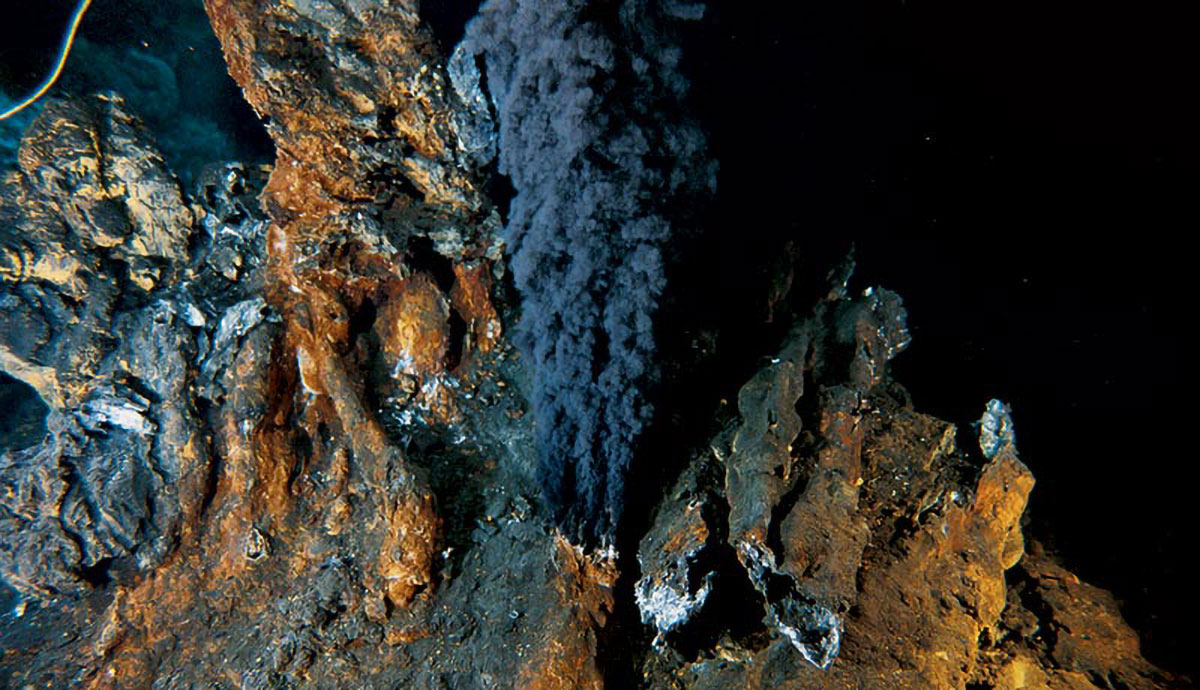
Deep-sea hydrothermal vents have been a “hot candidate” in the study of the origin of life since the late 1970s. This environment can support a complete ecosystem without sunlight, with microorganisms relying on chemical substances such as hydrogen sulfide to obtain energy and surviving through chemosynthesis rather than photosynthesis. The heat source of hydrothermal systems can come from volcanic activity within the Earth’s crust or from chemical reactions between water and rocks. Even without magma, localized warm “oases” can form in the frigid deep sea.
Cinquemani’s work builds on this traditional research framework and further emphasizes the potential role of impact-driven hydrothermal systems in the origin of life. When a large meteorite impacts Earth, the enormous kinetic energy is instantly converted into high temperatures, causing the surrounding rocks to melt. The impact crater then accumulates water during cooling, forming a special environment with an extremely warm central area surrounded by water. Hot water and minerals continuously exchange, forming a system similar to deep-sea hydrothermal vents. Cinquemani described it as: “You get a hot core surrounded by a lake, which forms a hydrothermal system similar to the deep sea, except the heat source comes from the impact rather than a volcano.”
To assess the actual evolutionary process of these environments and their potential to support life chemistry, the paper reviewed three typical meteorite crater cases from different periods: the Chicxulub impact crater in Mexico, formed about 65 million years ago and associated with the dinosaur extinction event; the Haughton impact crater in the Canadian Arctic, formed about 31 million years ago; and Lonar Lake in India, formed approximately 50,000 years ago and still containing lake water today. These impact-formed hydrothermal systems can remain active for thousands to tens of thousands of years, providing a time window for simple molecules to gradually evolve into more complex organic structures.
Researchers believe that on early Earth, frequently visited by meteorites and comets, these impact-driven hydrothermal environments may have been much more common than they are today, and therefore may have played an underestimated role in the birth of life—those events often considered “catastrophic” celestial impacts may have also built the chemical laboratories needed for life to begin. This idea extends the possible scenarios for the origin of life from the deep sea to lakes and underground systems within impact craters, building on decades of accumulated research on deep-sea hydrothermal vent theory.
Lutz himself was one of the early pioneers in deep-sea hydrothermal vent research. During his postdoctoral studies, he boarded the “Alvin” submersible and descended more than a mile below the sea surface, witnessing a thriving ecosystem in complete darkness. These voyages were considered groundbreaking in a new field of research and redefined the scientific understanding of “life without sunlight.” “For years, we’ve been discussing the possibility that life may have originated in deep-sea hydrothermal vents,” Lutz said.
Cinquemani’s review integrates existing deep-sea evidence while also introducing more and more recent findings on impact-driven hydrothermal systems, arguing that both types of environments have the potential to support key chemical reactions in the early stages of life. This shift in perspective not only concerns the history of Earth itself but also points to the exploration of extraterrestrial life: scientists speculate that active seafloor hydrothermal activity may exist beneath the icy moons Europa and Enceladus, and early impact craters on Mars may also have once nurtured similar environments. If hydrothermal and impact systems on Earth can indeed “warm up” life, then they may also provide important clues and target areas for the future search for extraterrestrial life.
For Cinquemani herself, this research is more rooted in a common human curiosity. She currently works as a technician at the Aquaculture Innovation Center at Rutgers University in Cape May, New Jersey, conducting aquaculture-related research while preparing for further studies in marine science. “Human curiosity is almost endless,” she said. “We will constantly ask questions and try to trace everything back to its source. Perhaps we will never be able to accurately recreate the moment of life’s birth, but we can get as close as possible and understand how things might have happened.”