Who Reigns Supreme in the 1500 Yuan CPU Segment? A Head-to-Head Comparison of the Intel Core Ultra 5 250K Plus and AMD Ryzen 5 9600X: A Quick Guide to Choosing
The 1500 Yuan price range is a key sweet spot for DIY PC builds and a fiercely contested battleground between Intel and AMD. With the arrival of Intel's ArrowLake refresh series, the Core Ultra 5 250K Plus, competition in the mid-range CPU market has intensified. This article provides a detailed comparison between the Core Ultra 5 250K Plus and AMD's Zen5 architecture-based Ryzen 5 9600X to help you make an informed decision.
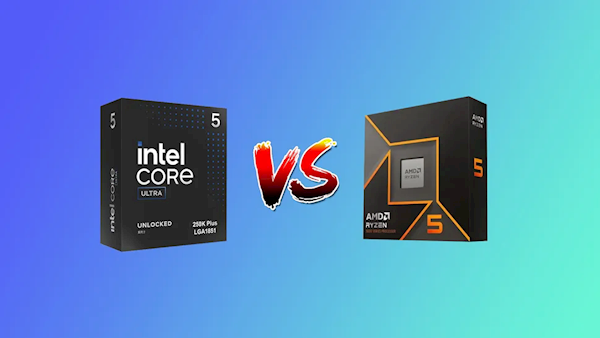
This new product, priced at $199, directly competes with the AMD Ryzen 5 9600X based on the Zen5 architecture. Tom's Hardware conducted a detailed review of both CPUs from multiple perspectives, and after reading it, you should have a clearer idea of which CPU to choose in this 1500 Yuan price range.
Let's start with the core specifications. The design philosophies of the two products are completely different. The Core Ultra 5 250K Plus is based on TSMC's 3nm process and utilizes Intel's hybrid architecture. It features 6 LionCove performance cores + 12 Skymont efficiency cores, totaling 18 cores and 18 threads. The performance cores have a maximum boost clock of 5.3GHz, and the efficiency cores have a maximum boost clock of 4.6GHz. Total cache is 60MB, with 30MB L3 cache. It natively supports DDR5-7200 memory, has a TDP of 125W, and uses the LGA1851 socket, compatible with 800 series motherboards. The current boxed retail price in China is 1699 Yuan (KF version without integrated graphics is 1599 Yuan).
The Ryzen 5 9600X is based on TSMC's 4nm process and Zen5 architecture, continuing the classic 6-core, 12-thread design. It has a maximum boost clock of 5.4GHz, 32MB L3 cache, and natively supports DDR5-5600 memory. The rated TDP is 65W, and AMD officially offers a compliant 105W TDP enhanced mode, which retains full official warranty even when switched on, and can be enabled simply by setting it in the motherboard BIOS. It uses the AM5 socket, compatible with 600/800 series motherboards. The current boxed retail price in China is 1349 Yuan.
Gaming performance is a core assessment item for mid-range CPUs. The test setup included an RTX 5090 graphics card to eliminate bottlenecks, and testing was conducted at 1080P resolution. The overall gaming frame rate geometric mean of the two CPUs was almost the same, with the Core Ultra 5 250K Plus leading by a mere 1%. When broken down into 17 tested games, it outperformed in 11 of them.
In 3A blockbusters such as "Cyberpunk 2077," "Doom Eternal," and "Starfield," the Core Ultra 5 250K Plus achieved a frame rate lead of 9%-16.7%, and its 1% Low frame rate performance was also more stable, resulting in fewer game stutters.
The Ryzen 5 9600X performed better in games such as "F1 2024," "Final Fantasy XIV," and "Minecraft," with a massive 30% frame rate advantage in "Minecraft." Surprisingly, the Core Ultra 5 250K Plus showed better power efficiency in gaming scenarios. Its average gaming power consumption was 82.3W, lower than the Ryzen 5 9600X's 86.2W, with an average temperature of 48℃, 11℃ lower than AMD, resulting in less thermal pressure.
Productivity scenarios are where the two products differ the most. The Core Ultra 5 250K Plus, with its more cores and threads, led the Ryzen 5 9600X by a full 79% in overall multi-threaded performance. The Ryzen 5 9600X data for this test was all in the default 65W mode. Enabling the 105W mode only brought a 5%-9% slight increase in multi-threaded performance, with almost no change in single-core performance or gaming performance, failing to close the core gap with the Core Ultra 5 250K Plus.
In Cinebench 2024/2026 rendering tests, the performance lead of the Core Ultra 5 250K Plus reached 86%-91%; in creative scenarios such as HandBrake video encoding and JPEG-XL image processing, the performance lead was as high as nearly 77%, and multi-threaded image processing performance doubled.
In single-threaded performance, the Core Ultra 5 250K Plus also maintained an approximately 5% overall lead, with the Ryzen 5 9600X only slightly surpassing it in a few lightweight tasks such as audio encoding.
In terms of overclocking and platform, the Core Ultra 5 250K Plus is more playable, unlocking the multiplier for fine-grained overclocking, and with ample tuning space when paired with a Z-series motherboard. The Ryzen 5 9600X is close to its frequency limit out of the box, with very little benefit from manual overclocking, making it more suitable for PBO undervolting to optimize power efficiency.
Under full-load productivity scenarios, the Ryzen 5 9600X's power consumption is 71%-88% lower than the competition, with overwhelming power efficiency. In terms of platform cost, the AM5 platform's B-series motherboard can be overclocked, with a lower entry-level price, and supports it until 2027, providing ample upgrade space. The Intel LGA1851 platform is about to be replaced with new products, the B-series motherboard does not support CPU overclocking, and its long-term upgradeability and entry cost are not advantageous.
Overall, the Core Ultra 5 250K Plus won this duel with a total score of 4:2. If you pursue all-around performance, build a PC that balances gaming and content creation, and need stronger multi-threaded performance, it is the best choice in this price range.
If you prioritize low power consumption, long-term platform upgradeability, build a PC primarily for gaming, and don't want to spend too much on the motherboard, the Ryzen 5 9600X is a more reliable and cost-effective choice.