As Expected, Those Who Hate AI the Most Are College Graduates
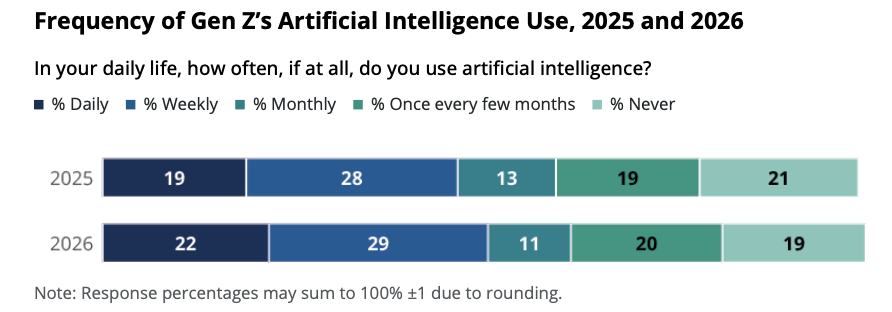
Over the past two years with the rise of generative AI, it was assumed that young people, as digital natives, would be its most enthusiastic adopters. While seemingly true on the surface – data from Pew Research Center shows 54% of American teens are using tools like ChatGPT for schoolwork, and a Gallup report indicates over half (51%) of Americans aged 14-29 use AI frequently – behavior doesn't equal intent. Gallup also found that hopefulness about AI among this age group dropped from 27% to 18% in just one year, with nearly a third (31%) feeling “angry” and 42% experiencing persistent anxiety. This ambivalent attitude – frequent use coupled with collapsing trust – is spreading among Gen Z (born 1996-2012).
Why is the generation that uses AI the most also the least trusting of it?
01 Anxiety: Keeping the Enemy Close
The group most hostile to AI is those who have just entered society or are seeking a foothold in the job market.
Gallup data shows that 48% of employed Gen Z believe the risks of AI in the workplace far outweigh the benefits, a surge of 11 percentage points within a year. Only 15% believe the benefits outweigh the risks.
This is easy to understand, given the poor economic climate and the difficulty American graduates face in finding jobs.
Data from the Federal Reserve Bank of New York shows that the unemployment rate for 22- to 27-year-old college graduates soared to 5.6% at the end of last year, significantly higher than the overall unemployment rate.
In this environment, AI is being portrayed as a tool to “increase efficiency” and become a “digital employee” for companies. Executives at some AI companies often tell the media that “a large number of entry-level white-collar jobs may be automated in the coming years.”
These jobs are often the “entry-level white-collar positions” exclusively for young people. Without the experience gained in these entry-level positions, young people don’t even have the opportunity to build a professional moat.
Therefore, even though this substitution hasn’t fully happened yet, expectations have already changed emotions. For young people, AI feels like a potential competitor.
The timing of the “unemployment crisis” coincides with the rise of AI.
A report in *The New York Times* highlighted the specific difficulties faced by many Gen Z individuals.
For example, 22-year-old psychology graduate Erin applied for nearly 200 jobs, even for basic business analyst positions, but only received 4 interviews and ended up working as a waitress on Long Island as a temporary solution. The job search process left her physically and mentally exhausted, and she has started seeking psychological therapy.
Meanwhile, freshman Sydney doesn’t know what major to choose. “I feel like any field I’m interested in could be replaced in the next few years.” Her confusion represents the feelings of most college students today.
On the other hand, tech giants are constantly laying off employees under the guise of deploying AI. This is the extremely fragmented reality of today. Silicon Valley elites can make businesses “reduce costs and increase efficiency,” but for young people, it means losing the key to entering the job market.
Ironically, to avoid being eliminated – they have to open ChatGPT every day to polish their resumes and ask large language models which universities are easier to get into.
This psychological and behavioral inconsistency towards AI is the core reason why Gen Z feels anxious about it.
02 Fear: AI They Have to Use
If they are so hostile and distrustful, why do as many as 51% of young people still use it daily or weekly?
*The New York Times* reporter Callie Holtermann captured the answer in her long-term interviews, discovering that the young people interviewed don’t think using AI is great. The driving force behind them opening the chat window is the fear of falling behind in school or at work if they aren’t familiar with the technology.
The rules of the workplace have already been reshaped by AI. When browsing job postings for entry-level positions, young people often see requirements such as “applicants must be proficient in ChatGPT or Gemini.”
A recent report by corporate AI agency Writer was even more blunt: 77% of executives explicitly stated that employees who don’t master AI will not be promoted. Even 60% of management are considering directly firing these people.
This means that in the current workplace and evaluation system, not knowing AI means direct exclusion.
Even if they manage to get a job, this fear doesn’t disappear.
These workers also face the impact of “FOBO” (Fear of becoming obsolete). The report pointed out that 26% of workers believe AI is directly undermining their creativity and core value within the company.
This is a deep professional deprivation. The code, law, or financial knowledge you’ve studied for years is rapidly losing its market premium. Accompanying the loss of value is a profound doubt about one’s own abilities. In the Gallup survey, many young people worry that AI will weaken their critical thinking and creativity.
And this “FOBO” isn’t just for workers, but also for managers who are forcing employees to embrace AI. Writer’s report found that 69% of companies are laying off employees due to AI, but 39% of these companies haven’t even figured out how to make money with AI. Even 73% of CEOs are anxious about their AI strategy.
72% of employees feel pressured by AI.
When fear reaches its peak, young people start throwing sand into the gears of the system.
Nearly half (44%) of Gen Z employees admit they are consciously hindering the company’s introduction of AI, including refusing to use it, misusing tools, and even deliberately reducing efficiency.
The methods of sabotage are varied. Some deliberately input confidential company information into public AI tools to trigger security alerts, while others refuse to use approved software. In more extreme cases, some manipulate performance reviews or deliberately submit low-quality AI-generated work to prove to management that “AI doesn’t work.”
Luddism aimed to resist unemployment and deteriorating working conditions caused by technological change.
Even if it means risking being fired, they will take this negative resistance to fight against their inner fears.
03 Vigilance: The More You Use It, the Less You Trust It
Faced with anxiety and fear, many young people are starting to be vigilant about AI.
This vigilance is reflected in a series of specific behaviors. The most obvious change is that they are starting to set boundaries for AI. They are very clear about what AI can do and what things shouldn’t be entrusted to it.
The first boundary is drawn in interpersonal relationships.
For example, *The New York Times* interviewed 27-year-old tourism employee Abigail Hackett. She often uses AI to handle complex copywriting at work, saving her a lot of time. But in her personal life, she never uses AI to draft any personal information. The reason is simple: she doesn’t want her “social muscles to atrophy.”
This is a “vigilant trade-off” that many users will have. AI can enter the workflow, but shouldn’t enter social relationships.
Even in time-consuming companion AI, young people’s attitudes have changed.
Over the past two years, role-playing chat tools like Character.AI have rapidly become popular among young people. They can simulate friends, lovers, or fictional characters, providing a kind of always-online “companionship.” At the same time, the controversy surrounding these products has also expanded, including adolescent addiction, emotional dependence, and even individual suicide attempts.
As a result, some opinions conclude that AI is weakening the social skills of minors.
However, long-term observations by researchers at the University of Sydney overturned this hypothesis. They found that the vast majority of young people are very aware and don’t treat AI as a real human substitute. They are more likely to treat these chats as a “game” or pastime.
For example, 15-year-old Quentin was a heavy user of Character.AI, but he clearly stated that it was just a game, essentially a bunch of 1s and 0s.
Once real life changes, such as making new friends at school or starting to date, the time they spend on chatbots will plummet. Chatbots are at best an electronic pickle when bored, and can be easily discarded once real life begins to function.
Establishing life boundaries, young people also don’t trust AI when making key decisions in life.
According to a 2024 survey by Ruffalo Noel Levitz, one-third of high school students use AI to plan their college applications. They will have AI generate a long list of schools, organize tuition, scholarships, and acceptance rates into tables for quick screening, but they won’t let AI make the judgment.
This vigilance is built through repeated pitfalls.
In *The New York Times* report, Wisconsin high school student Brandon developed a habit of rigorously verifying AI information because the large language model confidently recommended several university scholarships that didn’t exist, wasting his time verifying them.
San Francisco student Tanay saw through the false emotional value given by AI. His AI told him “you 100% will get into Princeton,” and he immediately realized that AI was using excessive affirmation to cater to him and was unhelpful in his school selection decision.
The average public high school has 376 students per counselor, so many students will use AI to assist with applications.
Who hasn’t been “amused” by AI? Once similar moments occur a few times, it’s difficult to return to the initial trust.
Returning to the Gallup and Pew survey data, the “AI paradox” can be explained.
More than half of young people use AI every day, that’s the survival instinct forced by the employment system and the pressure to get into college. And their trust in AI plummeted from 27% to 18% because the more they use it, the more likely they are to encounter problems and see the limits of the technology.
Anxiety, fear, vigilance, and even a certain degree of abuse, these seemingly conflicting states coexist in young people’s attitudes towards AI.
Because in this inescapable technological cycle, Gen Z has figured it out.
Tools are tools. Extract its value to the fullest, but don’t treat it like a god, and don’t let it make decisions for you.
Rather than saying they don’t trust the technology, it’s more accurate to say they realized earlier that the benefits and costs of this technology may fall on themselves at the same time.