“Sulfur Magma Planet” Just 35 Light-Years from Earth May Be a New Category of Exoplanet
Recent observations reveal a planet about 35 light-years away where “the ground is truly a sea of magma.” The planet, named L98-59d, is only about 1.6 times the size of Earth but possesses a mantle filled with silicate magma and an unusually sulfur-rich interior and atmosphere, potentially representing a newly identified type of “sulfur-enriched magma sea world.”
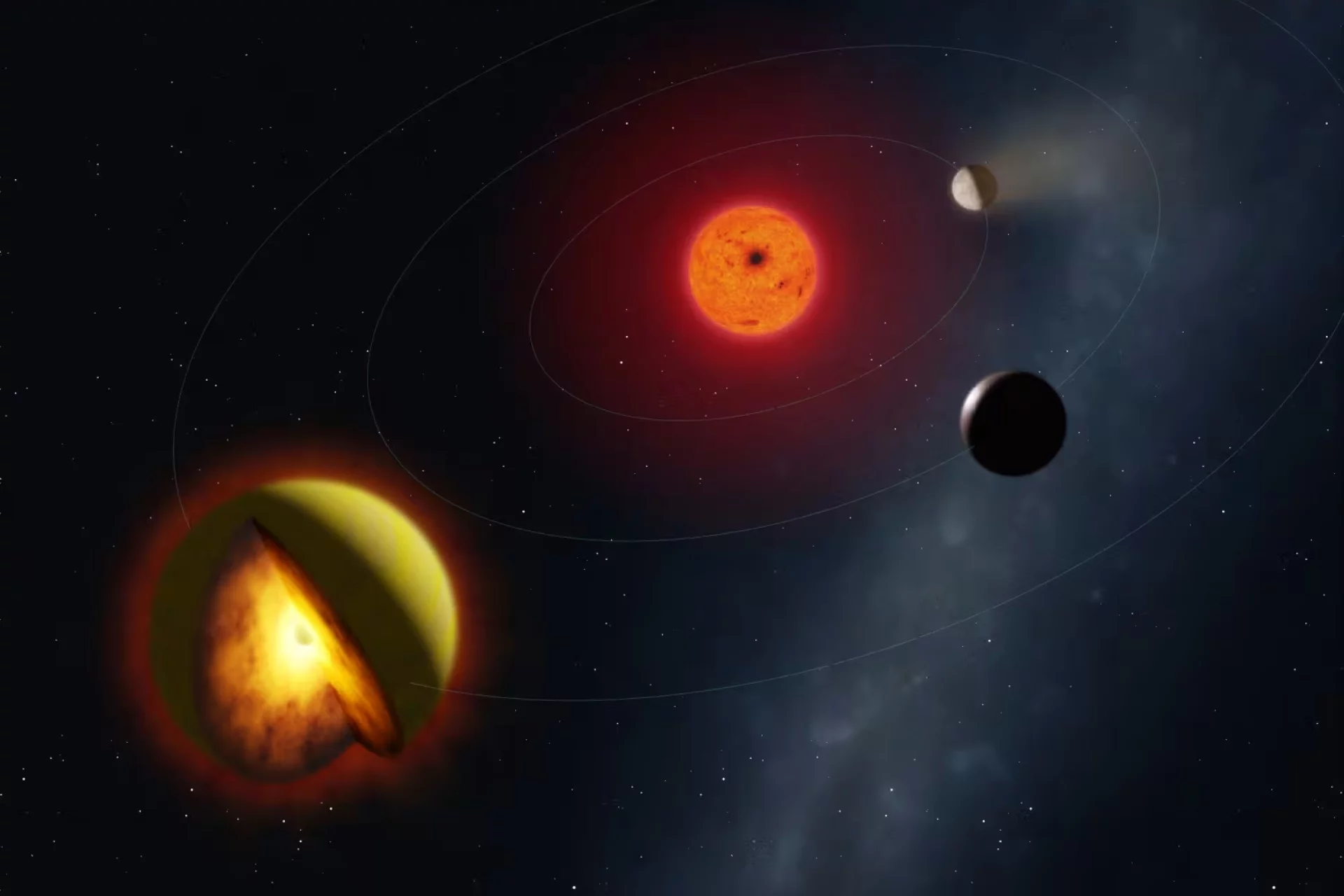
The findings were published in the journal *Nature Astronomy* on March 16th, with some data coming from joint observations by the James Webb Space Telescope (JWST) and ground-based observatories. Harrison Nichols, the paper’s first author who completed the research during his doctoral studies at Oxford University and is now a postdoctoral researcher at Cambridge University, stated in an interview with Refractor that this discovery indicates “we still have so much to learn about how planets form and evolve.” He emphasized that the types of planetary environments in the Milky Way are far more diverse than currently presented in classification systems, and this diversity must be fully considered when discussing habitable zone planets.
A key feature of L 98-59 d is its mantle, which is similar to the silicate magma of Earth’s volcanic eruptions, but expanded to a “global magma sea” covering the planet’s surface, with large amounts of sulfur stored deep within. Researchers infer that the planet likely formed in a protoplanetary disk environment richer in sulfur than our solar system. From a planetary formation perspective, this suggests that there may be many terrestrial planets in the Milky Way with elemental compositions drastically different from Earth, even sulfur-dominated, leading to the concept of entirely new types of rocky planets such as “sulfur worlds.”
Even more perplexing is that the planet seems to have retained a hydrogen-rich, extremely high-pressure atmosphere for billions of years despite continuous “stripping” by high-energy stellar radiation. Generally, rocky planets like Earth gradually lose light volatile components such as hydrogen and sulfur during evolution, but L 98-59 d defies this “norm,” forcing scientists to resort to high-precision numerical simulations to reconstruct its evolutionary history.
Models show that the planet was once hotter and more “inflated” in its early stages, appearing more like a “sub-Neptune,” and then gradually cooled and contracted over long ages, but its overall density remains low, indicating a thick, high-pressure atmospheric envelope. This hydrogen-rich, high-pressure atmosphere will make the planet’s outer layers highly opaque, while also creating an extreme greenhouse effect similar to Venus, maintaining the planet’s surface “primal magma sea” in a liquid state under the combined influence of stellar radiation and tidal heating. The research team points out that this mechanism of “locking” the magma sea through a thick atmosphere, moderate radiation, and tides has not been adequately considered in existing planetary classification frameworks.
Previously, astronomers have discovered magma sea worlds near other stars, such as 55 Cancri e, but these planets are often close to their stars and have very short orbital periods, relying primarily on intense stellar radiation to heat their surfaces. In contrast, L 98-59 d receives relatively mild radiation but relies on the combined mechanism of “atmosphere-radiation-tides” to maintain its magma sea, presenting a new stable pattern. This has led researchers to consider whether the existing “super-Earth” classification, which uses planet size as the sole criterion for division, is sufficient to describe these planetary populations with vastly different internal structures and compositions.
On the planetary chemistry level, although L 98-59 d is extremely hot and unsuitable for known life forms, it still provides scientists with important clues about the role of sulfur in planetary systems. Sulfur can participate in various geochemical cycles related to life under appropriate conditions. Using models, the research team inferred that the sulfur abundance in the planet’s birth environment was significantly higher than in our solar system, providing a theoretical reference for future searches for smaller, milder “sulfur-rich terrestrial planets.”
In the coming years, scientists plan to continue searching for more magma sea worlds like L 98-59 d using JWST, and they look forward to the “Atmospheric Remote-Sensing Infrared Exoplanet Large-survey” (ARIEL) mission, which will be implemented by the European Space Agency, to systematically sort out the compositional and internal structural differences of different super-Earths from a larger sample. Nichols stated that by modeling the entire super-Earth population and comparing it with current exoplanet census data, it may be possible to identify multiple “subclasses” with different compositions and structures, and to correlate them with different planetary formation and evolution pathways.
The research team is also using machine learning techniques to build more complex planetary evolution simulation frameworks to absorb more new data from space telescopes and large-scale survey missions in the future. In their view, L 98-59 d is just the beginning of many “outlier” planets, and these worlds that deviate from traditional paradigms will in turn push scientists to rewrite the basic picture of planetary diversity, habitability, and potential life habitats.