Over 5.5 Million Wild Bees Found Underground in New York Cemetery, Largest and Longest-Lasting Colony Ever Recorded
A recent study by Cornell University revealed a colony of approximately 5.5 million ground-nesting wild bees residing beneath a historic cemetery in Ithaca, New York. This is considered one of the largest and longest-lasting ground bee colonies ever documented, highlighting the crucial role of wild pollinators in agriculture and ecosystems, and sparking discussion about how "non-traditional green spaces" like cemeteries can serve as biodiversity havens in urban areas.
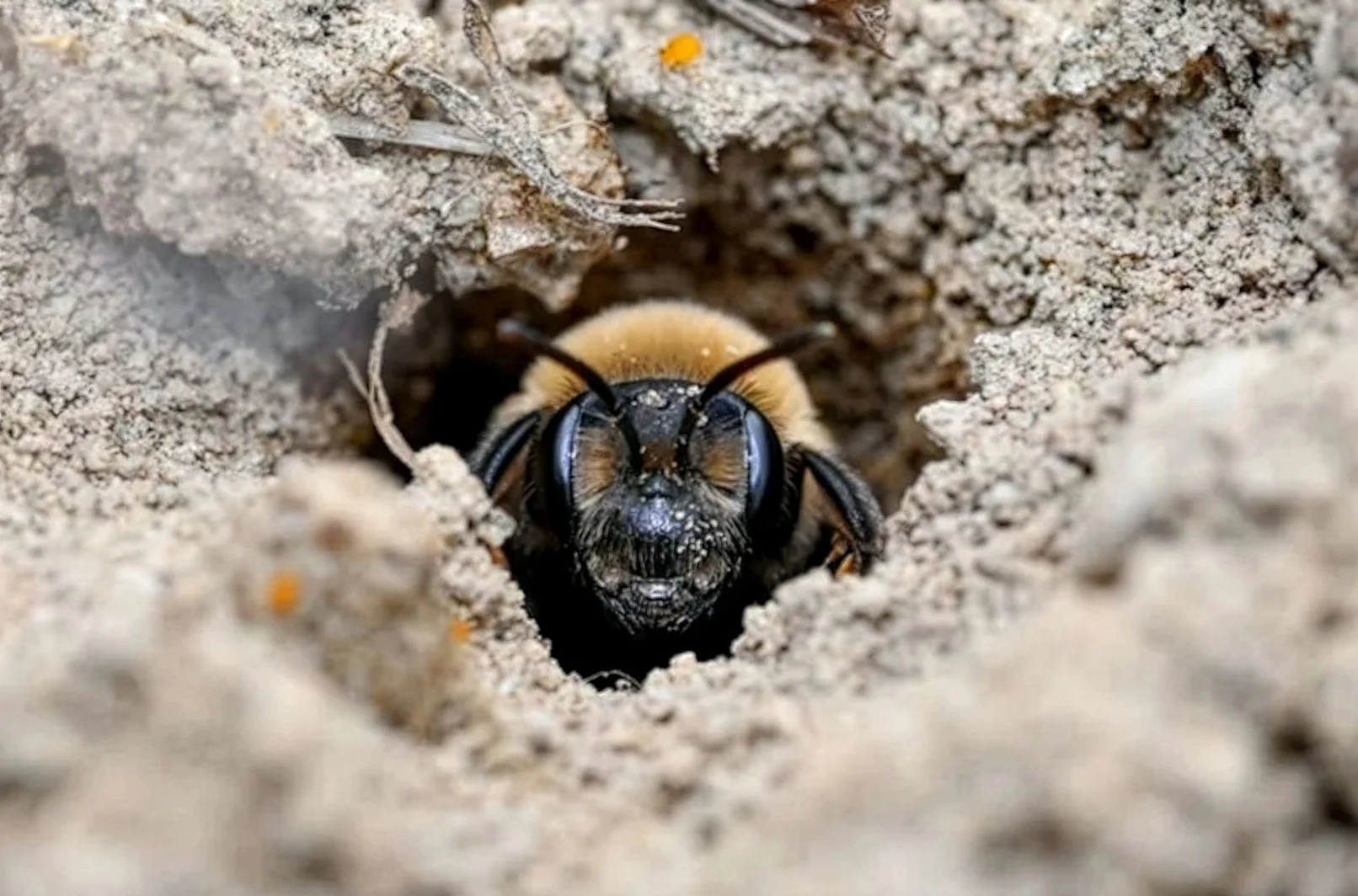
The research originated from a chance observation. In the spring of 2022, Rachel Fordyce, a technician in the Insect Collection at Cornell University’s College of Agriculture and Life Sciences, frequently parked near East Hill Plaza in Ithaca to save on parking fees, then walked to work through the adjacent East Lawn Cemetery. One day, she brought a vial of bees into the lab and told her advisor, Professor Bryan Danforth, “These bees are everywhere in the cemetery.” After identification, the insects were found to be Andrena regularis, commonly known as the “regular mining bee,” a solitary, ground-nesting wild pollinator.
Further investigation revealed that the bee colony beneath the cemetery was far larger than the research team initially expected. Researchers estimated that at least 5.5 million Andrena regularis bees were clustered in a high-density colony spanning approximately 1.5 acres (about 6000 square meters). In terms of colony size, this is equivalent to concentrating the bees from over 200 traditional beehives in a small area, a total exceeding three times the population of Manhattan. Steve Hoge, the first author of the research paper and an undergraduate student in Danforth’s lab, stated that while larger colonies may exist elsewhere that haven’t been recorded, this cemetery colony “is one of the largest known” in published scientific literature.
The Andrena regularis bee has significant economic value in local agricultural production. The latest research, published in the journal *Apidologie*, used this cemetery colony to systematically record the biological characteristics of this often-overlooked wild bee and proposed a new method for recording bee biology. The study emphasized that wild bees, represented by the Andrena regularis, play a crucial role in pollinating high-value economic crops like apples, which is one of New York State’s most important agricultural products. Danforth pointed out that this research “elevates the importance of solitary ground-nesting bees, showing their sheer numbers, their importance as crop pollinators, and our need to identify and protect these nesting sites.”
Historical records show that the presence of Andrena regularis in East Lawn Cemetery dates back to the early 20th century, while the cemetery itself was established in 1878. This discovery supports the idea that “old cemeteries are important habitats for urban wildlife.” Cemetery manager Kevin Morse said he has seen various wildlife in the park over the years, including deer, nesting Canada geese, hawks, foxes, and coyotes, and bees have always been active there, but have never stung him. He admitted that in three or four areas with particularly high bee density, “it feels a little reluctant to mow the grass each time.”
The research team believes that the cemetery’s status as a haven for a large bee colony is no accident. Danforth explained that the cemetery environment is relatively quiet, with little human disturbance, no pesticide application, and minimal soil disturbance, all of which create an ideal habitat for ground-nesting bees. The Cornell Orchard, located about a third of a mile from the cemetery, provides a rich source of flowers in early spring, and the sandy soil of the cemetery site is precisely the nesting substrate preferred by Andrena regularis, both of which likely support the long-term existence of this super-colony.
Andrena regularis belongs to the solitary ground-nesting bee family, which accounts for a very high proportion of the global bee population, but has been relatively understudied for a long time. Currently, about 75% of bee species adopt a solitary ground-nesting lifestyle, but are far less well-known than social honeybees and bumblebees. Hoge recalled that when he started the project, the most systematic scientific description of Andrena regularis could be traced back to 1978, after which there was very limited biological data available.
According to the latest research, female Andrena regularis bees will dig nests underground, constructing a series of brood cells and storing pollen and nectar for larval development. Eggs hatch into larvae underground, then undergo metamorphosis and development, eventually emerging as adults below the surface. A notable characteristic of this species is “overwintering as adults,” which is relatively rare among bees. Hoge pointed out that this is also one of the reasons why Andrena regularis can emerge early in the spring when honey source tree species bloom, including apple trees, other fruit trees, and early-blooming wildflowers. In New York, local Andrena regularis bees usually emerge in April, being most active when daytime temperatures approach 21 degrees Celsius (70 degrees Fahrenheit).
To systematically assess the colony size and species composition within the habitat, the research team designed an “emergence trap” monitoring method. They built small, mesh-covered enclosures above less than one square meter of ground, guiding insects emerging from underground into collection containers. Danforth explained that this method can “capture the entire animal community emerging from a small area of the surface at once.” Between March 30 and May 16, 2023, the team deployed 10 emergence traps, cumulatively collecting 3251 insects, including bees, flies, and beetles, representing 16 species, with Andrena regularis being the dominant species.
Researchers estimated the bee colony size beneath the cemetery by calculating the bee density per unit area based on the number of Andrena regularis bees recorded in each trap, then extrapolating to the total area of the cemetery, approximately 6000 square meters, resulting in an estimated colony size between 3 million and 8 million bees, with an average of 5.5 million. Monitoring data showed that male bees emerged first in warmer periods in April, followed by a concentrated emergence of females days later. Hoge pointed out that “males emerge first and wait on the ground for females, maximizing their chances of mating and passing on their genes,” a pattern consistent with observations of other early-spring bee species.
The emergence traps also revealed complex parasitic relationships within the cemetery ground bee colony. The research recorded Nomada imbricata, a cuckoo bee, appearing during the later emergence period of Andrena regularis, laying its eggs in the latter’s brood cells. The cuckoo bee larvae hatch and kill the host larvae, consuming the pollen resources originally intended for the host. This “brood parasitism” strategy further demonstrates the multi-layered interactions within the underground ecosystem of the cemetery.
To increase public awareness and participation in this group of ground-nesting bees, Danforth and his colleagues launched a global citizen science program, encouraging the public to submit sightings and images of ground-nesting bees and their colonies through a website. The research team emphasized that many similar large-scale colonies lack sufficient protection and that millions of bee individuals crucial for crop pollination could disappear instantly if their nesting sites are covered by roads or buildings. Danforth urged, “These populations are astonishingly large and urgently need protection. If we don’t maintain these nesting sites, we could lose 5.5 million important pollinator bees overnight if someone pours concrete on top of them one day.”