Microsoft Windows 11 "Start" Menu to Receive More Customization Options
After years of user criticism, Microsoft has confirmed it is developing more robust customization features for the Windows 11 "Start" menu, planning to offer more user-controllable layout options based on the current design. March Rogers, a design leader at Microsoft, recently announced on social platform X that the team is listening to user feedback and working to improve the Start menu's interaction experience and personalization capabilities.
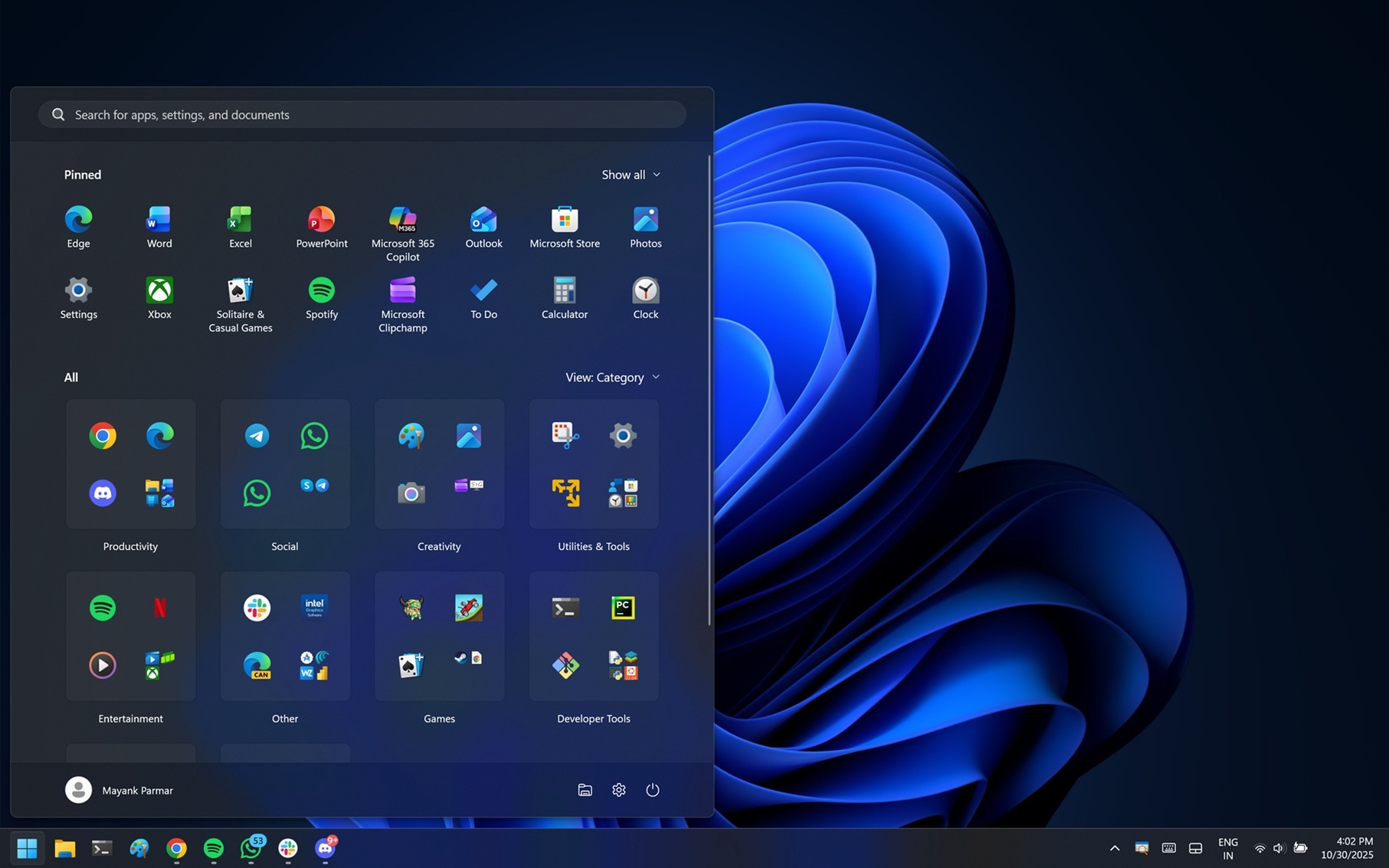
The "Start" menu in the current version of Windows 11 has been controversial since its launch. Some users find it too large on high-resolution screens and visually unappealing without adjusting scaling settings. More criticized is the newly introduced "categorization" layout: the system automatically categorizes apps, but users cannot freely edit categories or organize them according to their usage habits, resulting in a cluttered interface in both visual and practical terms.
Previously, media reports revealed that Microsoft internally tested at least five completely different designs before finalizing the current Start menu scheme, with numerous prototype interface screenshots never being publicly released. These prototypes showcased different information hierarchies, app presentation methods, and layout ideas, but ultimately were not adopted, remaining in the experimental stage. After these internal designs were shared on social media, they sparked widespread discussion among users and design professionals, prompting Microsoft's design team to respond more directly to external concerns.
In the latest response, March Rogers stated on X that the new Start menu design is backed by a series of user research and feedback, aiming to make it easier for users to access the apps they truly need. He also revealed that Microsoft is currently developing additional customization options, but has not yet announced specific features or launch times. From his statement, Microsoft is unlikely to overhaul the existing Start menu completely, but rather add adjustable items to the existing framework, providing users with greater freedom.
Currently, the Start menu offers very limited customization space to users, especially after the launch of the "categorization" layout. Complaints about the "categorization" feature have consistently been highly praised on the Microsoft Feedback platform, with some users explicitly requesting the ability to define categories themselves, believing that automatic categorization without editing capabilities only increases interface noise and usage burden. Some users bluntly stated that this design should not have entered the official version without review by experienced user interface experts.
From an implementation perspective, the Start menu categorization in Windows 11 does not use the cloud or artificial intelligence, but relies on a local JSON file of approximately 15MB to complete automatic categorization. This file presets categories such as "Entertainment," "Social," and "Creative," and matches them with the package family name of the app. However, due to incomplete descriptions or irregular metadata, some apps cannot be accurately identified and can only be categorized under "Other," exacerbating the fragmented experience.
This is why it is widely speculated that once Microsoft truly launches new Start menu customization features, settings related to "categorization" are likely to be a key focus of the changes. If users can manually adjust categories, merge or rename groups, or even completely disable the automatic categorization mechanism, the usability and controllability of the Start menu could be significantly improved.
In addition to the interface and customization aspects, the Start menu is also undergoing changes at the underlying technology stack level. Microsoft recently confirmed that it is migrating the Start menu from an implementation based on React Native to WinUI, an adjustment aimed at reducing latency, improving overall performance and stability. For users, this means that operations such as opening the Start menu, invoking search, and loading the app list are expected to become faster.
Sources reveal that Microsoft is also evaluating more improvements at the interaction level. One change under discussion is allowing users to manually adjust the overall size of the Start menu interface between small and large sizes, without relying on the system's global scaling settings. However, this feature is still in the planning stage and currently has no definite release schedule. Microsoft has also not indicated which update batch will deliver these improvements to users.
After several rounds of design experiments and prolonged user controversy, the Windows 11 Start menu is at another adjustment point. For Microsoft, balancing a unified design language, performance optimization, and highly diverse user needs will directly affect the shape of this core entry point in the coming years. For a large number of users who rely on the Start menu for work and entertainment, whether this round of changes can truly allow them to "take control of their Start menu" will also be an important indicator of the evolution of the Windows 11 experience.