Charging Pile Prices Increase, Cheap Electricity at 0.5 Yuan per Degree is Disappearing
Following the increase in oil prices, many new energy vehicle owners have found that public charging pile fees are also quietly rising. The once ubiquitous cheap electricity at 0.5 yuan per degree is becoming increasingly rare, and the cost advantage of electric vehicles is being continuously compressed. A Beijing car owner found that previously, a full charge cost about 50 yuan and could travel over 400 kilometers. Now, during peak hours, the electricity price per degree has increased by nearly 0.5 yuan, and a full charge requires over 80 yuan, increasing the cost per charge by more than 30 yuan. Many car owners feel that the advantage of saving money with electric vehicles is becoming difficult to maintain.
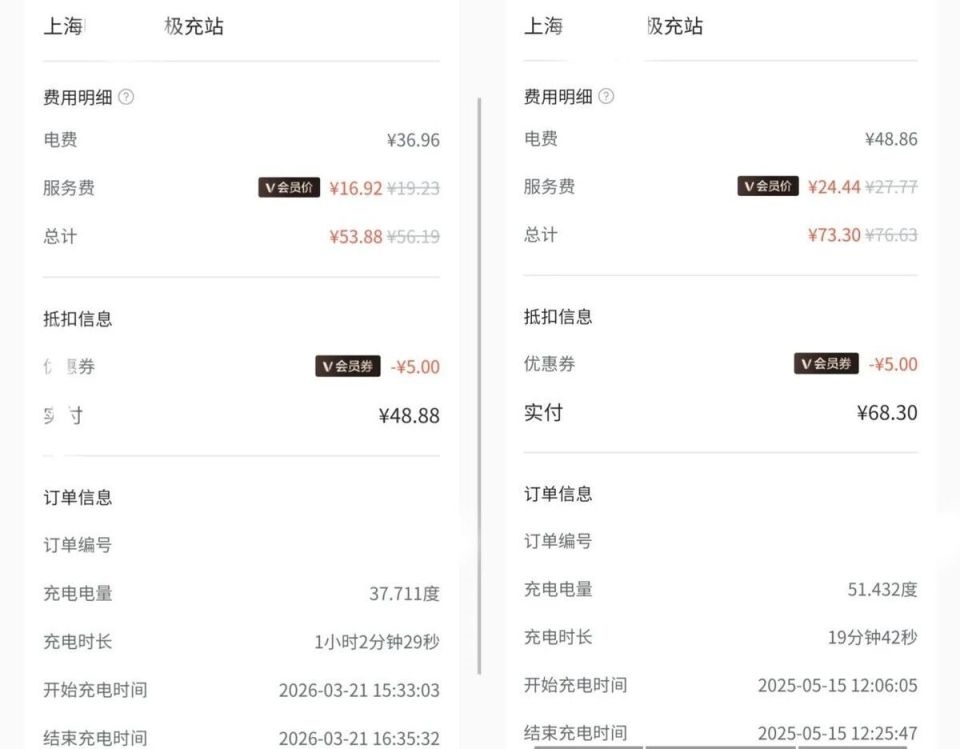
This round of price increases is not a uniform increase nationwide, but rather shows obvious regional differences, with varying price increases and decreases at different stations.
In most residential areas and shopping malls in Shanghai, charging pile prices are relatively stable. Some ride-hailing drivers have not felt a significant increase, and the unit price has even slightly decreased at some stations after stacking discounts.
However, many car owners have reported that it is becoming increasingly difficult to find low-price charging piles at 0.5 yuan/degree at night. Lower-tier cities also show obvious differentiation, and charging costs are mainly affected by regional, time period, and operator pricing strategies.
On one side, car owners complain about rising costs, while on the other side, charging pile operators are struggling to make a profit. An operator of a charging station in a fourth-tier city invested 900,000 yuan in 2020 to build a station, with a net profit of 500,000 yuan that year.
As industry competition intensifies, the service fee has been squeezed from 0.3 yuan/degree to 0.05 yuan/degree, and the station's idle rate has risen significantly. Now, the annual income is only 80,000 yuan, and the annual profit is only 60,000 yuan.
The core reason for the fluctuation in electricity prices is policy adjustments and rising costs. Starting March 1, 2026, fixed peak-valley electricity prices for public charging piles will be cancelled, and a fully market-oriented dynamic pricing system will be implemented, with no fixed low-price periods.
At the same time, the increase in industrial and commercial electricity prices, land rental, equipment depreciation, and operation and maintenance costs, coupled with the industry's malicious competition to lower service fees, forces most operators to raise electricity prices to maintain operations.
High-speed charging stations are even caught in a vicious cycle of "idle - price increase - queuing - rebuilding stations."
Currently, TELD and Star Charge have market shares of 18.88% and 15.37% respectively. The full-cycle operating cost of leading operators is about 0.4 yuan/degree, and the service fee must be higher than this price to break even.
For car owners, home charging pile electricity prices are stable, while using public piles requires traveling during off-peak hours and comparing prices.
For the industry, balancing operator profitability with car owner usage costs and improving the utilization efficiency of charging piles have become critical issues that urgently need to be resolved.