Batteries, Chips, and Now Tires: Over 70 Tire Companies Issue Collective Price Increase Notices
The “price increase wave” in the automotive industry is spreading from vehicle manufacturers to the entire upstream supply chain. Since mid-April, the domestic tire industry has experienced its second price increase this year, with over 70 tire companies issuing “price increase notices” as of April 20th. This affects everything from foreign giants to local brands, and passenger car tires to all-steel truck tires, with an intensity and scope rarely seen in recent years.
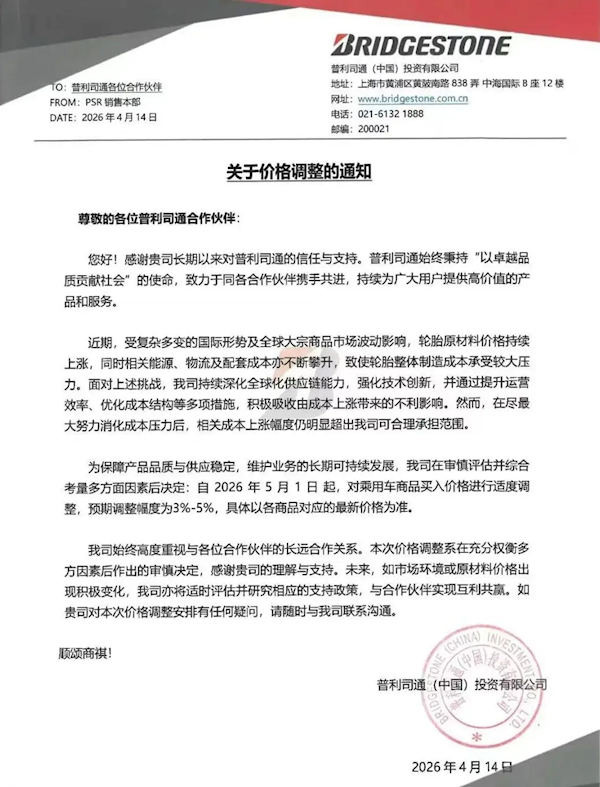
On April 14th, Bridgestone (China) took the lead in announcing a price adjustment, stating that prices for passenger car tires would increase by 3% to 5% starting May 1st.
The next day, domestic mainstream brands such as Zhongce Rubber, Sailun Tire, Linglong Tire, and Wanli Tire followed suit, with price increases generally ranging from 2% to 5%.
Tengsen Rubber even announced a 10% price increase across all products starting May 1st, marking the largest increase in this round of adjustments.
Rising raw material costs are the core reason driving this price increase. According to data from Zhuochuang Information, raw materials account for over 70% of tire production costs, with natural rubber, synthetic rubber, and carbon black accounting for over 60% of the total.
Since 2026, the prices of synthetic rubber and carbon black have continued to rise, coupled with increased logistics and transportation costs, putting rigid cost pressure on tire companies.
The tire price increase is not an isolated event. Since 2026, the price of lithium carbonate has rebounded sharply from a low of approximately 75,000 yuan/ton last year to the current level of approximately 160,000 yuan/ton, an increase of over 100%; the supply of automotive-grade storage chips remains tight.
Cost pressures are being passed down through each level of the industrial chain, prompting more than ten new energy vehicle companies to announce price increases or reduce terminal discounts. The nearly two-year “price war” in the new energy vehicle market has shown a clear shift.