This $400 Million Machine Spawned the World’s Most Sought-After LEGO Set
The world’s most important machine comes from a company you may have never heard of, but with a top-tier market capitalization. These extreme ultraviolet lithography machines are core tools for manufacturing chips for phones, computers, and data centers. There are only hundreds of these machines in existence globally, and they are all produced by the same Dutch company. However, this technological marvel that underpins the entire global economy may not even be ASML’s most coveted product. The company has another product that is even harder to buy than its EUV lithography machine: a LEGO replica of the EUV lithography machine.
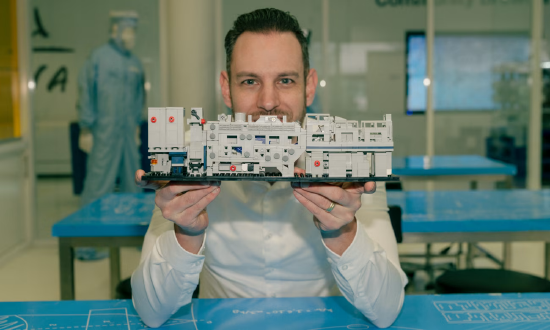
Rick Lenssen received a task: to turn a machine with a profound impact on the world into a toy.
This collector’s edition set is only available for purchase by employees with ASML-certified corporate email addresses, limited to one set per person, and this regulation is currently strictly enforced.
Despite both being extremely rare, there is a world of difference between this giant chip production equipment and a children’s toy that will make you yelp in pain if you step on it.
The real EUV equipment has over 100,000 components, while the LEGO miniature version has fewer than 1,000 parts, including purple lightning pieces representing extreme ultraviolet light, and a LEGO figure wearing a clean suit.
The real equipment, consisting of high-energy lasers and ultra-precision lenses, can cost up to $400 million; while the version assembled from colorful plastic bricks costs only about $200.
It took decades of groundbreaking research and countless miraculous scientific breakthroughs to create the system now used in chip factories.
And replicating it in LEGO was accomplished by just one person.
ASML’s extreme ultraviolet lithography machine has over 100,000 parts and costs up to $400 million.
The collector’s set is only available to employees with ASML-certified corporate email addresses.
The mastermind behind ASML’s most unexpected blockbuster product is a data analyst named Rick Lenssen – now nicknamed “Brick Lenssen” by some colleagues.
A few years ago, Lenssen went to a LEGO exhibition in the Netherlands with his young children and became fascinated with LEGO, which led to the journey of turning precision equipment into building blocks. The 39-year-old father began scouring BrickLink, a website, for missing parts from old LEGO sets. Soon, he began designing LEGO sets himself using software.
His first creation was a replica of ASML’s office park, which meant he had to spend his evenings and weekends at the place where he worked all day.
It took him more than two years and €2,500 out of his own pocket to complete the accurate replica using about 25,000 bricks, perfectly recreating everything from the peregrine falcons and a pigeon in the rooftop nests.
“That was its lunch,” Lenssen joked.
It took almost another year for him to find a place to display the work in the park. After being turned down by the company’s real estate department, Lenssen went directly to the top. He created a PowerPoint presentation and sent an email to then-ASML CEO Peter Wennink on a Friday night.
That night, Wennink replied: he loved the idea.
Lenssen’s first work was a replica of ASML’s park in Veldhoven, Netherlands, taking more than two years and using about 25,000 bricks.
But when it came to moving the work, Lenssen encountered a typical “ASML-style problem”: the EUV lithography machine is so large that it must be disassembled and transported to customers on three Boeing 747 aircraft. Lenssen had to disassemble his work piece by piece – because the model he built in the attic simply couldn’t be carried down the stairs. ASML’s movers loaded the LEGO parts onto trucks and delivered them to the company park.
To this day, visitors to the ASML reception hall see Lenssen’s work as the first thing they see.
And this wasn’t the last time he combined work and LEGO.
Around the time he completed this masterpiece, ASML launched an internal application to guide employees through the park in Veldhoven, Netherlands. To promote the app and reward beta users, the company invited Lenssen to design a LEGO skyline set of the park.
Then, he received his next assignment:
to turn this machine, which is vital to the world, into a toy.
In fact, ASML engineer Jeroen Ottens (who previously worked at LEGO) had already created a plastic model of an EUV lithography machine. But as ASML launched new models of its flagship products, the company needed a new series of LEGO replicas – and they already had someone in mind.
TWINSCAN (2021)
ASML released a LEGO set designed by Jeroen Ottens, 600 parts, employee purchase volume: 1718 sets
NXE: 3400C (2023)
Rick Lenssen’s first LEGO version of an EUV device landed in the employee store, 826 parts, employee purchase volume: 1930 sets
EXE: 5000C (2024)
Lenssen turned another EUV lithography machine into building blocks, 851 parts, employee purchase volume: 1355 sets
Lenssen completed the LEGO designs for the two high-precision devices in just a few weeks, one of which has a 61-page assembly manual.
He didn’t get paid for it, but he enjoyed one benefit: he could get the finished set for free.
Meanwhile, thousands of colleagues lined up to snatch up the company merchandise.
According to Marco Peters, ASML’s Chief Technology Officer, these LEGO sets are a reflection of the nature of engineers – they are born to solve complex problems and build precision objects, regardless of the material. Peters also took the LEGO set home and assembled it at the dining table. Employees involved in EUV equipment research even use the set to explain their actual work to their families.
Dutch engineers are usually reluctant to praise others, but they speak highly of Lenssen’s work.
One five-star review in the ASML employee store reads: “Looks pretty good.”
With such high praise, it’s no wonder that those who want to get their hands on these sets are no longer just internal employees.
Brian Kirby, a professor of engineering at Cornell University, first saw the LEGO version of the EUV lithography machine at an ASML technology conference. “As soon as I knew it existed,” he said, “I had to buy one.” At the time, external personnel could still purchase it from the company’s online store, so he quickly bought it.
“I should have bought two,” he regretted.
The LEGO miniature version has fewer than 1,000 parts, including purple lightning pieces representing extreme ultraviolet light.
Since then, ASML has tightened access to the employee store and canceled all external orders.
But there are still quite a few LEGO sets circulating online. In the Netherlands, they appear on the Marktplaats second-hand trading platform; on eBay, a boxed LEGO version of the EUV lithography machine is priced at $600, and a complete ASML LEGO set is priced at $4,500.
However, the vast majority of employees would never be willing to sell their treasured LEGO sets.
1355 sets of Lenssen’s latest LEGO version of the lithography machine have been purchased by employees;
while only 6 of the real machines have been sold by ASML.