Observation of "Cygnus X-1" Refreshes Cosmic Evolution Models: Black Hole Jets Release Energy Equivalent to 10,000 Suns
A new study led by Curtin University, using data from radio telescopes worldwide, shows that the energy carried by black hole jets is extremely astonishing, with a power equivalent to 10,000 suns. This provides important observational support for long-held theories about how black holes reshape the large-scale structure of the universe.
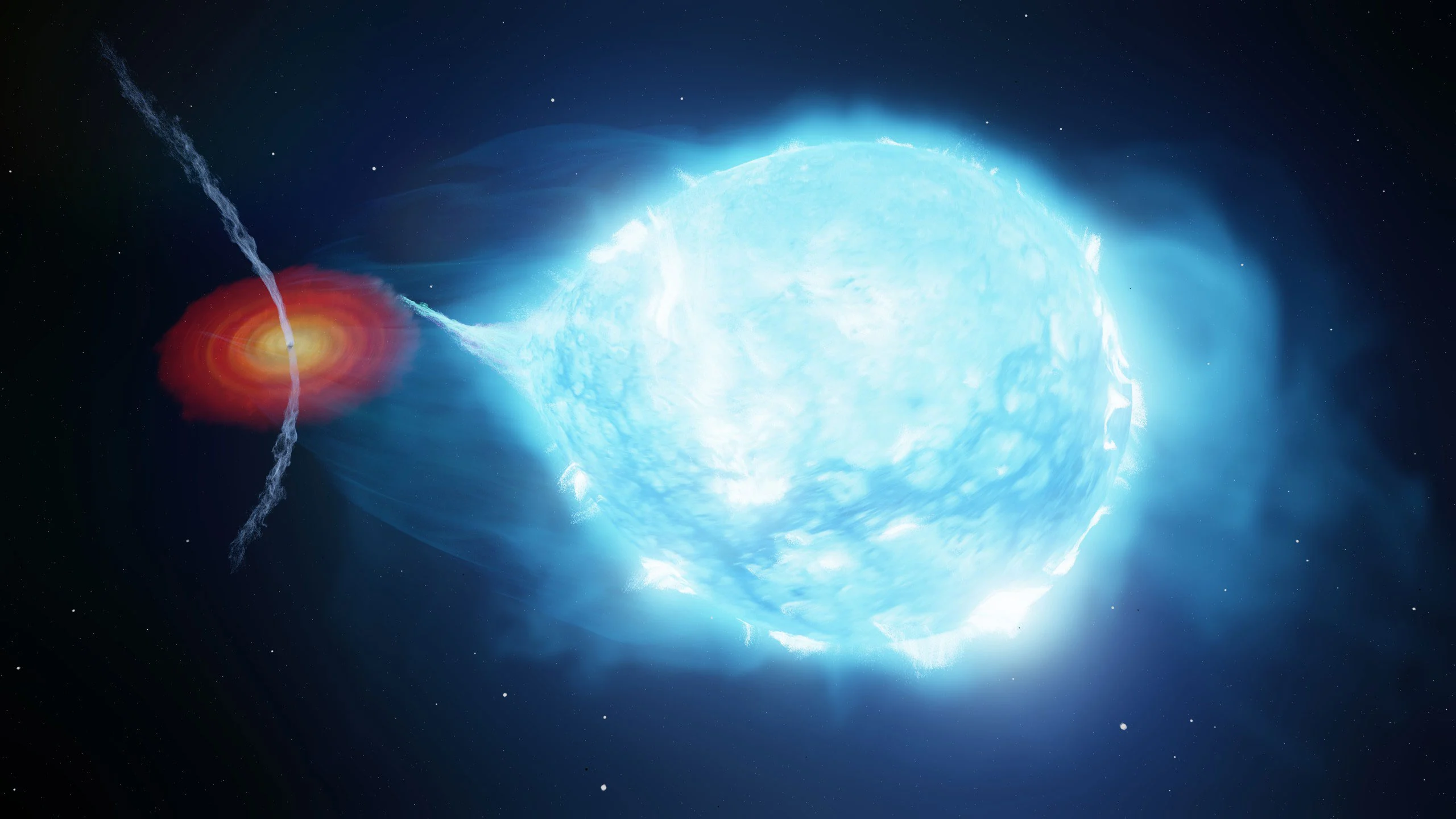
The paper was published in *Nature Astronomy*. The research team targeted the well-known X-ray binary system "Cygnus X-1," which contains the first confirmed black hole and a massive supergiant star. Observational results indicate that the jets produced by this system, in terms of instantaneous energy output, are comparable to the energy of approximately 10,000 suns.
To achieve this measurement, scientists networked radio telescopes around the globe to create an "Earth-diameter" observing array, allowing them to capture subtle changes in the jets' behavior during their orbital period at extremely high angular resolution. The study points out that as the black hole orbits its companion star, the supergiant's strong stellar wind continuously impacts the jets, causing them to deviate and wobble, similar to how strong winds disrupt a fountain's water column.
By simultaneously analyzing the intensity of the stellar wind and the degree to which the jets are deflected, the team was able to retroactively estimate the jet power on a "real-time" scale for the first time, rather than relying on long-term average estimates spanning tens of thousands of years as in the past. The results show that approximately one-tenth of the energy released as matter falls into the black hole is ejected by the jets at high speed and injected into the surrounding environment. This proportion is highly consistent with commonly used assumptions in large-scale cosmological numerical simulations, but has lacked direct observational verification until now.
The study also provided a key parameter: the jet speed. Jet material is ejected at about half the speed of light, approximately 150,000 kilometers per second (about 93,000 miles), a value that has been difficult to determine accurately for decades. The paper's first author, Dr. Steve Prabu, now at the University of Oxford, vividly described these jets, constantly "pushed" by the stellar wind, as "dancing jets" to describe their dynamic scene of constantly changing direction during binary orbital motion.
Professor James Miller-Jones, one of the co-authors, from the Curtin University Radio Astronomy Institute and the Curtin branch of the International Centre for Radio Astronomy Research, pointed out that previous techniques mainly provided the average power of jets over extremely long baselines, making it difficult to correlate with the instantaneous X-ray radiation produced when matter falls into the black hole. In this study, because the degree to which the jets are bent by the stellar wind could be continuously tracked within the orbital period, scientists were able to directly compare the jet energy with the X-ray energy on the same timescale.
Professor Miller-Jones emphasized that theory generally holds that the physical processes near black holes, regardless of their mass, are fundamentally highly similar, from stellar-mass black holes to supermassive black holes. Therefore, this precise measurement of the jet power of "Cygnus X-1" provides an important "anchor point" for understanding jets from black holes of different scales, which can be used to calibrate models of jets from black holes ranging in mass from 10 to 10 million times the mass of the sun.
As new large-scale scientific facilities, such as the Square Kilometre Array radio telescope being built in Western Australia and South Africa, come online, astronomers expect to detect signals from black hole jets from millions of distant galaxies. The research team stated that with this benchmark measurement of "Cygnus X-1," they will be able to more accurately assess the feedback effects of black holes on the gas, star formation, and even large-scale cosmic structures of their host galaxies when evaluating the overall energy output of these vast samples in the future.
The study points out that black hole jets are one of the key physical mechanisms that alter the surrounding environment and shape galaxy evolution. They can inject energy and matter into intergalactic space, suppressing or triggering new star formation, thereby playing a "regulator" role in cosmic history. This power measurement, using the "dancing jets," adds a solid observational basis to this macroscopic picture and is expected to promote a deeper understanding of the central role of black holes and their jets in cosmic evolution.