Research Team Directly Stimulates Olfactory Center with Ultrasound to Complete Immersive VR Experience
A small team of independent researchers is attempting to fill the long-missing "olfactory link" in virtual reality, but instead of dispersing scents into the air, they are choosing to "write" scent perception directly into the brain. Their developed prototype device uses focused ultrasound to precisely stimulate the olfactory bulb, responsible for processing olfactory information, without any chemical agents, scent cartridges, or spraying devices. If subsequent verification is feasible, it could bring a new level of immersion to virtual and augmented reality.
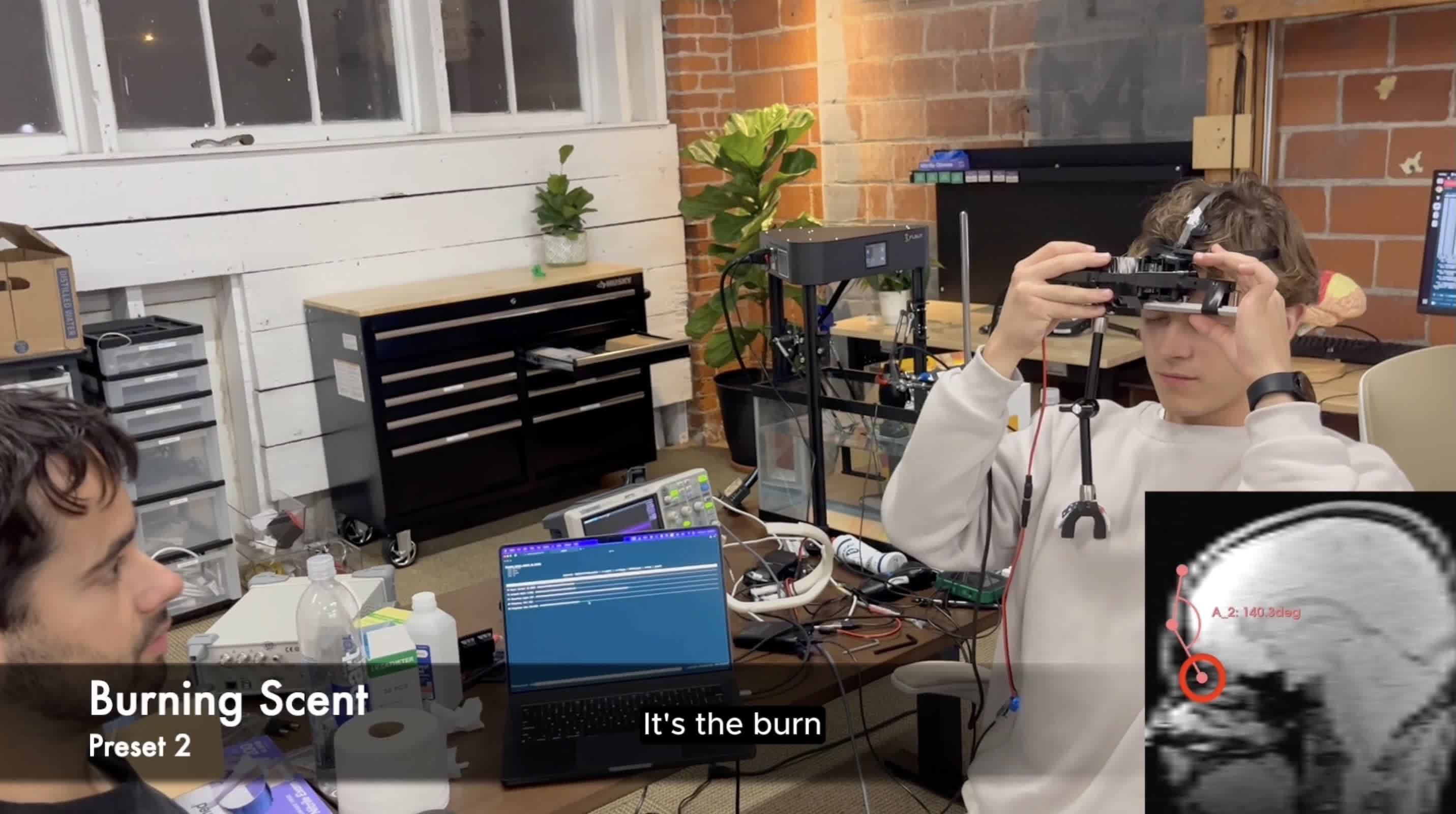
Current immersive systems mainly revolve around visual and auditory experiences, and there has been some progress in tactile feedback, but the sense of smell, which is most closely linked to memory and emotion, remains almost entirely absent. Biologically, olfactory signals enter the limbic system directly, including the hippocampus, without first undergoing higher-level cortical processing. This special pathway is considered the key mechanism behind "smell evokes memories," and is an effect that current VR struggles to replicate.
Research team members Lev Chizhov, Albert Yan-Huang, Thomas Ribeiro, and Aayush Gupta decided to abandon the traditional route of reconstructing scents in the air, and instead opted to directly stimulate the olfactory bulb area in the brain using ultrasound. They stated that even in animal models, attempts to directly induce olfactory perception with ultrasound in living organisms have been rare, making this direction highly exploratory in terms of technical approach.
The olfactory bulb is located above the nasal cavity, deep and surrounded by bone and soft tissue, making it difficult to access from the outside of the head. At the same time, ultrasound has poor propagation performance in the air, making precise targeting even more challenging. To address this, the researchers fixed the ultrasound transducer to the forehead and used what they described as a "solid, jelly-like pad" to provide support and comfort, then tilted the ultrasound beam downwards to target the area.
The team used the MRI data of one of the researchers to estimate the approximate coordinates and depth of the olfactory bulb, thereby determining the position of the ultrasound focal point. Based on this, they repeatedly adjusted the ultrasound frequency and pulse timing, searching for a combination of parameters that could penetrate the skull and focus energy at the target depth to obtain relatively stable subjective feedback.
During the experiment, subjects reported a range of experiences ranging from clear smells to vague sensations, including fresh air, ozone, burning wood, and decaying organic matter. The researchers noted a relatively clear distinction between "smell" and "sensation": the former had a clearer outline, seemed to have a specific source point, and could be "sniffed" to lock onto direction; the latter was weaker, slower, and often described as a fleeting impression rather than a recognizable specific smell.
Some subjects also reported mild physical sensations, such as a slight tingling or numbness on the face, suggesting that ultrasound stimulation may not only work on the olfactory pathway, but may also involve peripheral sensations. Breathing also affected the intensity of the experience: gentle inhalation often amplified the olfactory or perceptual experience, so the experiment required participants to cooperate with a slight "sniff" when attaching the device to their forehead.
In some trials, the related sensation gradually accumulated with several breaths, while in others it appeared almost suddenly. One subject instinctively perceived a smell similar to rotting garbage as a real odor in the environment, exhibiting an intuitive reaction akin to "mistaking the virtual for reality."
From an engineering perspective, this is still an early prototype: the device can barely be considered "head-mounted," but currently must be fixed to the forehead by hand. To achieve practical application, the device needs to be further miniaturized and deeply integrated with wearable hardware such as VR/AR headsets to meet the requirements of long-term wear, mobile use, and safety.
The potential significance of this research may extend beyond "virtual smells." It points to a broader direction: "writing signals into the brain" through non-invasive techniques without the need for craniotomy or electrode implantation, rather than simply reading passive information such as brain electrical activity or blood flow changes. This prospect is still highly speculative, but in theory, similar methods could be extended to other sensory and perceptual pathways beyond smell.
In terms of foreseeable short-to-medium-term applications, immersive media is the most direct landing point: if headsets can generate "brain smells" without relying on consumable agents and scent cartridges, it will eliminate a long-standing limitation in virtual scene design. Of course, entering the consumer market still faces multiple engineering challenges, including cost control, size and weight, safety regulations, and experience consistency, so it is more likely to land on enterprise-level training, professional simulation, and scientific research platforms first.
At a deeper level, this approach of bypassing physical air and chemical molecules and directly reaching the olfactory center changes people's traditional imagination of "digital smells." It is not about recreating various fragrances or odors in real space, but about attempting to trigger the brain's subjective perception of "smelling something" at the neural level. Once this idea matures, it may open up a new technological route in perceptual computing and human-computer interaction.