ASRock Partners with Intel to Launch Single-Channel Memory Technology, Reducing Memory Stick Prices Without Affecting Performance
Soaring memory prices are impacting all aspects of the tech industry, making it difficult for budget-conscious PC users to assemble devices. As time goes on, the prices of other components, including solid-state drives, are also rising. However, ASRock, in collaboration with Intel and TeamGroup, has now launched single-channel DRAM, a technology named HUDIMM and HSODIMM, which is characterized by HUDIMM memory sticks using only a 1x32-bit channel.
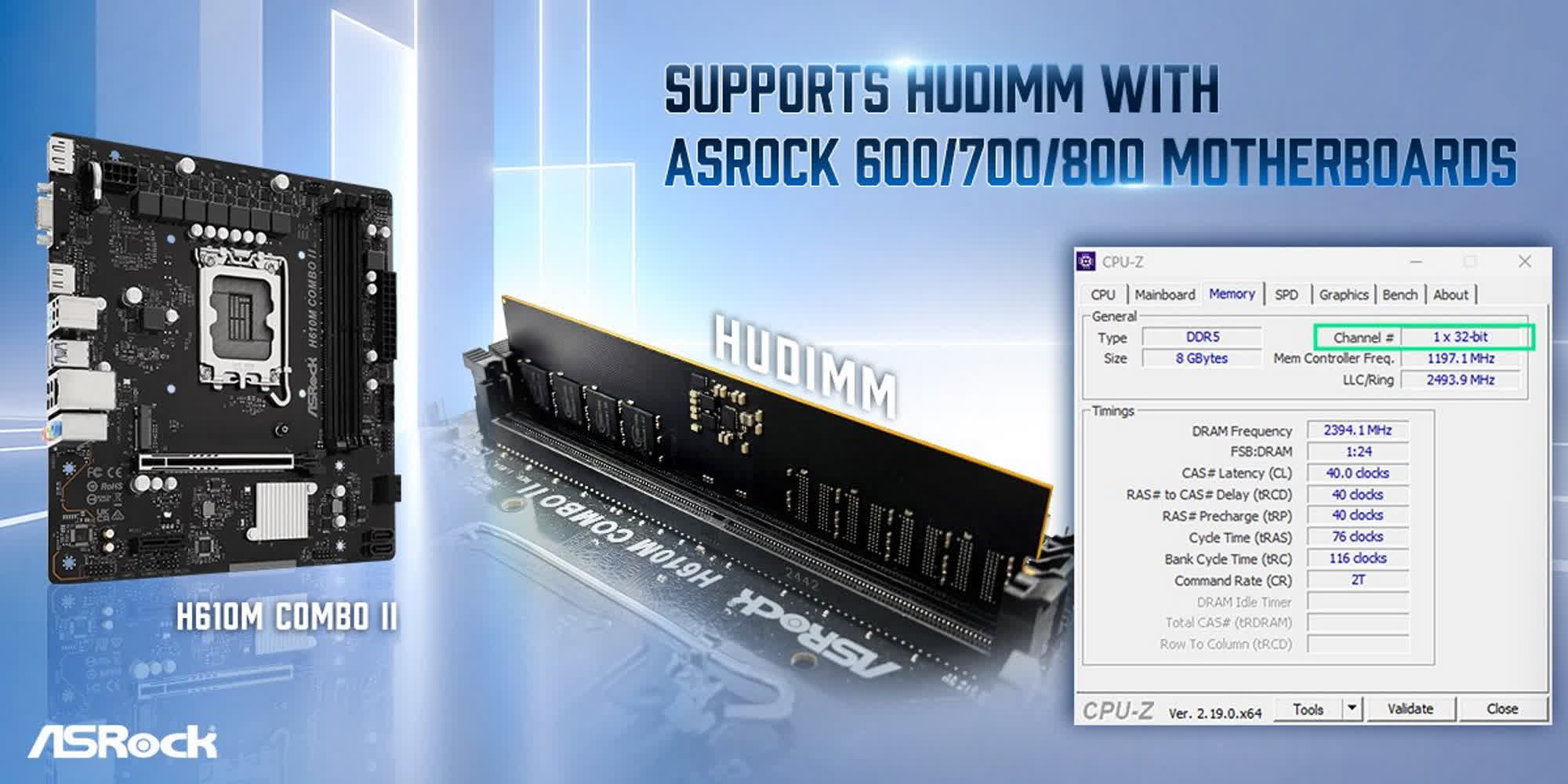
Standard UDIMM memory sticks use dual-channel, or 2x32 bits. Compared to standard memory sticks, this single-channel memory is cheaper to produce, and theoretically can be used to address the current issue of high prices for traditional standard memory sticks.
ASRock 600/700/800 Series Motherboards Support This Technology:
Intel stated that with the increasing demand and cost of DDR5 memory, ASRock's single-channel DRAM technology is crucial for continuing to popularize DDR5 memory. Intel is very grateful for ASRock's support in applying this technology to Intel 600/700/800 series chipsets, which will allow Intel users to better enjoy the benefits of DDR5 memory in the coming years.
ASRock has enabled support for HUDIMM DDR5 memory on its Intel 600/700/800 series motherboards. Although the number of sub-channels is halved, ASRock's published data shows that these memory sticks can still deliver good performance.
Minimal Impact on Performance:
Images posted by ASRock on social media show that using an 8+16GB memory combination in a DDR5 configuration can achieve higher bandwidth and lower latency. Reducing the number of channels only reduces memory capacity, so there will be virtually no impact on performance.
Performance data shared by ASRock shows that a single-channel 8GB memory stick + a 16GB dual-channel memory stick has an overall bandwidth higher than a single dual-channel 24GB memory stick, so mixing single and dual-channel is no problem.
Of course, the key significance lies in the fact that single-channel memory sticks are cheaper to produce, and therefore the actual price will also be cheaper. For example, a single-channel 8GB memory stick + a 16GB dual-channel memory stick will be cheaper than a single dual-channel 24GB memory stick.
However, whether single-channel memory sticks can truly lower prices remains to be seen, as the biggest problem currently is capacity. Flash memory manufacturers are shifting more capacity to the more profitable HBM series memory, so even if single-channel memory production costs are low, it may not be possible to obtain sufficient capacity.