Harvard Team Discovers Brainless Protists Capable of Associative Learning
Traditionally, the scientific community believed that “associative learning”—understanding the connection between two events, such as the association between a stimulus and a response—required at least some form of neural structure or brain. However, a recent study shows that tiny, single-celled organisms living at the bottom of ponds can also complete this type of learning task without any nervous system, potentially overturning traditional understandings of learning mechanisms.
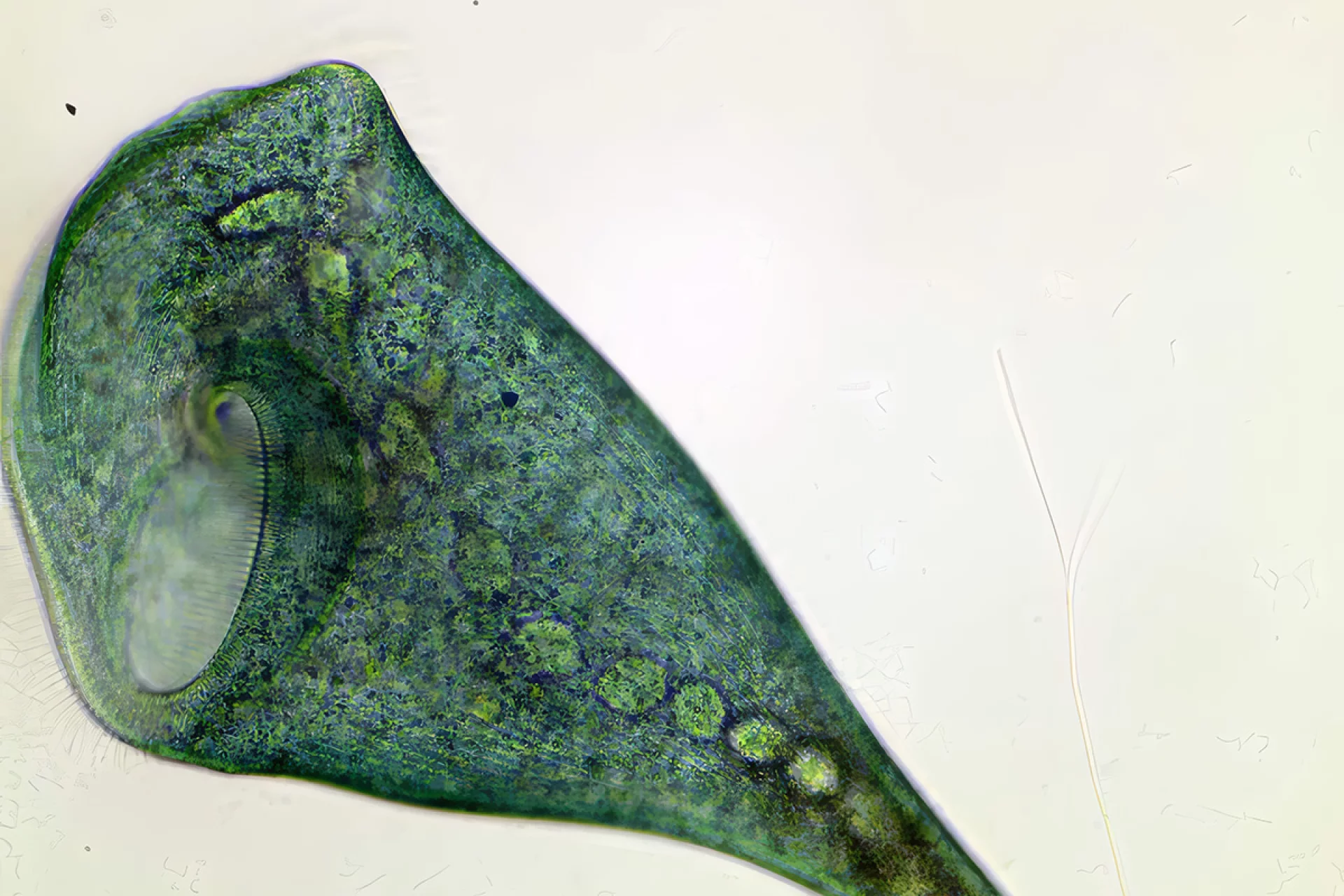
This research, which has not yet been peer-reviewed and has been published on the preprint platform BioRxiv, indicates that single-celled organisms, even those completely lacking a brain or nervous system, can exhibit learning behavior. Samuel Gershman, a cognitive neuroscientist at Harvard University and a collaborator on the paper, stated in an email to Refractor, “I was very surprised by this result, as there had been no previous evidence of associative learning in these organisms, and evidence in other single-celled organisms has been quite controversial. We weren’t sure if the experiment would work at all.”
The study focused on a protist called *Stentor coeruleus*, a trumpet-shaped ciliate approximately 1 millimeter in length, barely visible to the naked eye. One end has a structure called a “holdfast” used to attach to the bottom of the pond or other surfaces, while the other end is covered in cilia used for filter feeding. When it senses disturbances in its surroundings, such as an approaching predator, it quickly contracts its elongated body into a nearly spherical shape as a defensive response.
To study the learning process of this single-celled organism, Gershman’s team first collected dozens of *Stentor coeruleus* cells from the environment, placed them in petri dishes, and allowed them to stabilize and attach for several hours. Subsequently, researchers used a specially designed device to apply precisely controlled, mild tapping stimuli to the bottom of the petri dishes containing the cells. Initially, most of the *Stentor coeruleus* responded with a contraction when they felt the tapping, but as the tapping continued, the number of responding cells gradually decreased, indicating that they had become “habituated” to the repetitive stimulus and no longer perceived it as a threat.
Next, the team introduced a so-called “pairing protocol.” In this phase, the cells first received a weak tap (usually causing only a slight contraction), followed one second later by a stronger tap. This combination of “weak stimulus + strong stimulus” was repeated every 45 seconds, a time interval corresponding to the approximate time it takes for *Stentor coeruleus* to extend after contracting. After approximately the first 10 rounds of paired trials, the cells would produce a noticeable contraction reaction directly when the weak tap arrived, but as the trials continued to repeat, this reaction gradually weakened. Gershman pointed out that this process of establishing an association between the weak stimulus and the subsequent strong stimulus and adjusting the reaction intensity demonstrates that “single cells are also capable of implementing fairly complex learning algorithms.”
Researchers believe this discovery could change our understanding of when “learning” originated in evolutionary history. In an interview, Gershman stated that learning abilities considered to be advanced may have a far older evolutionary origin than complex nervous systems. He questioned, “Did associative learning first appear in multicellular organisms with brains? Perhaps not.”
Gershman further pointed out that there are “many similarities” between *Stentor coeruleus* cells and human brain neurons, suggesting that our brains may still be utilizing learning mechanisms that first evolved in single-celled organisms. In other words, the complex cognition and learning abilities of humans may, to some extent, inherit the “primitive algorithms” of single-celled ancestors. Currently, this research has been published as a preprint on BioRxiv and, after peer review, is expected to continue to ferment in broader academic and public discussions.