Ancient Parrot Feathers Reveal a Long-Distance Trade Network Across the Andes Mountains
A recent study reveals a sophisticated live bird trade network across the Andes Mountains, predating the Inca Empire, based on parrot feathers discovered in a 1,000-year-old tomb in Peru. The research, published in *Nature Communications*, utilized DNA analysis, isotopic detection, and spatial modeling to trace the feathers' journey from the Amazon rainforest to the Peruvian coastal desert, highlighting the complex connections between ancient civilizations and the value of interdisciplinary research.
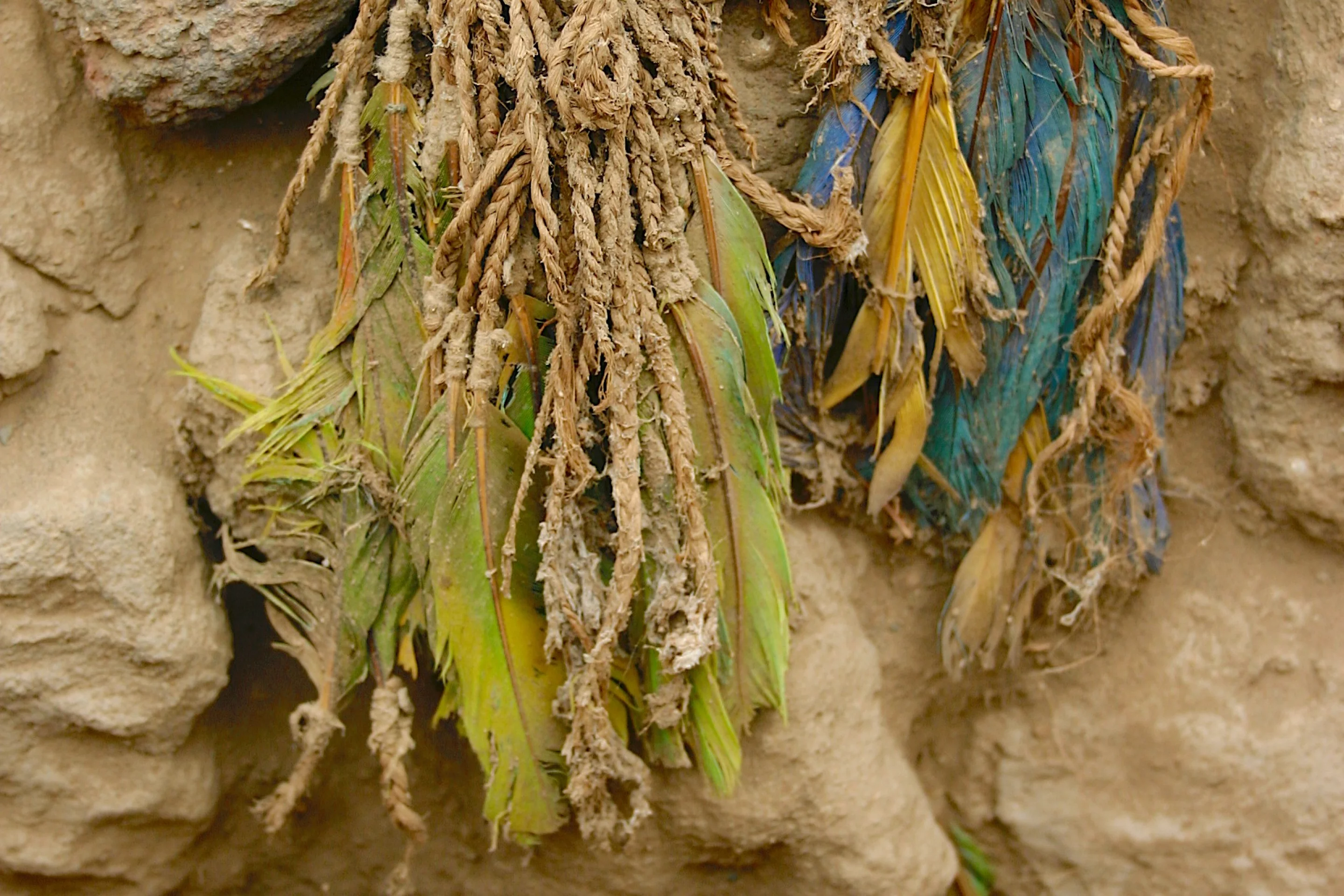
These feathers were unearthed at Pachacamac, an important religious center on the Peruvian coast and a core archaeological site of the ancient Ichsma people. Biologist George Olah, while studying macaw population genetics in the Amazon, immediately “recognized” the species upon seeing the feathers at the site and was surprised by the discovery in such a different environment. He proactively contacted Izumi Shimada, the site’s archaeological director, initiating this joint research.
The first step of the research was to confirm that the feathers were indeed from parrots. The preservation of ancient DNA is highly dependent on climate and burial environment. Peru’s dry coast provided excellent preservation conditions, allowing the feathers to remain intact in both macroscopic form and chemical composition. Aleksa Alaica, a multi-species archaeological scholar involved in the peer review, pointed out that in this specific context, “the stars almost perfectly aligned,” providing a rare technical foundation for the study.
DNA results showed that the feathers came from four Amazon parrot species. More importantly, the genetic sequences exhibited high diversity, indicating that the birds originated from wild populations, not from heavily inbred captive groups. This contrasts sharply with archaeological findings in the southwestern United States, where parrot feathers used locally often came from long-term captive birds with significantly lower genetic diversity.
However, these parrots’ natural habitat is not on Peru’s arid west coast, but in the humid Amazon rainforest. To explain how the feathers arrived there, the team used paleoenvironmental models to compare ecological conditions 1,000 years ago with those of today. The results showed that the west side of the Andes was also unsuitable for these birds at that time, and their natural range of activity was approximately 150 kilometers, far short of the distance needed to cross over 500 kilometers and the highest mountains in South America. Researchers therefore believe that the parrots could not have flown naturally over the Andes and that their transport to the coast must have involved human intervention.
To further confirm the mode of transport, the team analyzed the stable isotope characteristics of the feathers to infer the birds’ diet. Typical wild parrots in the rainforest consume primarily “C3 plants,” and their feathers exhibit a distinct “C3 signal” in carbon isotopes. However, these feathers showed a “C4 signal,” indicating a diet based on C4 crops such as corn—crops common in coastal areas but not typical rainforest food. This means the parrots were transported across the Andes alive and kept in coastal areas for at least a year until new feathers grew, recording the local dietary traces.
Olah explained that parrots typically molt once a year, and feathers are essentially a time slice of their diet during growth. If birds were simply captured from the Amazon and transported to the coast for a short period, the isotopes in their feathers would still retain rainforest dietary characteristics. The detection of coastal dietary signals confirms that the parrots spent a considerable amount of time in the coastal region.
Geographically and ecologically, the Andes Mountains pose a significant challenge to both humans and birds. Researchers point out that carrying large, noisy parrots over high-altitude areas, while facing cold and thin air, was a severe test for both the transporters and the birds. Therefore, the research team suggests that the transport route likely chose the lower mountain passes in the northern section, where the mountainous environment was relatively mild and not overly harsh.
This speculation about the northern route is also supported by archaeological evidence. The area overlaps heavily with the sphere of influence of the Chimú civilization, a powerful political and cultural center in the coastal region at the time. The paper points out that the Chimú are believed to have maintained resident and trade relations with the Chachapoyas people of the eastern Andean slopes, whose upper Amazonian mountains were one of the habitats of these parrot species, and local residents were also known for their skill in catching birds.
Based on this, the research team outlined a multi-stage, finely divided trade network: the Chachapoyas captured parrots in the rainforest foothills, reselling them as live cargo to the Chimú, who raised and tamed these birds on a larger scale, and then transported the parrots along existing coastal transport networks to religious centers such as Pachacamac in the south. This hypothesis is consistent with both the genetic and isotopic evidence of the feathers and with increasing archaeological research on the interconnectedness of the Andes-Amazon region.
Beth Scaffidi, a biological anthropologist at the University of California, Merced, said the study is highly consistent with recent large-scale archaeological excavations and airborne remote sensing results in the Amazon region. New evidence shows that the Amazon contains highly complex village, town, and even urban systems, connected by vast road networks that extend to the Andean region. She believes that these studies are constantly “lifting the veil,” allowing people to see that long before the rise of the Inca Empire, there were already deep and continuous interactions between the Andes and the Amazon.
Notably, the final exchange in these arduous and lengthy journeys was merely parrot feathers. Researchers point out that the human pursuit of “rare” and “exotic” objects has a long history, and this aesthetic and symbolic value is enough to support the high cost of long-distance trade. Izumi Shimada believes that to this day, humans still tend to assign higher value to “exotic flair.” The brilliantly colored macaw feathers are not only visually striking but also originate from the distant, rarely experienced Amazon world, projecting people’s imagination of mysterious regions and rare creatures.
The study was led by institutions including the Australian National University. The research team pointed out that with the application of more interdisciplinary methods in archaeology, it is hoped that in the future, more details of ancient cross-regional economic and cultural networks can be restored, and the long-term interaction history between the Andes and Amazon civilizations before the Inca can be re-examined.