University of Washington Team Creates VueBuds: Camera Headphones That Describe Everything You See
A team from the University of Washington has developed VueBuds, a new prototype of headphones embedding miniature cameras within true wireless earbuds. Combined with a visual language model (VLM), VueBuds can verbally describe the wearer's field of vision, identify objects, and translate languages, described by researchers as a "mobile, voice-only version of reverse image search."
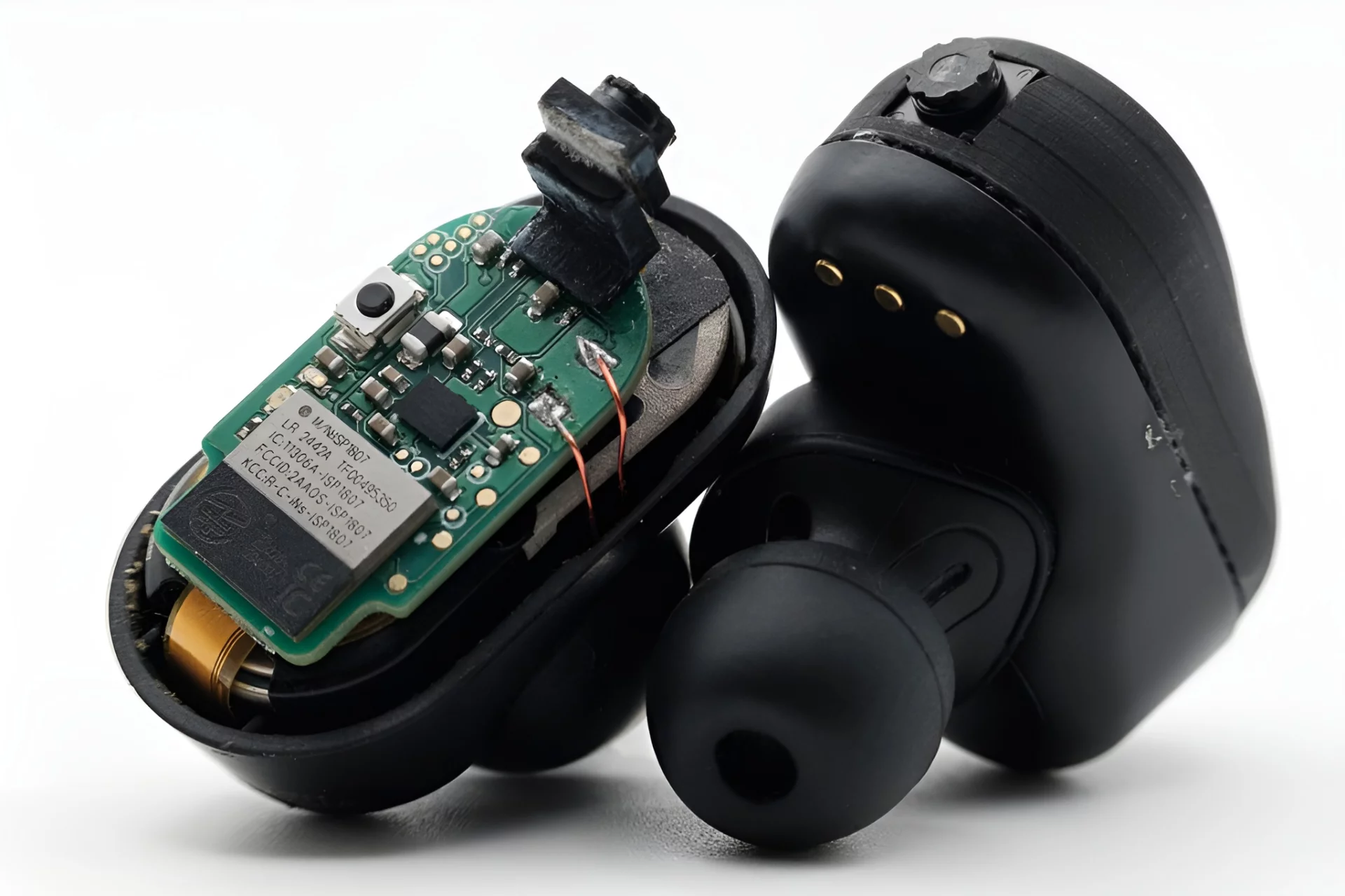
VueBuds' prototype is based on a modified Sony WF-1000XM3 wireless noise-canceling headphone, embedding grain-of-rice-sized black and white cameras into the earphone casing. Utilizing a built-in visual language model, processing is done locally or with low bandwidth. Users simply need to ask a question to receive a voice description of the scene before them, object names, or explanations and translations of text content. The research team published a paper detailing the system’s design and experimental results at the CHI 2026, a prominent human-computer interaction conference.
Shyam Gollakota, one of the project leaders and a professor at the Paul G. Allen School of Computer Science & Engineering at the University of Washington, stated that the team learned from the lessons of Google Glass—which was ridiculed as “Glassholes” due to its conspicuous appearance and significant privacy concerns, ultimately failing. Gollakota pointed out that many people dislike adding visible devices to their faces, while headphones are already highly popular and socially acceptable wearable forms. Therefore, embedding visual functionality into headphones could achieve a better balance between usability and privacy perception.
From a hardware perspective, VueBuds utilizes low-resolution black and white cameras and low-bandwidth transmission to keep power consumption below 5 mW and automatically shuts off when not in use to save battery. Researchers claim that in a test involving 90 users and 17 visual question-answering tasks, VueBuds’ answer quality was comparable to that of the Ray-Ban Meta smart glasses with embedded cameras and large models, demonstrating the potential of bringing rapidly developing visual language model capabilities to mainstream headphone devices.
In a demonstration video, a man wearing VueBuds stands in an apartment kitchen and asks, “Please describe the scene in front of me.” About a second later, an AI with a relaxed tone and mimicking a human female voice responds: “I see a kitchen area with a window letting in a lot of light. There are some bottles and a book on the counter. The window has blinds, and there is a sink on the left.” Subsequently, when he looks at a record cover and asks for the album name, the system quickly identifies it as The Beatles’ *Abbey Road* album cover.
According to experimental data disclosed in the paper, in a test with 16 participants, VueBuds achieved an accuracy rate of approximately 83% in object recognition and translation tasks, and an accuracy rate of approximately 93% in tasks such as identifying book titles and authors. The research team cited an example that users could potentially use the system to read Korean comics that have not yet been translated, or order hidden dishes “only available on Chinese-language menus” at Chinese restaurants, without being limited by their language skills.
Addressing the common question of whether the headphone cameras, located on either side of the face, would be obstructed by the wearer’s head, researchers explained that VueBuds draws on the principle of human binocular disparity, using “stereoscopic vision” fusion from the different perspectives of the two cameras to gain an understanding of the scene ahead. However, limited to black and white images, VueBuds cannot answer questions related to color; navigation and high-precision translation in complex scenarios still require higher-resolution color cameras and stronger computing power.
Power and computing limitations also mean that VueBuds currently cannot continuously and with high bandwidth capture and process video streams, and is only suitable for intermittent use in a “photo + question” manner. Nevertheless, the research team believes that its balance between power consumption, size, and response speed is sufficient to demonstrate the feasibility of this form as a “visual intelligence platform,” providing new directions for the functional expansion of future headphone devices.
At the same time, privacy and security risks are unavoidable topics. The article points out that a few years ago, a company proposed the idea of an application that could identify strangers’ names from a single photo, to which the popular ironic response online was: “If that were the case, women would die because of it.” VueBuds currently provides only limited security measures, such as a small “working indicator light” on the headphones, but observers often do not realize that a pair of headphones is capturing images. Combined with audio recording, Bluetooth connection, and third-party facial recognition services, such devices, if abused, could pose a serious privacy threat of being “low-resolution but deadly.”
The article points out that if regulatory authorities can formulate and enforce effective rules to ensure public safety and personal privacy are not compromised, such “seeing” headphone devices could bring significant convenience to visually impaired people and greatly enhance their freedom in life, travel, learning, and entertainment. The University of Washington emphasized in its official press release that VueBuds is currently still in the research prototype stage, but has demonstrated the prospect of integrating visual language models into everyday wearable devices, potentially ushering in a new generation of “hearable and seeable” smart headphone product forms.