New Material Like Liquid Metal Creates "Staple-Like Particle" System That Can Switch Between Rigidity and Flow
A team of engineers at the University of Colorado Boulder has developed a novel material composed of uniquely shaped particles that can freely switch between a "rigid whole" and a "loose fluid." The researchers drew inspiration from a common office stapler – a large collection of staples entangled together resists force when pulled, but quickly loosens and collapses into a pile of separate metal strips when vibrated or shaken in a specific way.
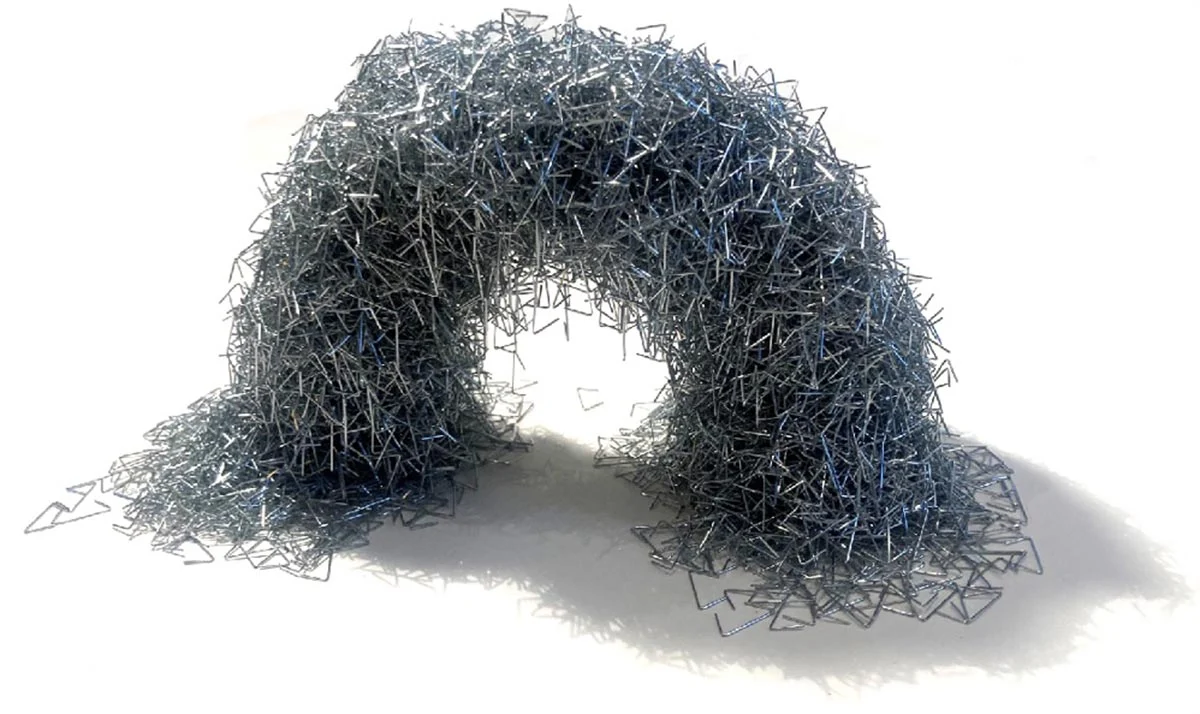
This phenomenon prompted the researchers to rethink material design approaches: instead of traditional solid blocks or chemical bonding, they started with geometric shapes, using a large number of small particles that can "hook" into each other, building an overall structure through physical entanglement, while also being able to quickly disassemble when needed. "We've been playing with configurations and geometry for years, but it wasn't until recently that we started seriously studying interlocking, entangled particles," said Professor Francois Barthelat, head of the Advanced Materials and Bio-Inspired Laboratory and the project leader. "This system exhibits a very unique combination of properties, and we believe it has great potential in engineering."
This research, published in the *Journal of Applied Physics*, refers to this phenomenon as "entanglement" – the process by which particles intertwine and form structural connections. Similar principles are not unfamiliar in nature: bird nests rely on the interweaving of branches and fibers for strength, while bones rely on the coupling between rigid minerals and soft proteins to achieve a balance of mechanical properties. The engineering challenge lies in: how to replicate this "interlocking" effect in artificial materials in a controllable manner.
The Barthelat team believes the key lies in the geometry of the particles. "Take sand as an example. Sand grains have smooth surfaces and are generally convex, making it almost impossible for true interlocking to occur between particles," explained doctoral student Youhan Sohn. "But if we change the shape of a 'grain of sand,' its macroscopic behavior and mechanical properties will change dramatically, including its ability to entangle and interlock with other particles."
After realizing the importance of shape, the researchers used Monte Carlo simulation, a computational method, to predict the interactions between particles of different shapes and to find geometric designs that could produce the highest degree of entanglement. They then validated the simulation results through a series of "pickup tests," observing the performance of these new designs during actual assembly, lifting, and vibration.
The experiment ultimately yielded an unexpected but extremely simple answer: "two-legged" particles, similar to staples, exhibited the strongest interlocking tendency. When piled up with a large number of these particles, the system can both tightly entangle to form a whole and loosen and disperse under certain conditions.
This design offers several important performance advantages, one of which is the rare "combination of high strength and high toughness." In traditional materials, high strength is often accompanied by increased brittleness, while high toughness often means a decrease in strength; however, this entangled particle material made of "staple-like particles" performs excellently in both tensile strength and toughness. Doctoral student Saeed Pezeshki pointed out: "Our entangled particle material utilizes these staple-like particles to demonstrate excellent toughness while maintaining high strength."
Another major advantage is the system's rapid assembly and reversible disassembly. The research team refined the degree of interlocking between particles by changing the vibration mode applied to the particle pile: gentle, low-intensity vibrations facilitate the slow "drilling" of particles into the gaps between each other, forming a tighter entanglement and increasing overall strength; while stronger vibrations disrupt the original contact state, causing the structure to disintegrate and the particles to return to a freely flowing granular state.
"It's a very strange material. It's clearly not a liquid, but it can't be simply classified as a solid either," Barthelat said. "This opens a new door for engineering design. It feels both alien and surreal when you actually manipulate such a tangled mass of particles with your hands."
Sustainable construction is an important potential application. The research team envisions that future buildings and bridges could partially adopt this entangled particle material as a structure or filler unit: during service, they have good load-bearing capacity; and when construction tasks are completed or the structure reaches the end of its life, it can be disassembled as a whole, realizing the reuse and recycling of components or particles.
Robotics is another possible path. Pezeshki revealed that he and other students discussed the idea that this material concept could be extended to "swarm robotics": a large number of small robots achieve mutual entanglement through shape and mechanism design, combining into larger, more complex structures when performing tasks; and then untangling from each other after the task is completed, dispersing to execute new instructions.
Barthelat used a familiar science fiction image as an analogy – similar to the liquid metal robot T-1000 in the movie *Terminator 2*: it can "liquefy" into a fluid state to pass through obstacles in narrow spaces, and then re-coalesce into a complete form on the other side. "Of course, this technology is currently expensive, and there are still significant challenges to large-scale application, but it is a direction that many researchers are focusing on," he said.
Currently, the team is continuing to optimize this material system, attempting more complex particle designs, such as adding additional protruding "legs" or "hooks" to make the particles somewhat similar to burrs commonly found on clothing. These multi-foot structures are expected to further enhance the entanglement effect and improve the stability and adjustability of the overall structure.