6G Networks Return to Reality, Slower Than 5G-A
After several years of 5G commercialization, 6G is on the horizon. Initial expectations for 6G were very high, anticipating speeds 10-100 times faster than 5G, potentially reaching 1000Gbps (1Tbps). However, this outcome may not materialize. The 6G standard is still under development, but the current focus is on practicality, abandoning the pursuit of unrealistic, super-high targets. Academician Wu Hequan of the Chinese Academy of Engineering mentioned this at the Global 6G Technology and Industry Ecosystem Conference.
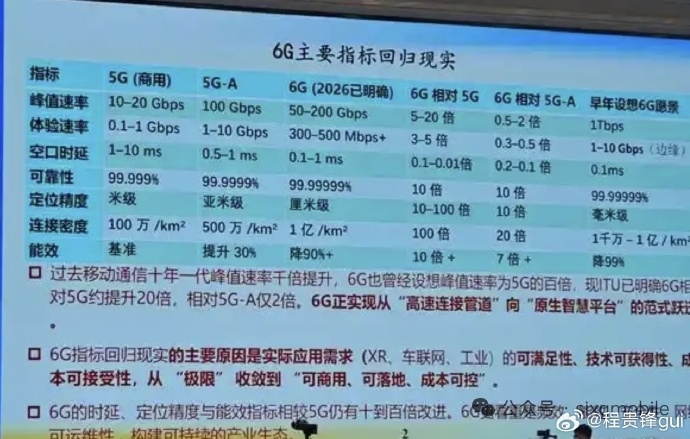
According to him, 6G was initially envisioned to have a peak rate 100 times faster than 5G, but the ITU has now clarified that 6G will be approximately 5-20 times faster than 5G, and only 0.5-2 times faster than 5G-A.
In terms of experienced rates, 6G was once expected to reach 1-10Gbps, but the ITU has now defined the 6G experienced rate as 300-500 Mbps+, which is about 3-5 times faster than 5G, but only 0.3-0.5 times faster than 5G-A.
It is clear that the 6G standard is more conservative in terms of speed than previously anticipated, with a peak rate of only 50-200Gbps, while 5G and 5G-A (also known as 5.5G) are 10-20Gbps and 100Gbps respectively.
Looking at experienced rates, 6G’s speed of 300-500Mbps is even a step backward, as the 5G standard is 0.1-1Gbps and 5G-A is 1-10Gbps.
However, 6G will improve latency and reliability by an order of magnitude. 6G latency of 0.1-1ms is better than 5G’s 1-10ms and 5G-A’s 0.5-1ms, and reliability will increase from 99.999% and 99.9999% to 99.99999%.
At the same time, positioning accuracy will also be improved from meter-level and sub-meter-level to centimeter-level, and connection density will be improved from 1 million/km2 and 5 million/km2 to 100 million/km2. These two indicators are 100 times higher than 5G and 20 times higher than 5G-A.
More importantly, 6G’s energy efficiency will be reduced by more than 90% compared to 5G, and improved by more than 7 times compared to 5G-A.
Wu Hequan stated that the main reason for 6G indicators returning to reality is the satisfiability of actual application needs (XR, vehicle networking, industry), the availability of technology, and the acceptability of costs, converging from “extreme” to “commercially viable, landable, and cost-controllable.”
In conclusion, according to Academician Wu Hequan, the future 6G network will no longer pursue extreme speeds, and the goal of 1000Gbps is meaningless. In fact, the experienced rate may even be lower than 5G-A.
However, 6G networks will see significant improvements in latency, reliability, and energy efficiency, meaning deployment and maintenance costs will be significantly reduced. This is also the reason why many equipment manufacturers and operators have not been optimistic about the rapid commercialization of 6G in 2030.