Samsung Shareholders Hold Anti-Strike Rally: Resist Excessive Employee Bonuses and Work Together to Protect Samsung
Samsung Electronics, having achieved its best-ever quarterly performance, is facing an unprecedented labor dispute. The Samsung National Union, dissatisfied with the stalled wage negotiations, threatens a major strike and demands over 400 billion Korean won in performance bonuses. In response, Samsung shareholders have announced an "anti-strike" rally on April 23rd to publicly oppose the union's demands.
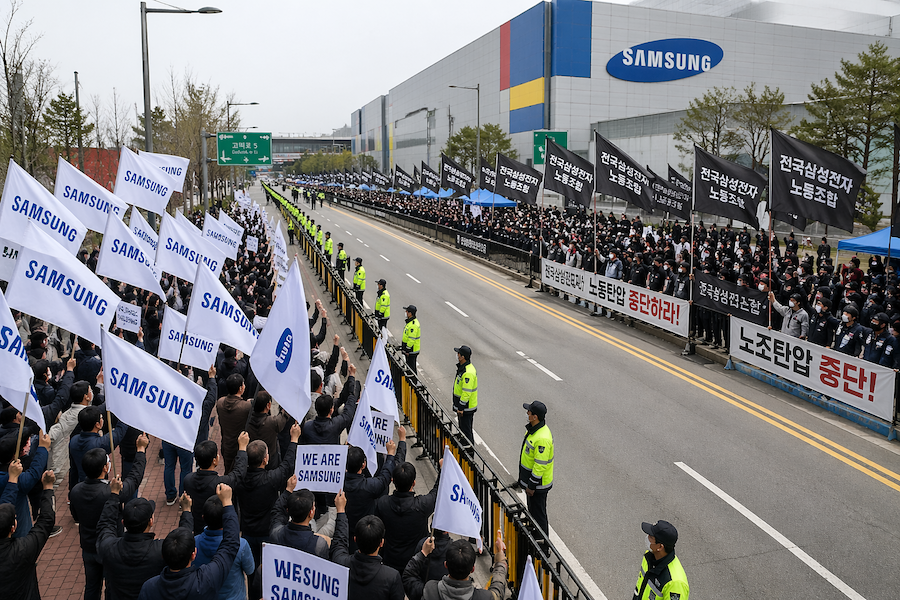
On April 7th, Samsung Electronics released its preliminary financial report for the first quarter of 2026. Operating profit reached 57.2 trillion Korean won, a 755% increase year-on-year, marking the company's best quarterly performance since its founding. However, this impressive report directly ignited conflict between labor and management.
Following the earnings report, the Samsung National Union increased its performance bonus demand from 10% to 15% of operating profit. It is estimated that the Samsung Semiconductor division's annual operating profit will be approximately 270 trillion Korean won. At a rate of 15%, the corresponding bonus amount would be as high as 40.5 trillion Korean won.
This amount not only exceeds Samsung's 37.7 trillion Korean won in total R&D investment for 2025 but is also significantly higher than the 11.1 trillion Korean won in total dividends distributed to 4 million shareholders that year.
In response to the union's strong stance, Samsung shareholders plan to hold an "anti-strike" rally at 10 a.m. on April 23rd on the pedestrian walkway at 5, Gode International Road, Pyeongtaek City, Gyeonggi Province. The rally location is directly across the street from the union's general strike rally. Anyone holding at least one share of Samsung Electronics stock is eligible to participate in the rally.
The rally organizers emphasized, “Faced with the reckless demands of Samsung Electronics employees for 400 billion Korean won in bonuses and the closure of the world’s leading semiconductor factory, 5 million Samsung Electronics shareholders have stepped forward.” They added, “Samsung’s current standing in the world is not only due to management and employees, but also to the consistent support and encouragement of us shareholders.”
“In this ‘bonus feast,’ we, the 5 million shareholders and true owners, have been completely marginalized. We can no longer entrust Samsung entirely to management or employees. Now, shareholders will work together to protect Samsung.”
Market analysts bluntly state that the average annual salary of Samsung Semiconductor division employees is already 150 million Korean won, and this strike is a collective act of selfishness. This demand lacks social persuasiveness and could also trigger a sense of relative deprivation among employees in other divisions such as DX. Lee Chan-hee, Chairman of the Samsung Compliance Committee, also publicly urged caution, stating that Samsung, as a “national enterprise,” the union should act more prudently, and warned against any illegal coercion.
Industry insiders warn that if this strike crisis is not properly resolved, it could have a disastrous impact on the global technology industry. Approximately 55,000 of the Samsung National Union’s over 70,000 members belong to the DS division of the semiconductor business. Once the strike begins, nearly half of the production capacity in the Pyeongtaek campus could be affected, leading to a chain of supply disruptions for power management chips and display driver chips. Samsung’s market share in DRAM could also be eroded by Chinese companies, and the first-mover advantage in the HBM market could fall into the hands of the American Micron.
With the global semiconductor market currently in fierce competition, supply chain stability is crucial for Samsung to maintain the trust of its overseas customers. This labor dispute not only affects Samsung’s subsequent R&D investment and expansion plans but also severely tests the crisis management skills of Chairman Lee Jae-yong, and his efforts to break the deadlock have become the focus of attention in the global technology community.