Tesla's Q1 2026 Report: Deliveries Exceed 358,000 Units, Up 6.5% YoY
On April 23rd, Tesla released its Q1 2026 financial report. Global production of pure electric vehicles exceeded 408,000 units, a year-on-year increase of 12.7%; deliveries exceeded 358,000 units, a year-on-year increase of 6.5%. Total revenue was $22.4 billion, a year-on-year increase of 16%.
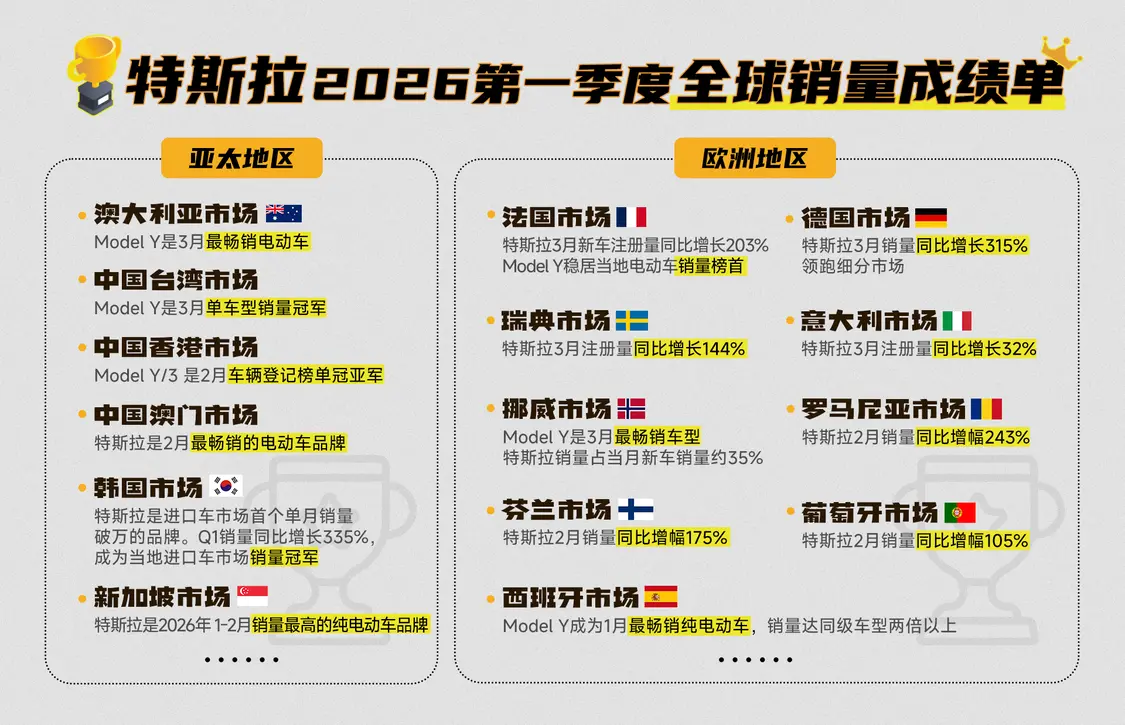
Shanghai Super Factory delivered 213,000 vehicles in the first quarter, a year-on-year increase of 23.5%; domestic sales in March exceeded 56,000 units, a month-on-month increase of 47%, with the Model Y being the sales champion for passenger cars in China. The Model Y has remained the global best-selling model for three consecutive years, with cumulative sales exceeding 4 million units; the Model Y L, a six-seat luxury SUV led by China in design, has been launched in multiple markets in the Asia-Pacific region. The Berlin factory produced over 61,000 vehicles in the first quarter, reaching a new historical high.
In terms of intelligent assisted driving, there are nearly 1.3 million paid users globally, with cumulative mileage exceeding 15.1 billion kilometers, of which over 5.42 billion kilometers are on urban roads. In the United States, Tesla vehicles with intelligent assisted driving enabled have an average of 8.53 million kilometers of safe driving before a major collision, more than 8 times the average level of US roads. Version V14.3 has been rolled out in North America, reducing inference latency by up to 20%; Musk stated that V15 is expected to be released from the end of this year to early next year, and the driverless version of FSD is expected to be gradually launched in the fourth quarter. Tesla has received approval for intelligent assisted driving in the Netherlands in April.
Robotaxi Business: Paid mileage in the first quarter almost doubled month-on-month. In February, the first mass-produced Cybercab autonomous electric vehicle rolled off the production line at the Texas Super Factory. The service area has been expanded to Houston and Dallas, Texas, and safety drivers have been removed, with the operating vehicles equipped with AI 4 hardware. Previously operated Austin and the San Francisco Bay Area are still expanding. Plans are to launch in five cities including Arizona, Florida, and Nevada in the first half of this year, and expand to more than ten states by the end of the year.
Humanoid Robot: Preparations for the first large-scale humanoid robot factory will begin in the second quarter, with the first-generation production line designed for an annual capacity of 1 million units, replacing the Model S/X production line at the Fremont factory; the second production line at the Texas factory will have a long-term annual capacity of 10 million units, expected to be put into production next summer. The third-generation humanoid robot is expected to debut in mid-2026, using the latest hand design and appearing closer to humans. Currently, hundreds of robots are deployed in factories for learning.
Computing Power and Chips: The final design of the next-generation AI 5 inference chip has been completed, which Musk calls "the most outstanding AI inference chip in the edge computing field," and the design of AI 6 has begun. The TERAFAB project has been released, with an expected annual computing power output of over 1 terawatt; a research and development wafer factory will be built at the Texas Super Factory, with an investment of approximately $3 billion. The Cortex 2 computing cluster has been put into operation. Dojo 3 self-developed chips are continuously advancing.
Energy Storage: The energy storage super factory in the Houston suburbs is progressing smoothly, and will produce the third-generation Megapack, which will be mass-produced later this year. Energy storage gross margin in the first quarter exceeded 39.5%, with installed capacity of 8.8 gigawatt-hours, and annual installed capacity is expected to be higher than in 2025. Tesla has begun deploying self-designed solar panels, equipped with 18 independent power zones.
Charging Network: Globally, there are over 80,000 Superchargers and over 8,000 Supercharging stations, with an availability rate of 99.95%. 2,200 were added in the first quarter, a year-on-year increase of 19%. A one-time construction of 55 Supercharging stations was completed in the Chongqing highway service area, which is Tesla's largest highway service area project in China. The number of Supercharging stations in mainland China has exceeded 2,600, with over 12,000 piles, and over 1,000 have been opened to non-Tesla vehicles. V4 Supercharger cabinets are being produced at the New York factory, with a power output three times that of V3.