Suspected Manipulation of Paris Weather Temperature Sensors for $34,000 Profit on Polymarket Prediction Market
A cryptocurrency-based prediction market, Polymarket, allows users to make predictions and profit based on outcomes. Recent anomalies in temperature data from Paris's Charles de Gaulle Airport coincided with successful predictions on Polymarket, leading to payouts of $34,000 and raising concerns about potential manipulation.
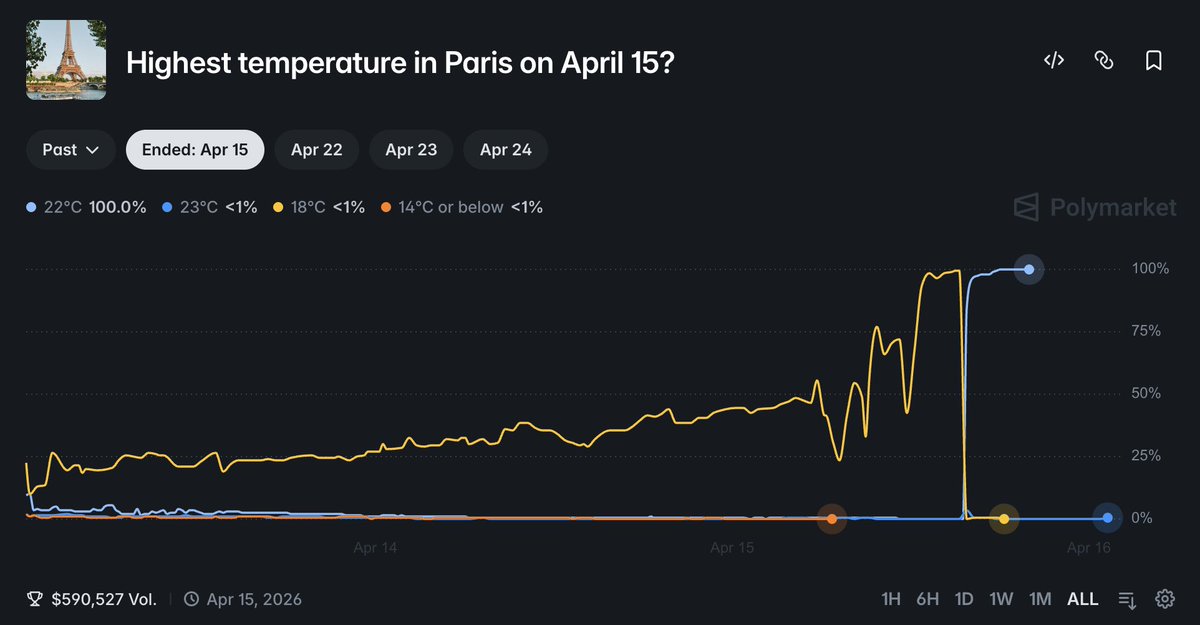
For example, someone could propose a prediction event: the temperature at Charles de Gaulle Airport on April 25th at 23:00, and attract others to invest. When France releases official meteorological information, Polymarket will determine which users predicted correctly and can receive prediction profits.
Abnormal Temperature Data at Charles de Gaulle Airport:
On April 6th and 15th, 2026, the French Meteorological Service detected two temperature sensor anomalies at Charles de Gaulle Airport in Paris. The temperature sensors at Charles de Gaulle Airport are one of the monitoring stations used to monitor Paris's temperature, and the data from these stations is ultimately aggregated to generate the temperature for Paris.
The first anomaly occurred on April 6th at 18:30, when the sensor at Charles de Gaulle Airport recorded a temperature increase of 4 degrees Celsius in just 12 minutes, briefly reaching 22.5 degrees Celsius before returning to normal.
The second anomaly occurred on April 15th at 21:30, when the sensor recorded a temperature spike to 22 degrees Celsius under partly cloudy skies, and then returned to normal within minutes.
During these anomalies, data from other monitoring stations around Charles de Gaulle Airport remained normal, and there were no abnormal changes in wind speed or relative humidity. Therefore, industry experts believe the most likely cause of the anomaly is someone placing a heating device near the sensor.
Many netizens on social media speculated that the cause of the abnormal temperature change was a hair dryer or lighter. Of course, this is just a joke, after all, this monitoring station is located at the end of a public road, and any heat source can quickly warm the sensor.
Polymarket Pays Out $34,000 in Successful Prediction Winnings:
Post-investigation revealed that during the two temperature sensor anomalies at Charles de Gaulle Airport, there were successful prediction events on the Polymarket prediction market, for which Polymarket paid out $34,000 in winnings to successful predictors.
The first was on April 6th, when someone predicted that the temperature in Paris would reach 21 degrees Celsius. This prediction was the closest to the actual temperature and received a reward of $14,000. This account was newly created just before placing the bet, and was not an old account.
The second was on April 15th, when another bettor with a different account predicted that the temperature in Paris would reach 22 degrees Celsius and received a reward of $20,000. Currently, users have filed complaints to Polymarket regarding these anomalies, alleging manipulation and insider trading.
More Abnormal Weather Data May Appear:
It is worth noting that the number of temperature data anomalies in cities and locations around the world, especially well-known ones, has increased compared to before. These anomalies are likely due to the Polymarket prediction market, where someone bets, someone buys insiders, and then manipulates or modifies meteorological data to profit.
News circulating on social media claims that some meteorological departments have insiders to help predictors modify data, and that the weather results are artificially tampered with in the last few minutes before the prediction ends to ensure that bettors can win and profit.
This practice is actually difficult to trace, as small fluctuations in weather data over short periods of time are usually not considered a major problem. Currently, the number of artificially modified data is still relatively small and will not have a significant impact on the overall data.
However, if Polymarket does not prohibit predicting the weather, it is estimated that such weather anomalies may increase significantly in the future. Long-term manipulation of results may also lead to deviations in overall weather data, which could have unpredictable potential consequences.