Kioxia Releases EG7 Series SSDs Based on QLC Particles, with Performance Comparable to TLC SSDs
Memory manufacturer Kioxia recently launched the EG7 series of solid-state drives, all of which use QLC flash memory particles. However, Kioxia claims that this SSD's performance is fully comparable to TLC SSDs, with sequential read speeds reaching 7,000MB/s.
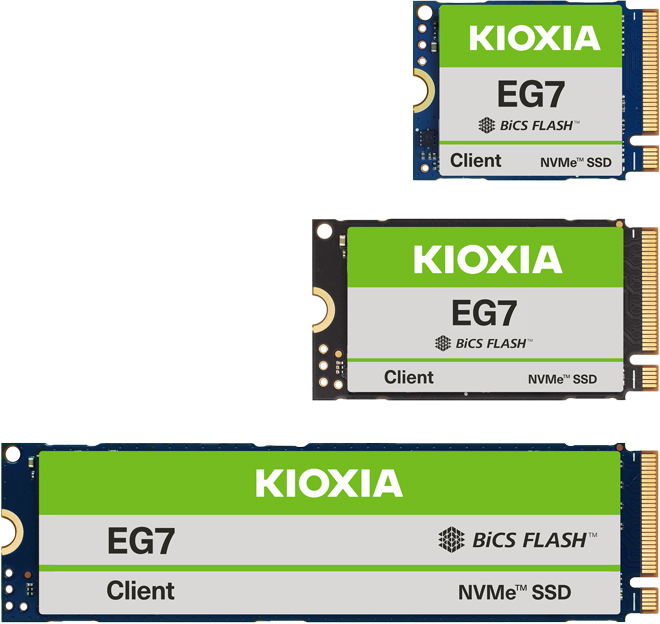
However, this SSD is surprisingly not equipped with a cache, which may be to save costs, as the EG7 SSD is primarily aimed at the consumer market. Kioxia has already supplied to several OEMs for building thin and light laptops and desktops, among other products.
In terms of performance, the EG7 SSD offers a sequential read speed of 7000MB per second, a sequential write speed of 6,200MB per second, and random read/write performance of up to 1000K IOPS. It is available in capacities of 512GB, 1TB, and 2TB, and in form factors of M.2 2230, 2242, and 2280, making it compatible with a variety of traditional laptops, desktops, mini PCs, and even handheld gaming consoles.
Laptops or desktops equipped with these SSDs will be available soon. If users are concerned about the lifespan of QLC flash memory particles, they can check the SSD parameters or model number when purchasing related products to avoid buying a model equipped with the EG7 series SSD.
In fact, there is already no better choice for consumers, as SSD prices are also gradually increasing. If users insist on purchasing TLC SSDs, they will need to pay a higher price. Ultimately, it comes down to budget. If the budget is high enough, they can naturally continue to use TLC SSDs.
Kioxia also emphasized that as large technology companies and hyperscale data centers continue to procure storage products, this will also lead to a gradual increase in SSD prices. Therefore, consumers may find it difficult to purchase a 1TB SSD for less than $50 in the future, and the price of high-capacity, high-performance SSDs may be even higher. Therefore, users must consider and balance performance, efficiency, and cost, and this also means that consumers may need to spend more money to purchase smaller-capacity SSDs in the future.