China’s First Native Lunar Meteorite Reveals Key Geological Events
On World Earth Day 2026, the Ministry of Natural Resources China Geological Survey announced the latest research findings on the “Pakepake005” meteorite. Discovered in the Taklamakan Desert in Xinjiang in 2024 and approved by the Nomenclature Committee of the Meteoritical Society, it is confirmed as lunar breccia, filling the gap in the discovery of lunar meteorites in China.
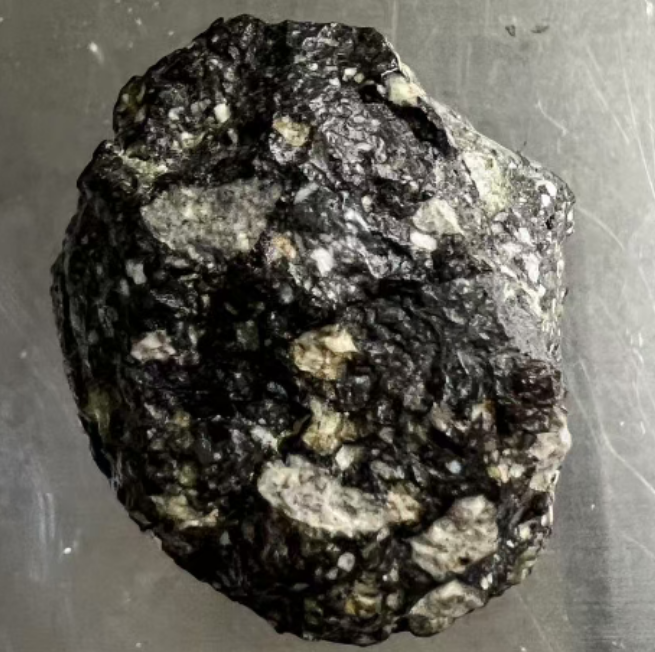
Research shows that this meteorite records at least two key geological events in the Moon’s evolution: one is the famous Imbrium Basin impact event approximately 3.92 billion years ago, which profoundly reshaped the lunar landscape.
The other is the eruption of very low-titanium basalt magma approximately 3.49 billion years ago. This special volcanic eruption indicates that the Moon’s interior was still very hot and volcanic activity was frequent at that time.
Even more remarkable, a new mineral – “Cerenium Magnesium Chang’eite” – was also discovered in the meteorite. This mineral has been approved by the International Mineralogical Association’s review vote, becoming the 11th new lunar mineral discovered by humans, and the third new lunar mineral discovered in lunar meteorites.
The formation process of lunar meteorites is quite “thrilling”: when the lunar surface is hit by violent impacts from asteroids and other celestial bodies, some rocks are “knocked” off the Moon, drift in space, and eventually fall to Earth. Various lunar materials undergo fragmentation, mixing, and re-cementation to form composite rocks, faithfully recording the evolutionary history of the Moon at different stages and from different sources.
Unlocking the secrets contained within this 44-gram meteorite was inseparable from China’s domestically produced high-resolution secondary ion mass spectrometry (SIMS) instrument. This equipment broke the foreign technology monopoly and achieved surpassing performance. “It’s like giving rocks a CT scan, allowing precise acquisition of internal chemical information without dissolving the sample, and high-precision analysis of almost all elements and isotopes.” Che Xiaochao, an associate researcher at the Planetary Science Research Center of the Institute of Geology, Chinese Academy of Geological Sciences, introduced that the instrument is also widely used in semiconductors, new energy materials and other fields.