What Happens If You Cover a Seal's Whiskers? Scientists Actually Did It
Seals have large eyes and beautiful whiskers, but these whiskers are not merely decorative; they are tools for efficient hunting. Seals typically live in coastal waters, which are often murky due to tides and storms. For seals to hunt in murky water, their vision struggles to clearly see prey activity, leading scientists to hypothesize that they use their whiskers to sense prey.
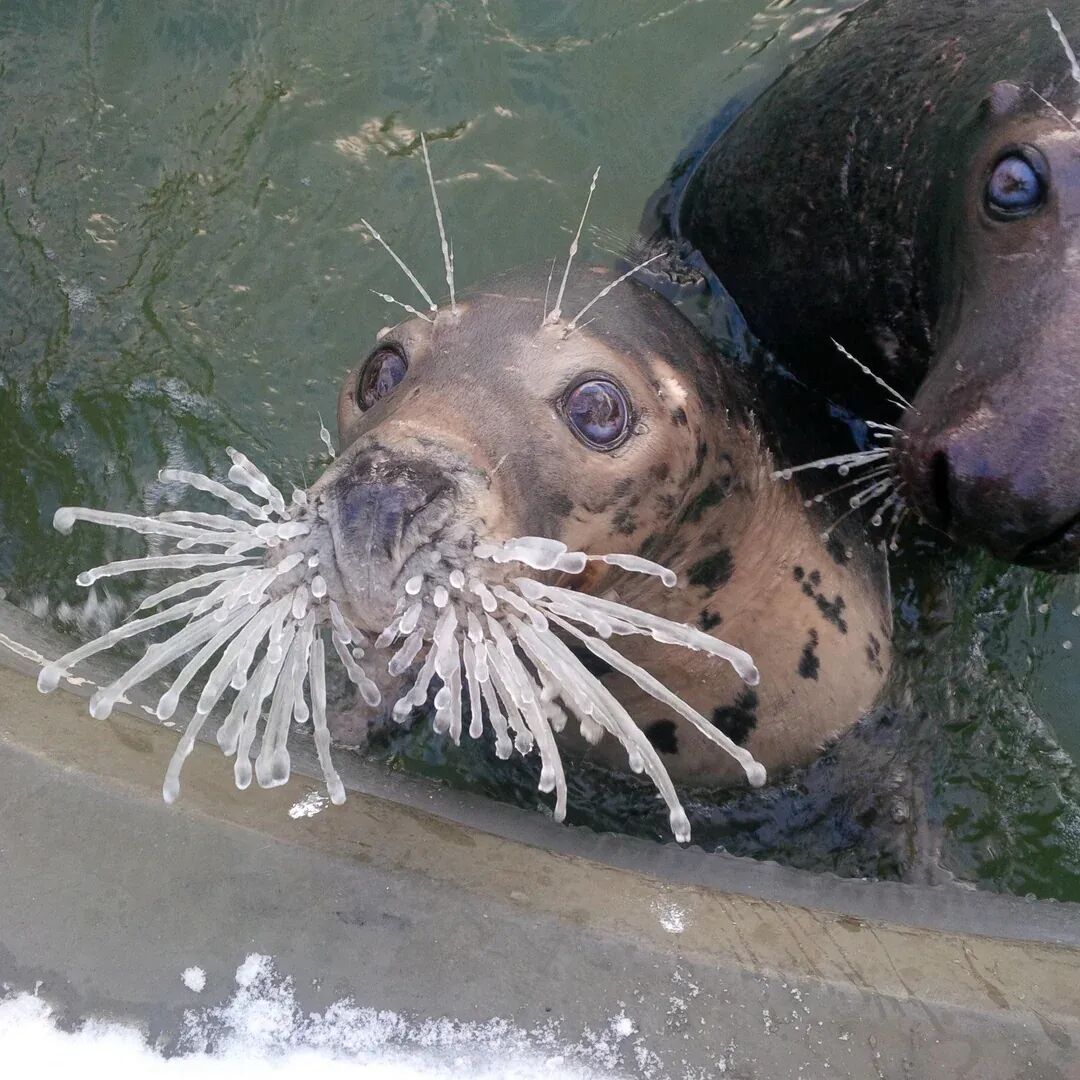
Many studies have already confirmed the role of seal whiskers in hunting, but recent research has reaffirmed this and revealed that seal whiskers are far more sensitive than previously imagined!
The study was led by Yvonne Krug, a biologist at the University of Rostock in Germany, and her subject was a male harbor seal named Philu (Phoca vitulina).
[Image of harbor seal Philu]
Yvonne lived with this harbor seal for two years, constantly training him to choose the smaller of two artificial underwater vortices.
You might wonder why she trained the seal to identify vortices.
This is because swimming fish create vortices as they move their tails, and seal whiskers likely identify these disturbances to determine the fish's direction of movement.
Some fish have an incredible fast escape reflex when threatened, twisting their bodies into a C-shape and then propelling themselves away at high speed, known as the "C-start response."
One of the harbor seal's main prey, the trout, uses the "C-start response" to evade predators.
This evasive swimming behavior causes the trout to create two vortices of different sizes underwater, and it always moves towards the smaller vortex.
Yvonne wanted to know if harbor seals could identify these two vortices of different sizes. If they could, it would mean the trout's deceptive evasion tactic is ineffective against harbor seals.
So, she trained Philu to recognize artificial vortices.
It turned out that harbor seals indeed have this ability.
Under her training, Philu learned to distinguish between vortices of different sizes, even when the size difference was less than the width of a human thumb. In reality, the size difference between the two vortices created by the trout's "C-start response" is much larger than this.
Furthermore, to confirm that the seal was indeed using its whiskers to make this judgment, Yvonne conducted an experiment where she covered Philu's whiskers with nylon stockings. As a result, Philu lost the ability to identify the size of the vortices, proving that seals do use their whiskers to distinguish them.
Why can seal whiskers identify vortices?
Human whiskers have become largely unnecessary, and even why human whiskers haven't disappeared like hair in other areas of the body often requires scientific papers to explain.
However, the whiskers of many other mammals are different; they are very sensitive and can be used to sense or observe objects because the roots of these hairs are filled with nerve endings.
Therefore, seal whiskers simply inherit the tradition of mammals, with the unique aspect being that they remain sensitive even underwater. This may be related to several factors.
For whiskers to capture vibrations caused by animals in the water, they must filter out many disturbances caused by the water itself.
[Image illustrating whisker movement in water]
When seals swim underwater, their whiskers aren't flattened against their bodies but stand upright, helping them capture vibrations.
On the other hand, the whiskers of most mammals are regularly shaped, while seal whiskers are completely irregular—almost all seal species have wavy whiskers.
[Image comparing harbor seal and California sea lion whiskers]
Research suggests that this shape helps them maintain stability while swimming and avoid water flow interference, allowing them to better capture vibrations from living creatures.
[Image of a blind seal nursing its offspring]
Finally,
Seal whiskers may be more useful than their eyes, as there have been cases of blind seals successfully raising offspring both in captivity and in the wild.
Reference:
[1].https://doi.org/10.1242/jeb.249258