Future MacBooks May Replace "Notch" with Detachable Cameras and Rotatable Screens
A recently published patent application reveals Apple is exploring redesigning the camera and screen structure for future MacBooks, including a detachable camera module that "extends" from the body, and even a rotatable and detachable display, to replace the current screen "notch" design.
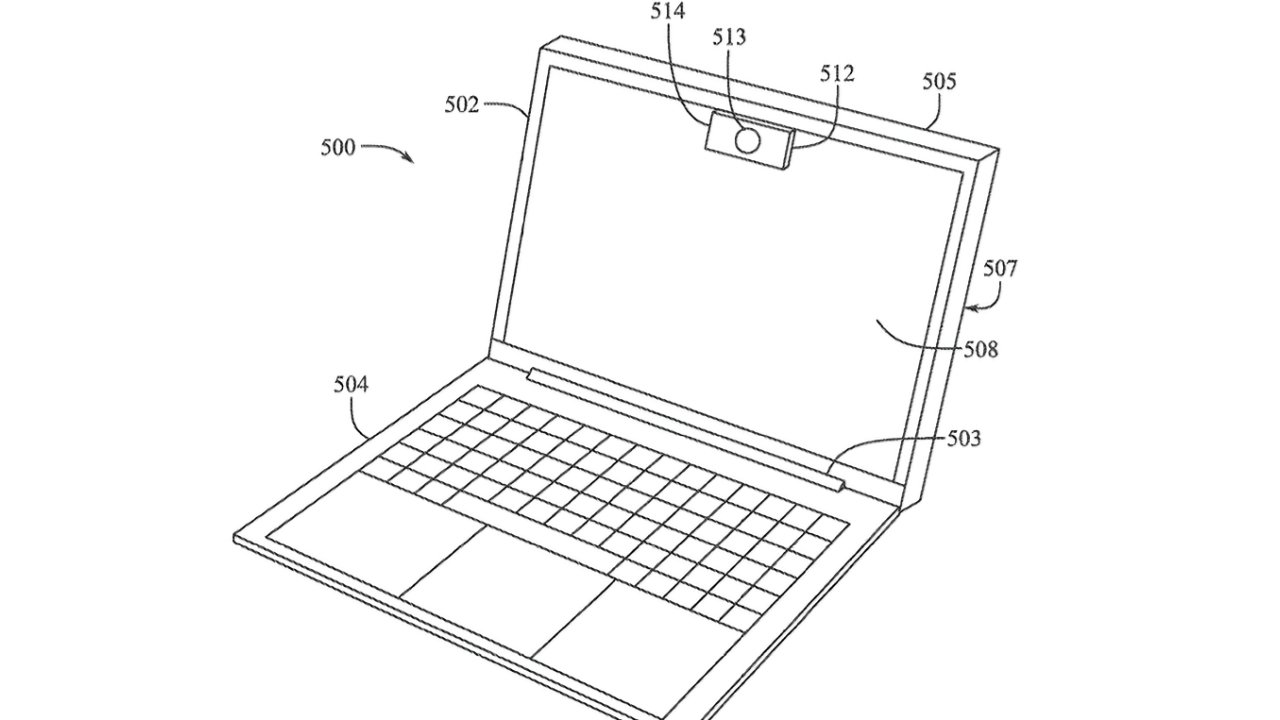
Currently, the FaceTime camera on the MacBook Pro is often considered inferior to the iPhone. It’s difficult to fit a larger, more complex camera module into the same ultra-thin screen, which is also seen as a major limiting factor in Apple’s reluctance to introduce Face ID to laptops.
According to a patent document titled “Camera integration for portable electronic devices,” Apple isn’t continuing to focus on “thinning” but is instead shifting to prioritize the volume and performance needs of the camera system. Patent drawings show the new camera module can be no more than about 3 millimeters thick, but will protrude noticeably from the surface of the MacBook Pro’s lid. Apple describes in the patent multiple times that the camera module can be positioned in the notch location at the top of the display component, or moved to the side of the screen, or even detached from the front and fixed to the back of the screen.
The patent describes the “optical component” being fixed to the body or display component via “retaining components” such as magnets, enabling detachable and repositionable installation. The document also frequently mentions communication scenarios between multiple camera modules, such as one camera facing the user from the front of the screen and another shooting outward from the back of the screen. This means future MacBooks may be able to achieve front and rear dual shooting on a single device, similar to the simultaneous front and rear recording feature once demonstrated on the iPhone 11, but this time on a laptop form factor.
This design offers more imagination in video conferencing or interview scenarios. For example, users can participate in meetings via the built-in camera in front of the keyboard, while using the module on the back to capture the interviewee or the conference room environment. However, from the existing patent description, there are still many questions about the actual composition and user experience of “simultaneous front and rear shooting,” such as whether the relative positions of different participants to the screen and the viewing angles are natural enough.
In addition to the camera itself, the patent further touches on structural changes to the display portion. The application document mentions that such portable devices can adopt a design “comprising a base portion including an input component, and a display portion rotatably connected to the base portion.” This means users can install an additional camera module on the back of the MacBook Pro and obtain a suitable shooting angle by rotating the entire display portion; or install the module on the front and use the built-in LiDAR or other sensors by rotating the screen.
A more radical idea is that the display portion can not only rotate around an axis, but also be completely detached from the body, flipped, and then reinserted. In this scheme, the MacBook’s lid is similar to a pluggable display panel that can be used as a traditional laptop screen in the forward direction, or flipped to serve as another display mode, or even form a more flexible combination with the keyboard base. The patent itself does not delve into more applications of the “configurable screen or keyboard unit,” but only reserves space for this detachable and flip structure.
It is worth noting that this application is not Apple’s first foray in this direction. In 2024, Apple submitted patent content that looked almost identical, and had previously obtained related patent authorizations. In the eyes of outsiders, repeated applications may be related to legal or procedural requirements, but at least it shows that Apple is still continuously promoting this idea, rather than a one-time technical exploration.
Unlike many concepts that only stay on paper, this patent does not spend much space discussing the “selling points” of rotating or detaching the screen at the specific use level, but focuses on how to introduce larger and more diverse camera and sensor modules into the MacBook under the existing ultra-thin body constraints. Theoretically, once the screen structure can rotate or even detach, the bending loss problem caused by internal wiring can be partially solved through wireless display and other methods, and future wireless extended screen experiences similar to Sidecar may also be integrated into the MacBook body in a more independent form.
This patent application lists four inventors, including Keith J. Hendren, who participated in the design research of “building an iMac with a single piece of glass,” once again demonstrating that Apple’s radical exploration of the overall structure and material application is still ongoing. Whether the detachable camera and rotatable, flipable screen can actually enter mass-produced MacBooks remains to be seen, but from the constantly emerging related patents, the future of Mac laptops in form and interaction may be far more than just digging a “notch” in the screen.