OpenAI Launches GPT-5.5, Codenamed "Spud," a More Powerful AI Model for Enterprises
OpenAI officially released its most powerful large model to date, GPT-5.5, internally codenamed "Spud," this Thursday, just one week after its competitor Anthropic launched its latest model. This release is seen as a significant milestone in the development of artificial intelligence, marking the acceleration of more efficient and powerful general intelligence systems towards practical application scenarios.
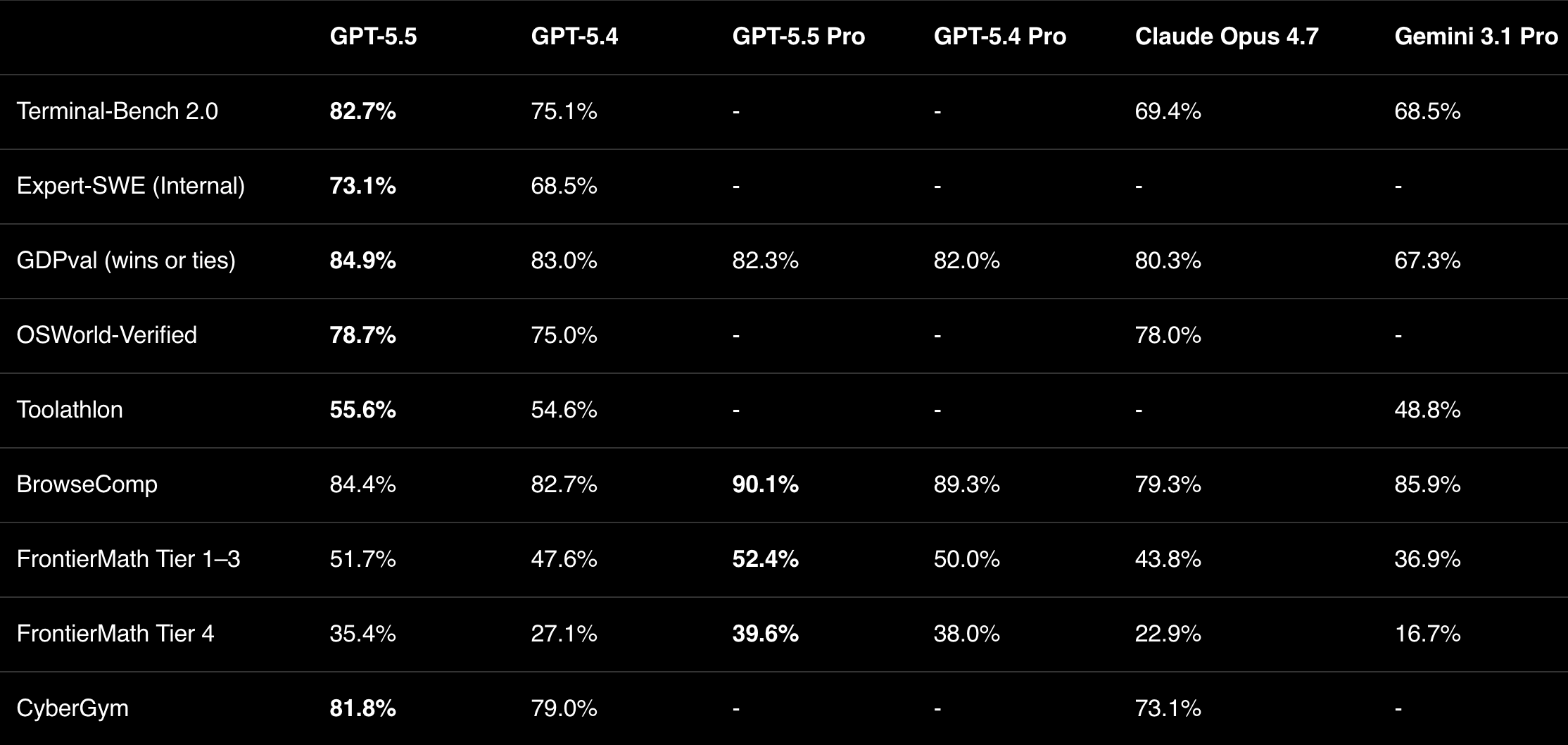
OpenAI co-founder Greg Brockman stated in a media briefing that GPT-5.5 represents a “completely new class of intelligence” and is an important step towards more autonomous and intuitive computing forms. He said that compared to the previous generation GPT-5.4, GPT-5.5 is a “faster, more discerning thinker that also consumes fewer tokens,” capable of completing complex workflows with less human intervention and more autonomy in multi-step task processing. Despite a significant leap in overall capabilities, OpenAI says that GPT-5.5’s response speed remains roughly the same as GPT-5.4 in real-world usage scenarios.
In terms of product release pace, GPT-5.5 has been available to paying users on ChatGPT and Codex since Thursday, and the API interface will be gradually opened after OpenAI completes the deployment of additional network security protection measures. OpenAI stated that the performance improvements brought about by this model upgrade are particularly evident in areas such as code writing, computer operation, general office work, and preliminary scientific research, which require long-context reasoning and continuous execution of tasks. Unlike the past where users needed to gradually break down prompts, users can now directly present GPT-5.5 with complex requirements that are structurally chaotic and contain multiple sub-tasks, allowing the model to independently plan steps, call tools, self-check results, and continue to advance until a usable conclusion is produced.
Teams that have gained early access have used GPT-5.5 to validate creative work with “emotional coloring,” review an additional thousands of documents in bulk, and save up to 10 hours of time per week. In terms of underlying computing power, GPT-5.5 continues OpenAI’s previous practice of training models using NVIDIA GPUs. Some NVIDIA employees have participated in a weeks-long test of the model, and subsequently all NVIDIA employees will also gain access.
Justin Boitano, Vice President of Enterprise Computing at NVIDIA, told Axios that GPT-5.5 can play a role similar to a “chief of staff” within enterprises, providing capabilities to AI agents already running as “digital employees” within NVIDIA. He revealed that NVIDIA and OpenAI have jointly developed a “blueprint” aimed at helping various enterprises more easily deploy such models within their own business systems. NVIDIA said that its new generation of chips can reduce the cost of running advanced AI models such as GPT-5.5 by up to 1/35 per token, a metric that is crucial for companies looking to scale AI usage without letting IT budgets spiral out of control.
At a more macro level, Brockman pointed out that humanity is moving towards a “computing-powered economy,” where future work will increasingly rely on AI capacity, making computing power itself the core foundation of the economic system. For OpenAI, a current key concern is whether the release of GPT-5.5 can further promote the adoption of enterprise users, which is also closely related to its recent strategic shift. Previously, OpenAI executives described the rapid rise of competitor Anthropic as a “red alert” and “wake-up call,” and took this as an opportunity to more clearly shift the company’s strategy towards business landing for enterprise customers.
As more and more AI systems begin to take on longer and more complex tasks, the economics of running these systems is becoming as important as the model’s capabilities themselves. Under the interplay of NVIDIA’s cost reduction technology, OpenAI’s model iteration, and enterprise demand, the new round of competition around large model capabilities and computing costs is becoming a key variable in reshaping the global technology and business landscape.