Intel Foundry Business Sees Yield Improvements Across the Board, Boosting Efficiency at Intel 4, Intel 3, and 18A Nodes
Following the release of its 2026 Q1 results, Intel disclosed that its foundry business is experiencing positive changes. Yields have improved across key process nodes – Intel 4, Intel 3, and 18A – which are now in mass production, indicating an improvement in the manufacturing foundation supporting Intel's current product portfolio.
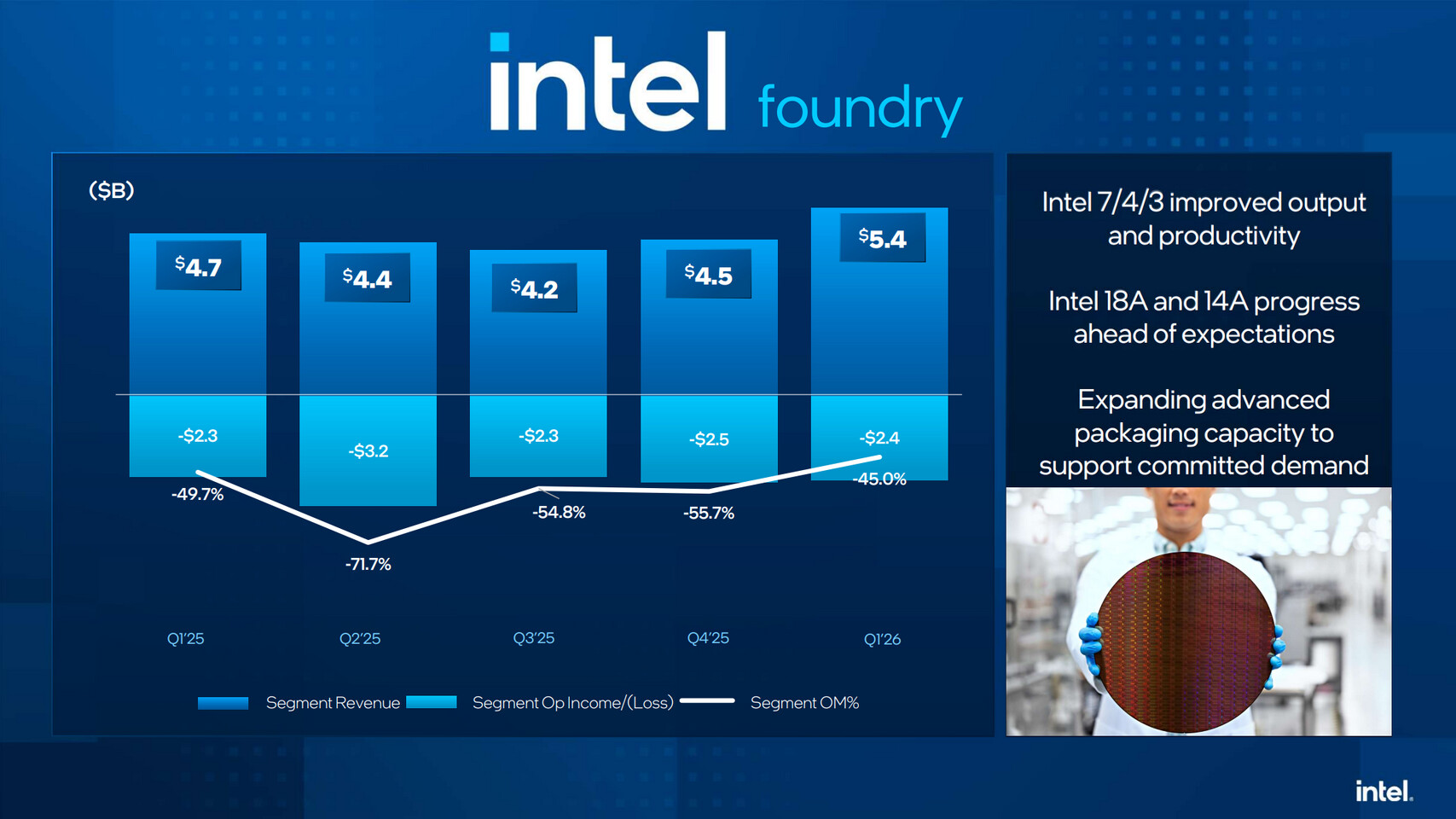
Reports indicate that Intel delivered strong overall performance this quarter, with operational improvements in both the Intel Product and Intel Foundry departments. The progress of the foundry business is particularly noteworthy, as simultaneous yield improvements across all major production nodes are considered a significant milestone.
During the 2026 Q1 earnings call, Intel CFO David Zinsner stated that the company continues to improve yields for more mature nodes like Intel 4 and Intel 3, while also optimizing the currently strongest 18A node to reduce manufacturing waste and increase the number of usable chips, particularly improving yields for large-sized chips.
According to David Zinsner, Intel Foundry’s operating loss in the first quarter was $2.4 billion, an improvement of $72 million quarter-over-quarter, primarily due to improved yields at Intel 4, Intel 3, and 18A nodes, which drove gross margin improvements. However, this improvement was largely offset by higher operating expenses, mainly due to Intel’s increased investment in the 14A node to support evaluations by internal and external customers.
He also stated that Intel Foundry currently bears the majority of the costs for the early ramp-up phase of the 18A process, and as 18A moves towards larger-scale mass production and yields continue to improve, Intel expects the foundry business’s operating loss to continue to improve throughout the year. In addition, Intel Foundry’s actual output this quarter exceeded company expectations, yields continued to improve steadily, and several key milestones for the 14A node were completed.
From an industry observation perspective, this indicates that Intel’s plan to revive its foundry business is at least gradually getting on track at the manufacturing execution level, and yield improvement is just one part of it. The report also mentioned that Intel has secured Tesla as the first major customer for the 14A node, but details of the cooperation remain limited.
In addition to yield improvements, Intel’s other key task at present is to continue updating the process design kits (PDKs) for the 18A and 14A nodes. Reports show that the 14A node is currently at the 0.5 version PDK stage, and customers will only finalize production scale, design schemes and other specific requirements after the 0.9 version PDK is released, so Intel still has time to further refine this node.
The report believes that Intel is currently collaborating with customers and continuously incorporating customer feedback into the node design optimization process. As 18A further ramps up and 14A development continues, whether Intel Foundry can narrow its losses by simultaneously improving yields, customer resources, and process maturity will remain a key focus of the market.