Jupiter's "Invisible Superstorms" Release Extremely Powerful Lightning, Potentially Hundreds of Times Stronger Than Earth's
A new report from a research team at the University of California, Berkeley, reveals that some storms on Jupiter, the largest planet in the solar system, are releasing incredibly powerful lightning, potentially 100 times stronger, or even more, than lightning on Earth. Based on data from NASA's Juno probe, these findings provide important clues for understanding Jupiter's extreme weather systems and the convective mechanisms in planetary atmospheres.
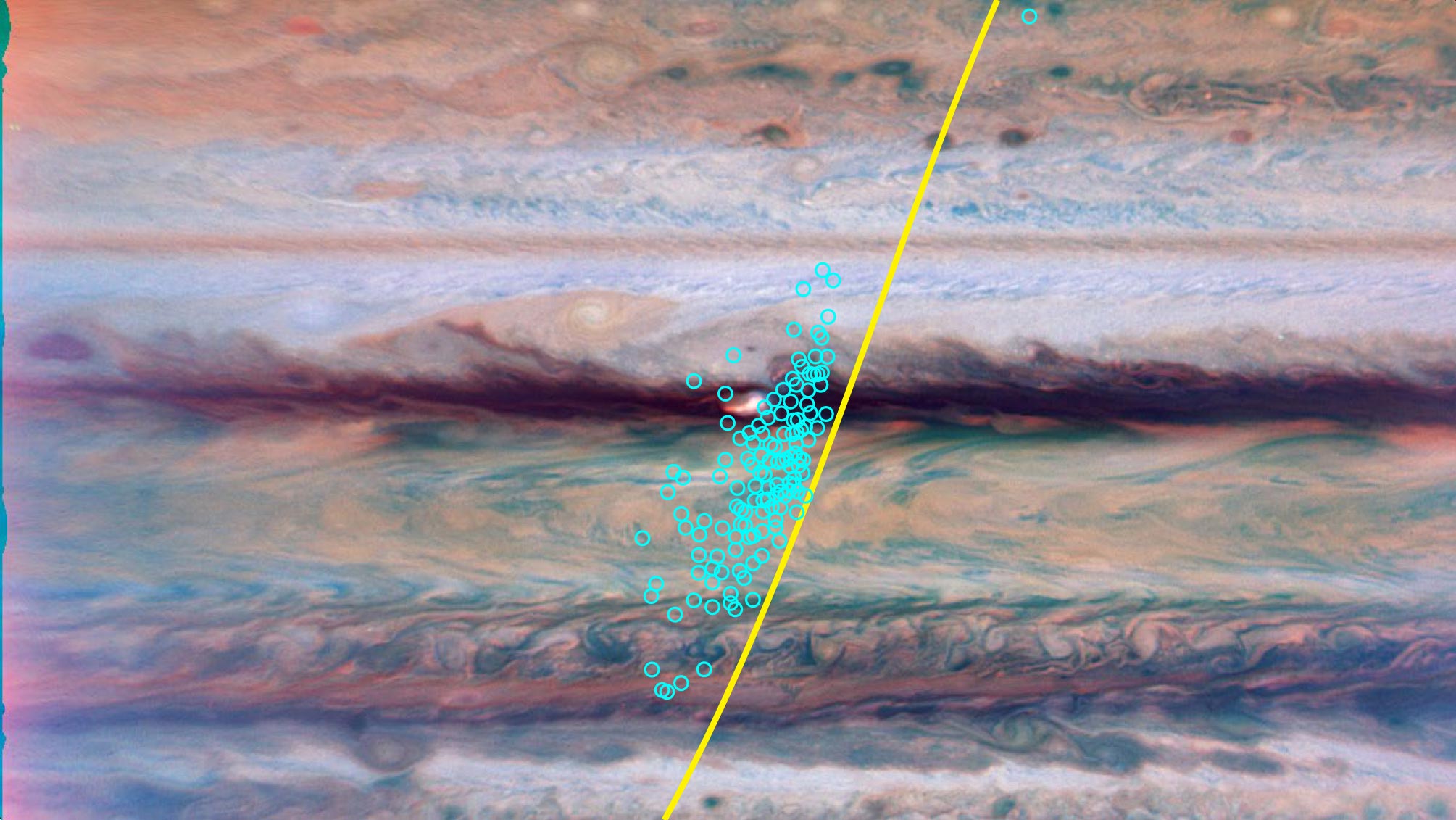
This research is based on observational data collected during Juno's orbital period around Jupiter since 2016. The probe is equipped with a microwave radiometer that captures radio signals emitted by lightning, working on a similar principle to how lightning interferes with radio communication on Earth, but detecting microwave signals at the high-frequency end of the radio spectrum.
Researchers say that studying lightning phenomena outside of Earth not only helps to understand the weather processes of other planets, but also helps humans understand the many unknown thunderstorm activities in Earth's atmosphere. Michael Huang, planetary scientist at the Space Sciences Laboratory at UC Berkeley and first author of the paper, points out that over the past decade, the scientific community has identified various “Transient Luminous Events” above strong thunderstorms on Earth, including red sprites, jets, halos, and ELVEs – millisecond-level electrical phenomena, indicating that people still know very little about lightning itself.
On Jupiter, lightning is seen as an important window for observing atmospheric convection. Unlike Earth, Jupiter's atmosphere is dominated by hydrogen, and humid air is actually heavier in this environment, making it more difficult to rise. In contrast, Earth's atmosphere is mainly composed of nitrogen, and water vapor is lighter than the surrounding air, making it easier to rise and form convection. The research team points out that, for this reason, Jupiter's storms need to accumulate more energy during their development, and once they reach high altitudes, they may be released in a more violent manner, forming strong winds and extremely intense cloud-to-cloud lightning.
In fact, almost all spacecraft that have flown by Jupiter have detected lightning phenomena. Because Jupiter's night side is dark, early missions could usually only see the brightest flashes, which once led the scientific community to believe that Jupiter's lightning was much stronger than Earth's. However, this understanding was partially corrected when Juno's high-sensitivity star tracker discovered a large number of weaker flashes similar to those on Earth. Researchers also point out that relying solely on visible light observations of the night side can lead to misjudgments, as thick clouds can obscure some light, making lightning appear weaker than it actually is.
In contrast, microwave radiometers can penetrate clouds and are therefore considered more suitable for assessing the true intensity of lightning. However, Jupiter's atmosphere is wide, and multiple storms often occur simultaneously, making it difficult for researchers to accurately match a radio pulse to a specific storm; if the source of the flash cannot be locked, it is difficult to accurately calculate the energy of a single lightning strike.
A turning point came between 2021 and 2022. At that time, storm activity in Jupiter's North Equatorial Belt weakened, allowing the research team to combine observations from the Hubble Space Telescope, Juno's camera, and amateur astronomers to lock onto several isolated storm systems. Michael Huang calls these storms "invisible superstorms." These storms can last for months and reshape the surrounding cloud structures like larger superstorms, but their cloud tops are not as high.
During this observation window, Juno flew over isolated storms 12 times, 4 of which were close enough to detect microwave signals generated by lightning. The probe recorded an average of 3 flashes per second, and even captured 206 independent pulses during one flyby. In a total of 613 pulse samples, researchers estimated that the intensity of Jupiter's lightning ranged from equivalent to Earth's to more than 100 times stronger. The research team also emphasized that due to the inconsistent radio wavelengths used in different studies, there is still some uncertainty in this cross-planetary comparison; other studies have even speculated that Jupiter's lightning may be millions of times stronger than Earth's.
Regarding the conversion of total energy, Ivana Kolmašová, a space physicist at Charles University in Prague and the Czech Academy of Sciences, who participated in the study, pointed out that this process is very complex, because lightning releases energy in various forms, including radio waves, light, heat, sound, and chemical reactions. According to Earth standards, a single lightning strike typically releases about 1 billion joules of energy, enough to power 200 ordinary households for 1 hour. Michael Huang estimates that a single lightning strike on Jupiter could release energy equivalent to 500 to 10,000 times that of Earth's lightning.
Researchers believe that the formation mechanism of Jupiter's lightning is broadly similar to that of Earth, that is, rising water vapor condenses into water droplets and ice crystals, accumulates electric charge during collisions, and ultimately forms a large voltage difference and triggers discharge. However, the ice particles on Jupiter contain ammonia in addition to water, and the scientific community proposes a hypothesis: these components may combine to form "slush hail"-like "mushroom balls" that fall through the atmosphere, which may be closely related to the formation of lightning.
Although the new research provides clearer observational evidence, why Jupiter's lightning is so powerful remains a mystery. Researchers point out that stronger lightning means higher voltage, but it is still unclear whether the difference between Jupiter's hydrogen-dominated atmosphere and Earth's nitrogen-oxygen atmosphere plays a key role, or whether it is because Jupiter's storms are more than 100 kilometers high, far higher than Earth's approximately 10-kilometer thunderstorm systems, or whether Jupiter's wet convection needs to accumulate more heat before erupting. The team says that this field is still in an active research phase.
This research paper, titled "Power Distribution of Lightning Radio Pulses in Jupiter’s ‘Invisible Superstorms’ in 2021–2022," was published on March 20, 2026, in the journal *AGU Advances*, and the research was funded by NASA.