Is Chicken Bitten by a Cobra Truly More Delicious?
The belief that chicken bitten by venomous snakes tastes better is widespread, and a dish called "Snake-Bitten Chicken" once existed in southern China, where chefs specifically cooked chickens bitten by snakes. This article investigates whether this claim is true.
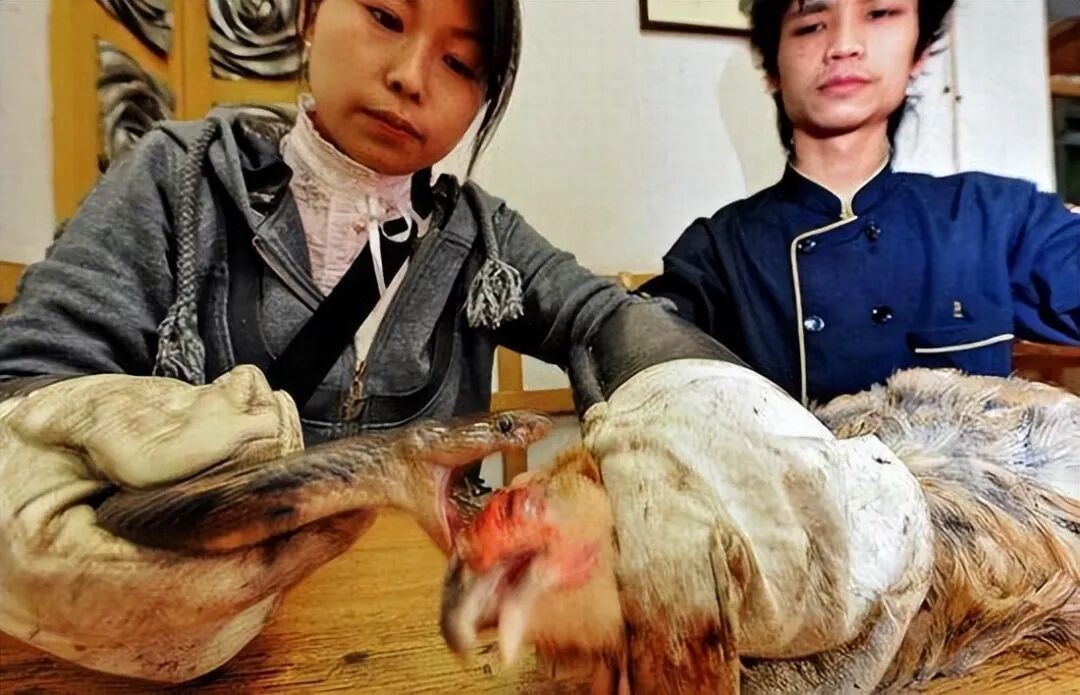
So, the interesting question is, does chicken bitten by a venomous snake really taste better?
There's a folk saying that snake venom has a similar function to meat tenderizer, and that chicken injected with snake venom becomes more tender, thus tasting better.
Let's debunk this claim – it's definitely wrong!
Snake venom may sometimes contain protein hydrolyzing enzymes that act like meat tenderizer, but snake venom is a complex mixture containing various enzymes and peptides. Most of these either have no effect on the meat or are far more destructive than meat tenderizer.
There are two main types of toxins in snake venom:
One is neurotoxic toxins, typically small molecules – peptides – that block the transmission of nerve signals. Being bitten by a snake with this type of venom usually doesn't cause significant pain, but symptoms like drooping eyelids and difficulty breathing appear as muscles and tissues become uncontrollable.
The other is hemotoxic toxins, typically large enzyme molecules that dissolve red blood cells, destroy blood vessel walls, and interfere with blood clotting, among other destructive effects. Being bitten by a snake with this type of venom causes intense pain, with severe symptoms like blackening, swelling, and decay appearing first at the bite site.
Vipers, such as the silver ring snake and cobra, typically contain more neurotoxins in their venom, while vipers like the five-step snake and bamboo leaf snake primarily contain hemotoxic toxins.
However, it's important to note that venomous snakes usually don't release only one type of toxin; they release multiple types simultaneously, with one type being more dominant.
Also, snake venom isn't limited to neurotoxins and hemotoxic toxins; there are many other types of toxins as well.
Many people are concerned about whether the meat of a chicken bitten by a snake is still safe to eat.
In fact, both peptides and enzymes are broken down and denatured by high temperatures and also by the digestive system. So, as long as there are no other symptoms (like decay), cooked meat from a snake-bitten chicken is definitely safe to eat.
Having briefly understood snake venom, let's discuss why snake venom isn't simply meat tenderizer.
Notice that in the phrase "chicken bitten by a cobra is the most delicious," the snake is specifically a "cobra."
Why not say that chicken killed by a five-step snake is delicious?
In fact, restaurants that make "Snake-Bitten Chicken" generally use cobras.
There's a reason for this!
As we mentioned earlier, cobras primarily release neurotoxins, and their venom may also contain some destructive enzymes, but in very limited quantities. Therefore, the impact of this type of venom on the meat itself is almost negligible.
Precisely because of this, chickens killed by these snakes look normal, which may be the real reason people dare to try eating them.
△ This is a wound from a bite by a silver ring snake (a cobra), and it doesn't look very serious externally.
The five-step snake, on the other hand, primarily releases hemotoxic toxins, containing a large amount of enzymes that destroy cells and tissues. These enzymes enter the bloodstream and destroy red blood cells and blood vessel walls, break down cell membranes, and damage muscles or other proteins.
When this type of venom spreads through the bloodstream, dissolved blood, liquids from inside cells, and liquids produced by protein hydrolysis are released into the gaps between muscles and tissues.
Chickens killed by this type of snake appear swollen, blackened, and even with a large pit at the bite site.
Furthermore, because these toxins quickly and thoroughly kill cells and destroy tissues, depriving them of immunity, wounds or a large area around them will be rapidly colonized by bacteria and begin to rot and smell.
Although hemotoxic toxins do contain some protein hydrolyzing enzymes that can degrade connective tissue in muscles like meat tenderizer, these enzymes are only a small part of the venom. The venom contains more enzymes that destroy cells and blood vessels, which don't simply make the meat tender but severely damage it.
Therefore, the meat of chickens killed by these snakes won't taste better; it will taste worse, and even look unpleasant. Most people probably wouldn't dare to try it, and restaurants wouldn't sell this type of "Snake-Bitten Chicken," or customers wouldn't pay for it.
(Interested friends can search for images of wounds from a five-step snake bite to see what they look like.)
So, does chicken bitten by a venomous snake really taste better?
I briefly checked some information, and currently, no research indicates that this is true. After all, "Snake-Bitten Chicken" is a very niche dish, and no one has researched it.
However, I know that some unique flavors are indeed produced by the combination of different amino acids.
For example, tomatoes taste best when their glutamates and aspartates begin to combine, with a 4:1 ratio being optimal.
Also, when crabs and sea urchins are cooked together, a unique umami flavor emerges, far exceeding the flavor of either one cooked separately. This is because the amino acids released when they are cooked combine to stimulate our unique taste buds.
In the cooking of "Snake-Bitten Chicken," the snake venom may have been converted into some amino acids, which combine with the amino acids released by the chicken to create a unique flavor.
Simply put, in this dish, snake venom may act like MSG!
Of course, these are just my speculations and may not be true.
I think the perception that "Snake-Bitten Chicken" tastes better is more likely a psychological effect – the venom actually has no effect, but people feel that it tastes better.
I haven't personally eaten "Snake-Bitten Chicken," but I've known about it for a long time and have seen many people's descriptions and related videos.
The preparation method for "Snake-Bitten Chicken" is:
The chef first has a venomous snake bite the chicken, either the head or the root of the wing, then directly slaughters and cooks the bitten chicken (some chefs will also cook the snake and chicken together, making a so-called "Dragon and Phoenix Hot Pot").
In fact, the efficiency of venom glands producing venom is very low!
Some snake farms raise venomous snakes to collect their venom, and the cycle for artificially collecting venom from these snakes is usually about once a month.
That is to say, it takes about a month for a snake to produce a full amount of venom.
The restaurants that make "Snake-Bitten Chicken," that "tool snake" bites several chickens a day. Where does it get so much venom? It's basically just a dry bite.
Therefore, there's no question of the venom changing the properties of the chicken meat or playing a role in the cooking process. It's just that diners feel it's "Snake-Bitten Chicken," and that's why they think it tastes better. At least, that's certainly the case for restaurants specializing in "Snake-Bitten Chicken."