Nanorobots Capable of "Chasing" and Transporting Bacteria Unveiled, Only 1/50th the Diameter of a Human Hair
A research team from the University of Würzburg in Germany has recently developed a photon-driven nanorobot, approximately one-fiftieth the diameter of a human hair, capable of precisely tracking, capturing, transporting, and releasing bacteria in liquid microenvironments, providing a new technological pathway for humans to directly manipulate the microbial world.
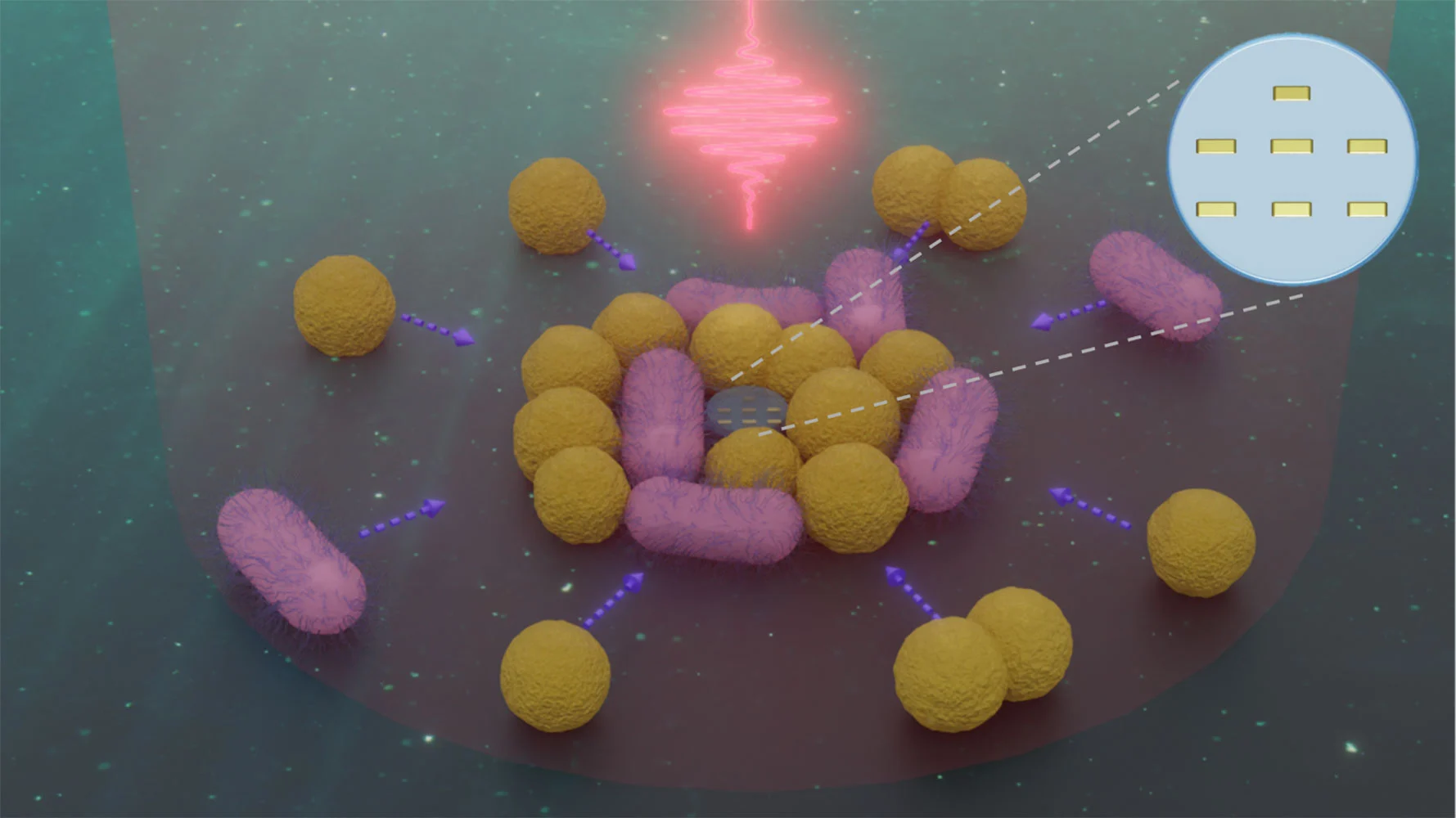
Reports show that these miniature robots are aimed at microscale operations where traditional methods are almost ineffective. For biological materials such as single cells and bacteria in liquid environments, achieving high-precision control has always been a major challenge in scientific research. This new achievement demonstrates that tasks such as collecting and repositioning bacteria are now realistically feasible.
The research team is led by Professor Bert Hecht from the Julius-Maximilians-University of Würzburg. The team’s core solution is to use the weak recoil generated when a single photon is emitted to drive micrometer-sized devices called “mini drones.”
It is reported that these devices can integrate up to four plasmonic nano-antennas internally. They first absorb light with specific properties and then re-emit photons in a directional manner; each emission brings an extremely small recoil force, similar in principle to the recoil of a fired bullet. Due to the extremely low mass of the nanorobot itself, even this weak force is sufficient to bring about high speed and rapid acceleration.
In the latest research, the researchers further reduced the size of these light-driven robots to less than 1 micrometer while simplifying their control method, but still retained the propulsion mechanism based on photon recoil.
The team utilized the characteristic that the antenna wires inside the robot naturally align with the polarization direction of incident light. By adjusting the polarization state of the light, researchers can control the orientation of the robot, while its forward momentum still comes from photon recoil, making its control method more akin to the “steering plus propulsion” mode of macroscopic vehicles.
Jin Qin, the first experimental scientist on the paper, stated that, essentially, the team has constructed a nanorobot driven by light that can lock onto and collect bacteria. Due to the simplified structure, the robot’s size has been reduced to a scale where it can directly enter microbial activity, in a sense like a “microscopic cleaning device.”
Researchers say that this nanorobot has high maneuverability and can quickly complete 90-degree turns, allowing it to perform systematic and efficient scanning over larger sample areas. At the same time, it can selectively capture, transport, and release a considerable number of bacteria.
This means that, in controlled experimental environments, these devices are expected to implement “cleaning” operations on microenvironments—collecting bacteria and transferring them to predetermined locations.
Bert Hecht pointed out that this achievement vividly demonstrates that light can not only be used to observe the microscopic world, but also to actively shape it. Although the concept of a “mini robot cleaner” sounds quite futuristic, the related physical principles have now been experimentally verified.
Even when carrying larger bacterial clusters, this nanorobot can still maintain complete maneuverability, albeit with a slight decrease in speed. The research team believes that this stability further highlights its application potential in microbiology, biomedical research, and ultra-small-scale precision manipulation.
The related research paper, titled “A nanoscale robotic cleaner,” was co-authored by Jin Qin, Carsten Büchner, Wu Xiaofei, and Bert Hecht, and was published on March 27, 2026.