Apple Expected to Rise to Third-Largest Laptop Vendor Globally by 2026
According to market research firm Sigmaintell, Apple is predicted to become the world's third-largest laptop vendor by the end of 2026, with overall MacBook shipments expected to surpass traditional PC giant Dell, further improving its ranking in the global laptop market. The firm estimates that Lenovo will remain the world's number one with 43 million laptop sales in 2026, followed by HP with 39 million, and Apple is projected to sell 28 million MacBooks, a significant increase from its approximately 23 million units in 2025.
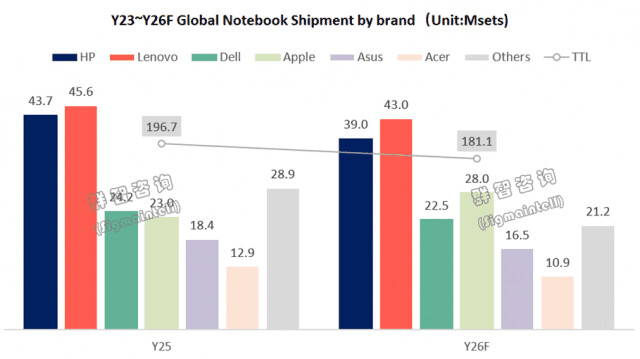
The report points out that a key driver of Apple's sales increase is the recently launched entry-level model, the MacBook Neo. This product is expected to contribute approximately 10 million units in sales in 2026, with the remaining approximately 18 million units being accounted for by the MacBook Air and 14-inch and 16-inch MacBook Pro models.
In terms of product coverage, Apple has now established a complete layout from entry-level to high-end professional. The MacBook Neo starts at $599, with student discounts as low as $499, the mid-range market is served by the lightweight MacBook Air, and high-end professional users are catered to by the MacBook Pro series.
Analysts believe that this product combination spanning multiple price points enhances Apple's visibility in the laptop market and allows more consumers at different budget levels to find suitable options within its product line. In particular, on the MacBook Pro products, Apple's self-developed chip platform's unified memory architecture is considered to have greater flexibility in component procurement and supply chain allocation, and is also more suitable for local AI inference and development scenarios, thus being favored by some AI enthusiasts and researchers.
Unlike most laptop manufacturers, Apple does not rely on AMD, Intel, or NVIDIA to provide core hardware platforms. While other manufacturers often need to plan new product releases around the update cycles of CPUs and GPUs, Apple, with its proprietary Apple Silicon system, maintains greater independence in product decisions and release timing, which is also seen as one of the important factors enabling it to continue expanding its market share.