Ming-Chi Kuo: OpenAI to Mass Produce Phones in 2028, Collaborating with Qualcomm and MediaTek on Chip Development
On April 27th, renowned Tianfeng International Securities analyst Ming-Chi Kuo stated that the latest industry investigation shows OpenAI is collaborating with MediaTek and Qualcomm to develop phone processors. Luxshare is the exclusive system integration design and manufacturer, with mass production expected in 2028.
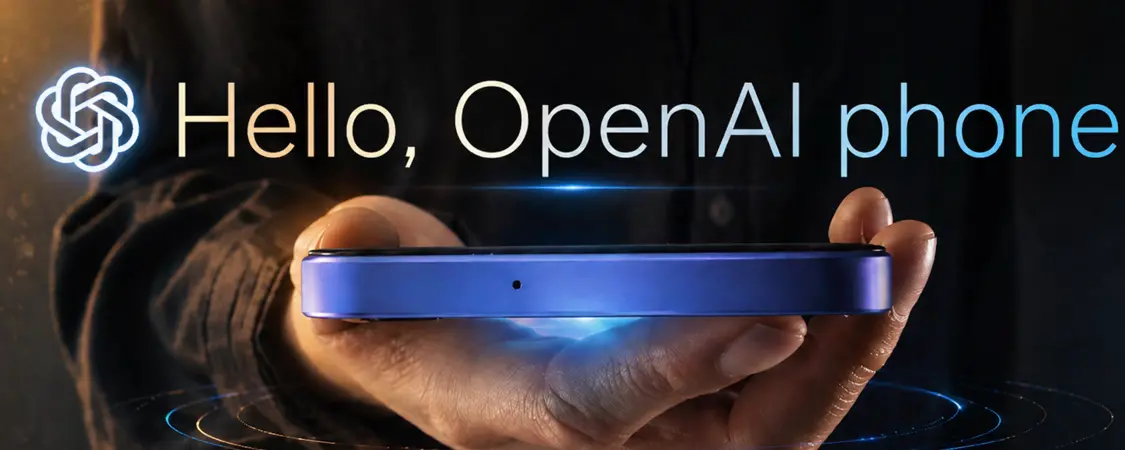
Figure 1: OpenAI to Make Phones
Ming-Chi Kuo states that AI agents redefine phones; users’ purpose is no longer to use a pile of applications, but to perform tasks and meet various needs through the phone. This fundamentally changes the perception of phones. Ming-Chi Kuo also provided a conceptual design diagram of the phone interface and compared it with current phones (using iPhone as an example).
He also explained why OpenAI is making phones? 1. Comprehensive Control: Only by fully controlling the operating system and hardware can a full range of AI agent services be provided. 2. Obtaining Real-Time Status: Only phones can have all of the user’s “current state” (State), which is the most important input information for real-time AI agent reasoning services. 3. Scale Advantage: 3. In the foreseeable future, phones will still be the largest terminal devices in terms of quantity.
Moreover, phones need to continuously understand user context, so the processor has new requirements in terms of power consumption, memory hierarchy management, and local operation of small models. More complex or high-intensity tasks are handled by cloud AI.
Figure 2: The Evolution of Future Phones
Ming-Chi Kuo pointed out OpenAI’s advantages and business model. OpenAI has advantages in consumer brand influence, user data accumulation, and AI model capabilities. Phone hardware itself is highly mature and can be developed through supply chain cooperation. In terms of business model, it may bundle subscription services with hardware and build a new AI agent ecosystem in collaboration with developers.
OpenAI’s development of phones is also beneficial to MediaTek and Qualcomm. As chip partners, they are expected to benefit from the replacement cycle in the long term, and specifications and suppliers are expected to be determined by the end of 2026 or the first quarter of 2027. In terms of revenue potential, taking “MediaTek × Google TPU Zebrafish” as an example, the revenue of a single AI chip is approximately equivalent to that of 30-40 AI agent phone processors. If it initially targets 3-400 million high-end models globally each year, the replacement wave will become another strong driving force for operational growth.
For Luxshare, no matter how hard it tries, its assembly status in the Apple supply chain is difficult to surpass Hon Hai. Therefore, this project is extremely significant for Luxshare. By laying out in advance, Luxshare is expected to become a leading beneficiary in the next generation of phones.