Musk and Altman to Face Off in Court: Can a Fair Jury Be Assembled for This Case?
A group of ordinary people, who may even have little knowledge of artificial intelligence, will soon decide the future of OpenAI. Elon Musk's lawsuit against OpenAI and its executives (including CEO Sam Altman) officially went to trial on Monday. A number of tech giant executives are expected to testify, with the core dispute being whether OpenAI management deceived Musk and abandoned the organization's original non-profit mission, privately transforming and establishing a for-profit business segment.
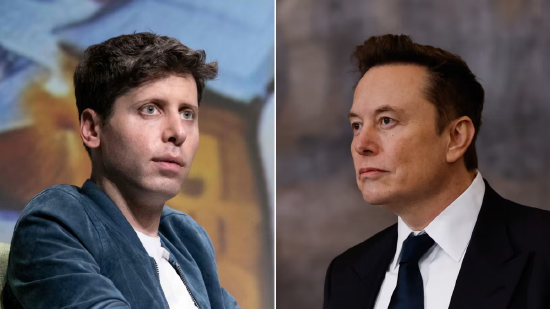
(From left to right): OpenAI CEO Sam Altman; Tesla and Space Exploration Technologies Corp. (SpaceX) CEO Elon Musk.
This trial comes at a sensitive and critical time for OpenAI: the company is preparing for a large-scale initial public offering (IPO), and competition in the industry is fierce. If Musk wins the lawsuit, OpenAI's listing plan may be completely ruined. Altman and OpenAI co-founder and president Greg Brockman may be removed from their positions, which would clear the way for Musk's AI company xAI to seize the initiative in the industry.
Wedbush Securities analyst Dan Ives said in a research report email: "Musk versus Altman is like a tech circle showdown, and all investors are watching closely. In court, both sides are likely to expose each other's shortcomings and attack fiercely, which will be detrimental to all parties involved, and Musk has privatized this dispute."
However, this case involves the world's richest person, a leading artificial intelligence company, and a number of top tech giants and industry leaders, making it extremely difficult to select a completely neutral and unbiased jury.
How will the jury be selected?
Musk and Altman are no longer just corporate executives, but well-known public figures. Jury consultant Alan Tuerkheimer told CNN that a large number of potential jurors, especially those from Silicon Valley, "already have deeply ingrained subjective stances towards these two tech and AI giants."
Temple University School of Law Trial Advocacy Program Director Elizabeth Lippi believes that existing impressions are not an absolute obstacle.
“The law does not require jurors to have never heard of Elon Musk or artificial intelligence,” she said. “It only requires jurors to set aside their preconceived notions and make a decision based solely on the evidence presented in court.”
Tuerkheimer revealed that the judge will summon three times the number of candidates as in a typical civil case during the jury selection phase on Monday.
The judge and both lawyers will thoroughly investigate the attitudes of potential jurors, examining not only their views on the two well-known parties but also the public's overall stance on the artificial intelligence industry.
In this case, the jury only needs to issue a non-binding opinion on liability determination, and the final compensation award and penalty judgment will be decided solely by presiding Judge Yvonne Gonzalez Rogers.
Musk's Core Claims
Musk co-founded OpenAI in 2015 and operated it as a non-profit, while also providing funding support. He claims to have contributed approximately $44 million cumulatively in the early stages of the founding. However, in 2018, a fierce power struggle broke out between the two sides, and Musk eventually left the company and subsequently founded his own AI company, xAI.
After Musk left, OpenAI urgently needed to replenish operating funds and established a for-profit subsidiary in 2019. In 2025, this for-profit entity will be transformed into a public benefit corporation, supervised and controlled by a non-profit foundation. This structural adjustment was approved last year by the Attorneys General of California and Delaware.
Musk alleges that this structural change completely betrayed OpenAI's original intentions: the organization was originally intended to develop safe, open-source artificial intelligence to serve the public interest, not to pursue private interests. He believes that OpenAI illegally profited from his earlier investments, constituting a breach of charitable trust and unjust enrichment.
Microsoft was also named as a co-defendant, accused of assisting and condoning OpenAI's violation of the charitable trust agreement.
Musk wrote in the original complaint: "Altman and his accomplices betrayed me and betrayed the founding purpose of this non-profit organization. This breach of trust and deception is a Shakespearean scandal."
Musk's demands include: ordering OpenAI to restore its original non-profit structure, removing Altman and Brockman from their board positions, and seeking damages of over $130 billion. Musk has stated to the court that all compensation will be allocated to OpenAI's non-profit entity and he will not benefit personally.
OpenAI countered that Musk himself strongly pushed for the company to shift to a for-profit model at the time; the real reason for his departure was his inability to control all company decision-making. This lawsuit is entirely based on Musk's jealousy, regret over leaving, and an attempt to maliciously suppress competitors.
Lippi pointed out: "The core issue of this case is highly realistic – can an organization established for the public interest completely transform and deviate from its original mission halfway through? At the same time, jurors and the public will examine Musk's true motives: is this lawsuit about upholding principles, or is it purely a commercial competitive tactic? This contradiction will run through the entire case."
The trial evidence includes hundreds of pages of emails, text messages, and private writings from tech industry leaders. Expected witnesses include: Musk, Altman, Brockman, Microsoft CEO Satya Nadella, former OpenAI senior management, and Musk's associates (including the mothers of several of his children, former OpenAI director Shion Zililis).
The jury is expected to begin deliberations on May 12.
Lippi said: "An email could be fatal in cross-examination, but the key to winning the trial always lies in the narrative logic, background facts, credibility of the parties, and burden of proof. The winning side will inevitably sort out the complex documents into a complete and understandable factual context for ordinary people."