Microsoft and OpenAI Decouple Their Partnership Amidst Tensions Due to Amazon's Involvement
Microsoft and OpenAI, once hailed as the ideal partnership in the AI era, have reached a point of mutual release and freedom. On Monday evening Beijing time, both Microsoft and OpenAI simultaneously released statements announcing that their "collaboration has entered a new phase."
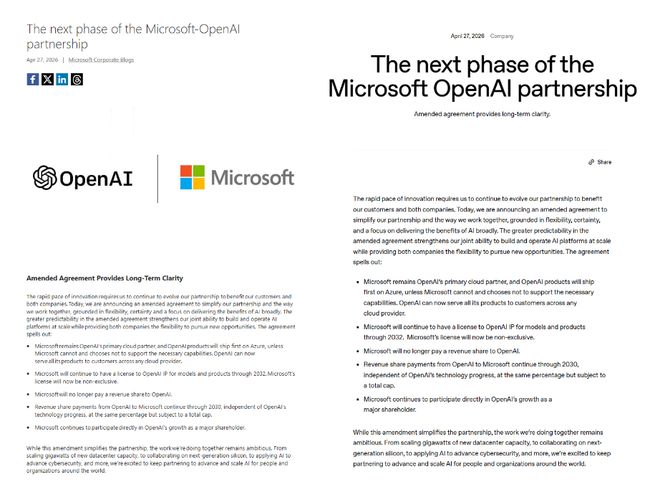
(Source: Company Website)
The statement indicates that Microsoft’s licensing of intellectual property rights for OpenAI models and products will become non-exclusive, with the validity period remaining unchanged until 2032.
Microsoft will no longer pay OpenAI a revenue share. OpenAI will continue to pay Microsoft a revenue share until 2030, with the percentage remaining unchanged but subject to an undisclosed total cap, and will not be affected by technological advancements.
At the same time, Microsoft remains OpenAI’s primary cloud partner. OpenAI’s new products will be prioritized for release on Microsoft Azure cloud (unless Microsoft is unable to support or chooses not to support necessary features). OpenAI can now offer all its products to customers through any cloud service provider.
Both parties stated in the statement that the revised agreement “aims to simplify the cooperation and collaboration between the two parties.” The revised agreement enhances the predictability of cooperation, thereby strengthening the ability of both parties to build and operate AI platforms on a large scale, while also preserving the necessary flexibility for both companies to explore new development opportunities.
Affected by this news, Microsoft fell nearly 1% at the opening of trading on Monday, after falling nearly 4% in pre-market trading. Amazon also fell nearly 1% after the opening of trading on Monday. Both Microsoft and Amazon will release their financial reports after the close of trading on Wednesday local time.
Relationship Already Tense
As background, Microsoft’s investment in OpenAI began as early as 2019, and in January 2023, it invested a whopping $10 billion to acquire nearly one-third of the equity in the ChatGPT developer (with a transaction valuation of approximately $29 billion at the time).
In October of last year, during OpenAI’s restructuring, it was confirmed that Microsoft held “approximately 27%” equity in OpenAI’s for-profit entity. Based on OpenAI’s most recent financing valuation of $850 billion, Microsoft’s $13 billion investment has doubled to nearly $228.3 billion.
The rift between the two parties was also embedded in this agreement. Microsoft disclosed at the time that OpenAI could now co-develop some products with third parties, but API products co-developed with third parties would be limited to Azure. Non-API products could be offered on any cloud service provider.
The problem is that OpenAI’s “third-party partner” is Amazon Web Services (AWS), the world’s leading cloud computing provider. At the end of February this year, Amazon announced a $500 million investment in OpenAI, with an initial $15 billion, and subsequent amounts to be unlocked as specific conditions are met.
OpenAI also announced that AWS will be the exclusive third-party cloud distributor for OpenAI’s enterprise-level agent management platform, Frontier. At the same time, OpenAI will use Amazon’s self-developed Trainium chips and jointly develop customized models with the latter (to bypass Microsoft’s API exclusivity).
Subsequently, rumors emerged that Microsoft management was concerned that OpenAI’s cooperation with AWS violated OpenAI’s agreement to run models exclusively on Microsoft Azure cloud, and had considered taking legal action. At the time, a Microsoft spokesperson meaningfully told the media: “We are confident that OpenAI understands and respects the importance of fulfilling its legal obligations.”
At the same time, an internal memo leaked in mid-April revealed that OpenAI’s revenue chief, Denise Dresser, also complained that Microsoft was hindering its development. Dresser wrote that the company’s newly established cloud partnership with AWS had brought “astonishing” demand, but the company’s cooperation with Microsoft “limited our ability to serve customers where they are.”
Following the revision of the agreement at the end of last year, Microsoft also accelerated its efforts to develop its own large models. Although the previous agreement allowed Microsoft to use OpenAI’s intellectual property, it also prohibited it from developing competing artificial intelligence systems.
Mustafa Suleyman, Microsoft’s AI CEO, said in early April that the team’s goal by 2027 is to “truly reach state-of-the-art levels,” covering models capable of responding to or generating text, images, and audio.