Desktop Metal 3D Printers Priced Below $10,000: Industrial-Grade Technology Arrives on the Workbench
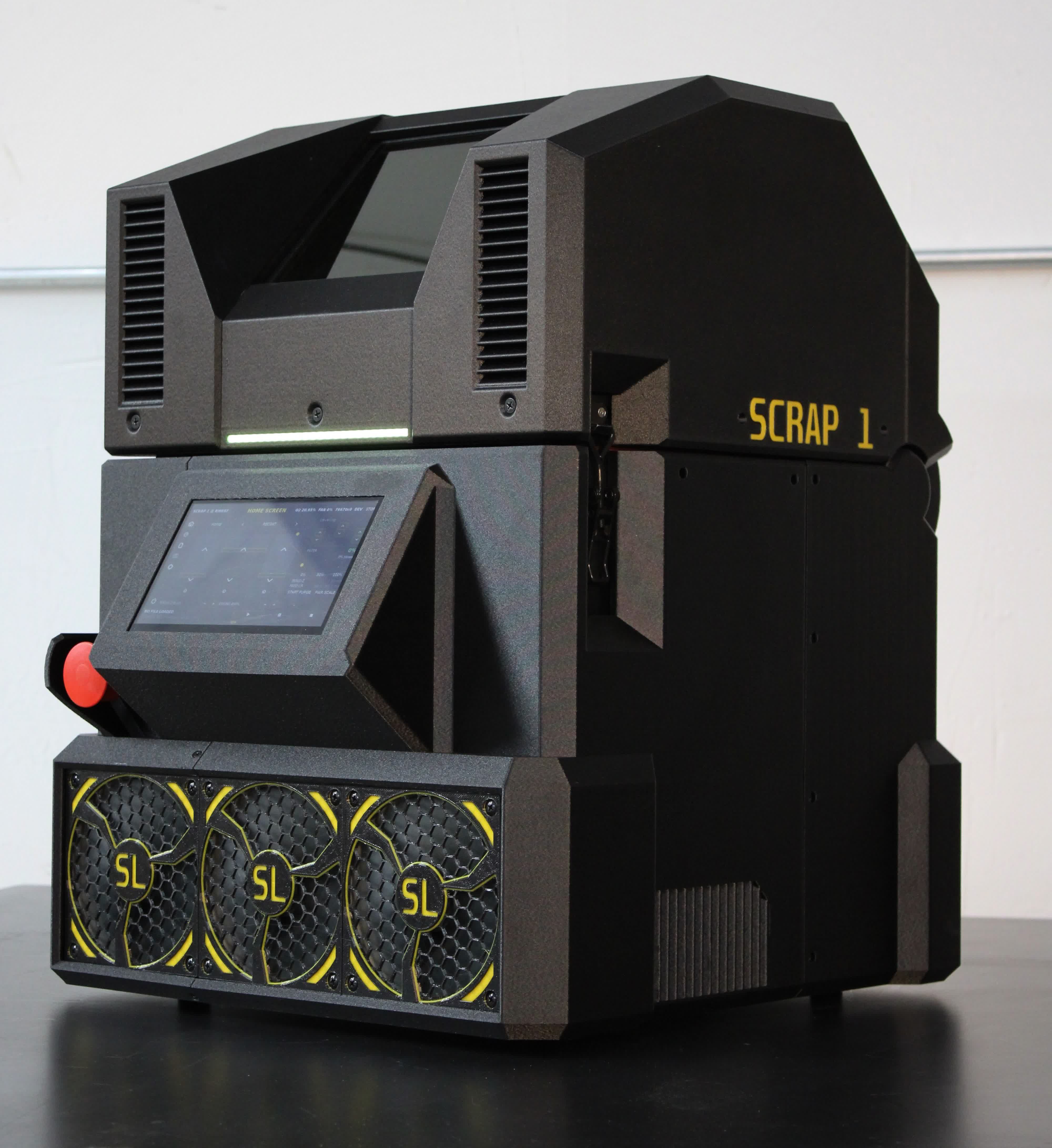
ScrapLabs, a startup based in Colorado, is attempting to compress highly capital-intensive metal additive manufacturing technology into a nearly "tool-level" desktop device. The company officially launched its Scrap1 metal 3D printing system at the RockyMountainRepRapFestival in Loveland, Colorado on April 18-19, bringing the common industrial laser powder bed fusion (metal laser powder bed fusion) process into a price range of under $10,000.
For a long time, metal laser powder bed fusion has been dominated by large industrial platforms. The basic principle is to spread an extremely thin layer of metal powder and then use a laser to selectively melt it in designated areas, repeating this process until the complete part geometry is formed. Parts made in this way have high density, good mechanical properties, and can also realize complex structural designs such as internal channels and lattice structures that are difficult or impossible to process with traditional machining. It is precisely these capabilities that have made this process widely used in aerospace, automotive manufacturing, and mold industries, but high equipment investment and supporting infrastructure requirements have also kept it out of reach for small and medium-sized users for a long time.
Scrap Labs is aiming at this market gap. Compared with traditional metal printers that often cost more than $200,000 and require dedicated power distribution, constant temperature and humidity environments, and complex powder safety systems, Scrap 1 is positioned as a compact system that can be placed on a workbench, rather than a large device that must be placed in a separate industrial unit. Even current “low-cost” metal printing solutions for small and medium-sized customers often still cost tens of thousands of dollars and assume that users have near-laboratory-level installation and maintenance conditions.
In terms of design philosophy, Scrap 1 attempts to minimize the barrier to entry without changing the core process. The device integrates liquid cooling and air cooling systems and is equipped with HEPA filtration to control particulate matter emissions, balancing process stability and operational safety. The platform supports a variety of metal materials, including stainless steel, tool steel, copper, nickel-based alloys, and cobalt-chromium alloys, aiming to cover a variety of application scenarios from functional prototypes to small-batch production.
In terms of connection and control, Scrap 1 provides a variety of connection methods such as Ethernet, Wi-Fi, and USB, and is operated through a web-based control interface. The firmware is based on Klipper development, the slicing software is compatible with common desktop tools such as PrusaSlicer and OrcaSlicer, and also supports Scrap Labs' own ScrapSlicer process, making it easy for users with existing desktop plastic printing experience to directly migrate to metal printing. Unlike the closed software and hardware ecosystem common in industrial-grade additive systems, Scrap Labs intends to use open toolchains and familiar software experiences as selling points to reduce learning costs and lock-in risks.
Scrap Labs focuses on user groups that previously relied on outsourcing services, such as university laboratories, vocational school projects, small manufacturing companies, racing car modification workshops, and design studios. For these institutions and teams, being able to deploy metal 3D printing capabilities internally is expected to significantly shorten the iteration cycle, making it no longer completely dependent on machining workshops or external service providers for parts from design to physical testing, thereby reducing communication and production waiting times.
It is reported that Scrap Labs has opened reservations for Scrap 1: during the limited-time discount period, the kit version starts at $9,600, and is expected to increase to $14,200 after April 30, 2026; the complete assembled version is priced from $17,990. The company plans to start shipping in early 2027 and provide refundable deposits or waiting lists so that potential users can arrange procurement and deployment time according to project schedules.
In terms of R&D progress, Scrap Labs stated that it completed the concept verification stage in December 2025 and is currently conducting Alpha testing with early partners. Larger-scale Beta testing is expected to begin at the end of 2026, followed by mass production ramp-up around mid-2027, initially delivering to the US market. Whether this relatively "affordable" metal laser powder bed fusion device can meet industrial-grade expectations in terms of part consistency, material performance, and operational safety remains to be verified.
Nevertheless, by compressing the laser powder bed fusion process into a smaller, more flexible deployment platform and connecting it with open software and existing desktop additive workflows, Scrap Labs is pushing this manufacturing technology, traditionally highly concentrated in factory environments, to a wider and more diverse user base. Whether this attempt can truly rewrite the entry barrier and ecosystem structure of metal 3D printing will be seen after Scrap 1 is mass-produced and implemented.