China Delivers World's First 10,000-Car Carrier
According to CCTV News, today, the world's first 10,000-car LNG dual-fuel Pure Car and Truck Carrier (PCTC) built by Guangzhou Shipyard International (GSI), a subsidiary of China Shipbuilding Group, was officially delivered to South Korean company HMM in Guangzhou Nansha. This giant vessel, dubbed the "floating car city" by the industry, not only sets a new global record for the largest loading capacity of car carriers but also marks a key breakthrough for China in the field of high-end shipbuilding, fully mastering the core technology of 10,000-car carriers.
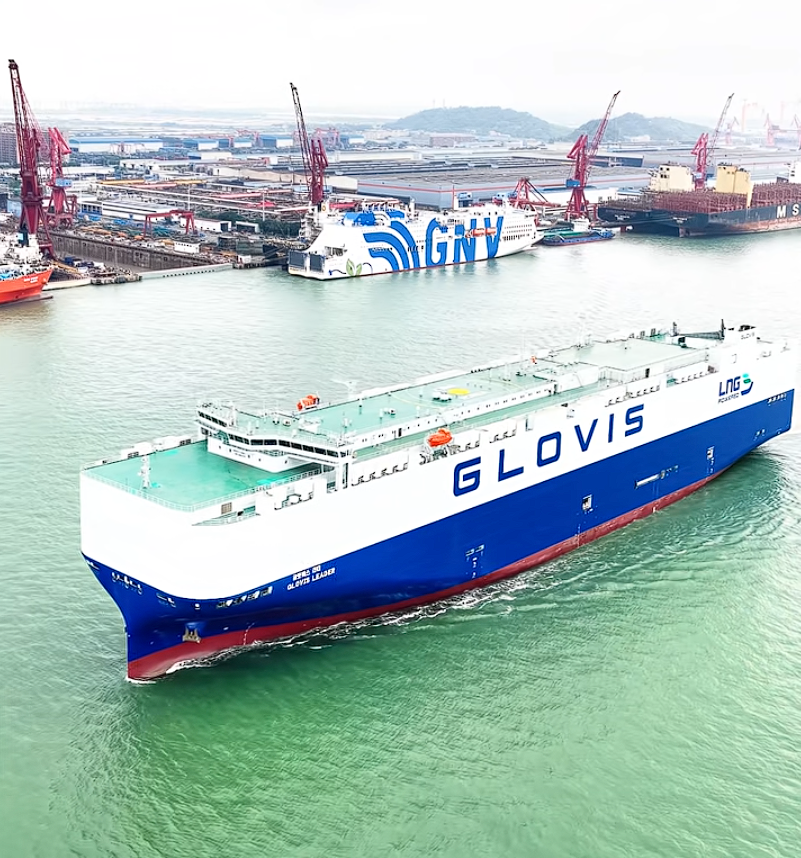
The vessel was developed and designed by the Marine Design & Research Institute of China (MARIC) under China Shipbuilding Group. During the construction process, GSI overcame a number of technical challenges including the structural strength, precision control, and new energy adaptation of ultra-large PCTCs. It adopted digital intelligent construction technology to achieve full-process precision control, shortening the construction period by approximately 15% compared to traditional ship types, demonstrating the technical strength and innovation ability of China's shipbuilding industry.
The ship has a total length of 230 meters, a molded width of 40 meters, and a structural draft of 10.5 meters. It features a 14-layer car deck design, with 4 layers being adjustable. The maximum loading capacity reaches 10,800 standard passenger vehicles, far exceeding the previous world record of 9,500.
Notably, its flexible deck layout can accommodate a variety of vehicle types, including electric vehicles, hydrogen-powered vehicles, and heavy trucks, meeting the diversified needs of global automobile trade.
To ensure the safe transportation of new energy vehicles, the ship innovatively adopts a partitioned independent ventilation system, with each deck area equipped with independent fire protection and ventilation equipment, effectively reducing the risk of lithium battery fires.
At the same time, the ship is equipped with an advanced intelligent ballast water management system and a ship energy efficiency management system, realizing real-time monitoring and optimization of navigation status.
The power system adopts an LNG/fuel dual-fuel design, equipped with a highly efficient ME-GI main engine, with a speed of approximately 19 knots. It can achieve low-carbon navigation throughout the entire voyage, reducing carbon emissions by about 25% compared to traditional fuel ships, fully complying with the latest environmental protection standards of the International Maritime Organization (IMO). It balances transportation efficiency and fuel economy and is also equipped with a photovoltaic energy auxiliary system to further improve energy utilization efficiency.