Lenovo, HP, Dell and Other Laptops See Price Increases Across the Board: A 12,000 Yuan Computer Now Costs 18,000 Yuan
Recently, offline retail stores have experienced a new round of concentrated price increases for laptops. Mainstream brands such as Lenovo, HP, and Dell have raised prices across the board, with increases starting at 20%, and some popular models seeing even higher increases than the industry average.
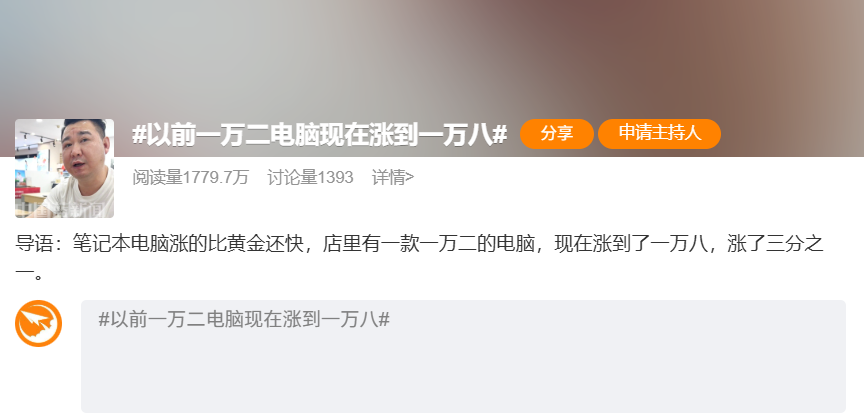
According to reports, Mr. Song, the head of a computer store in Hangzhou, said that this price increase is even more rapid than the stock market and faster than gold. A computer originally priced at 12,000 yuan (Lenovo Savior Y9000P) in the store now costs 18,000 yuan, an increase of one-third. Even entry-level models, originally priced at 10,000 yuan, now cost 12,000 yuan, and Lenovo, HP, and Dell have all seen price increases to varying degrees.
When asked if the costs could be absorbed, Mr. Song said: "What can I do about it? Ultimately, the consumer pays."
This price increase in end products is not a market adjustment by a single brand, but a concentrated transmission of rising costs across the entire PC industry chain. As early as April, the PC industry had already experienced a wave of price increases across the entire industry chain.
The price increase range extends from core components such as CPUs, memory, and hard drives to basic materials such as PCB circuit boards, plastic raw materials, and packaging materials. A comprehensive price increase in end products has become a foregone conclusion.
A combination of multiple factors has created a perfect storm that is driving up costs across the entire PC industry chain. The large-scale construction of AI infrastructure has led chip manufacturers to prioritize the supply of server chips needed for AI data centers, resulting in a sustained shortage of consumer-grade CPUs and storage chips.
The situation in the Middle East, which is scheduled to be upgraded by the end of February 2026, has further exacerbated the already tense supply chain. Obstruction of navigation in the Strait of Hormuz has disrupted the supply of key materials such as helium, aluminum, and crude oil, which are highly dependent on for semiconductor production. An industry insider revealed that the delivery cycle for PCB circuit boards has already been extended from the original 6 weeks to 6 months.
Unlike previous component shortages that only affected high-end gaming PCs, this round of price increases in all materials covers all categories of consumer laptops, and ordinary consumers will directly face the pressure of rising end product prices.