Those “Baibiao” and “Monthly Payments” That Tricked You Into Clicking the Wrong Option Are Finally Going to Be Sanctioned
Many people have experienced the frustration of accidentally signing up for installment plans with extra fees while shopping online, often hidden within complex payment interfaces. These “Baibiao” (white bars) and “monthly payment” options, along with similar products, have become pervasive in online shopping. Now, new regulations are coming into effect on September 30th to curb these deceptive practices.
Various "Bei," "monthly payments," and "tiao" have, over the years, stuck to our lives like a summer-melted toffee, permeating various payment scenarios.
Those of us who are careful repeatedly refuse to use them, searching for the hidden cancellation options on third or fourth-level pages, trying to permanently say goodbye to “Bei,” “monthly payments,” and “tiao.”
But they are like the constantly respawning monsters on the roadside in a game, flashing unexpectedly on your phone, silently cutting in front of bank cards and balances.
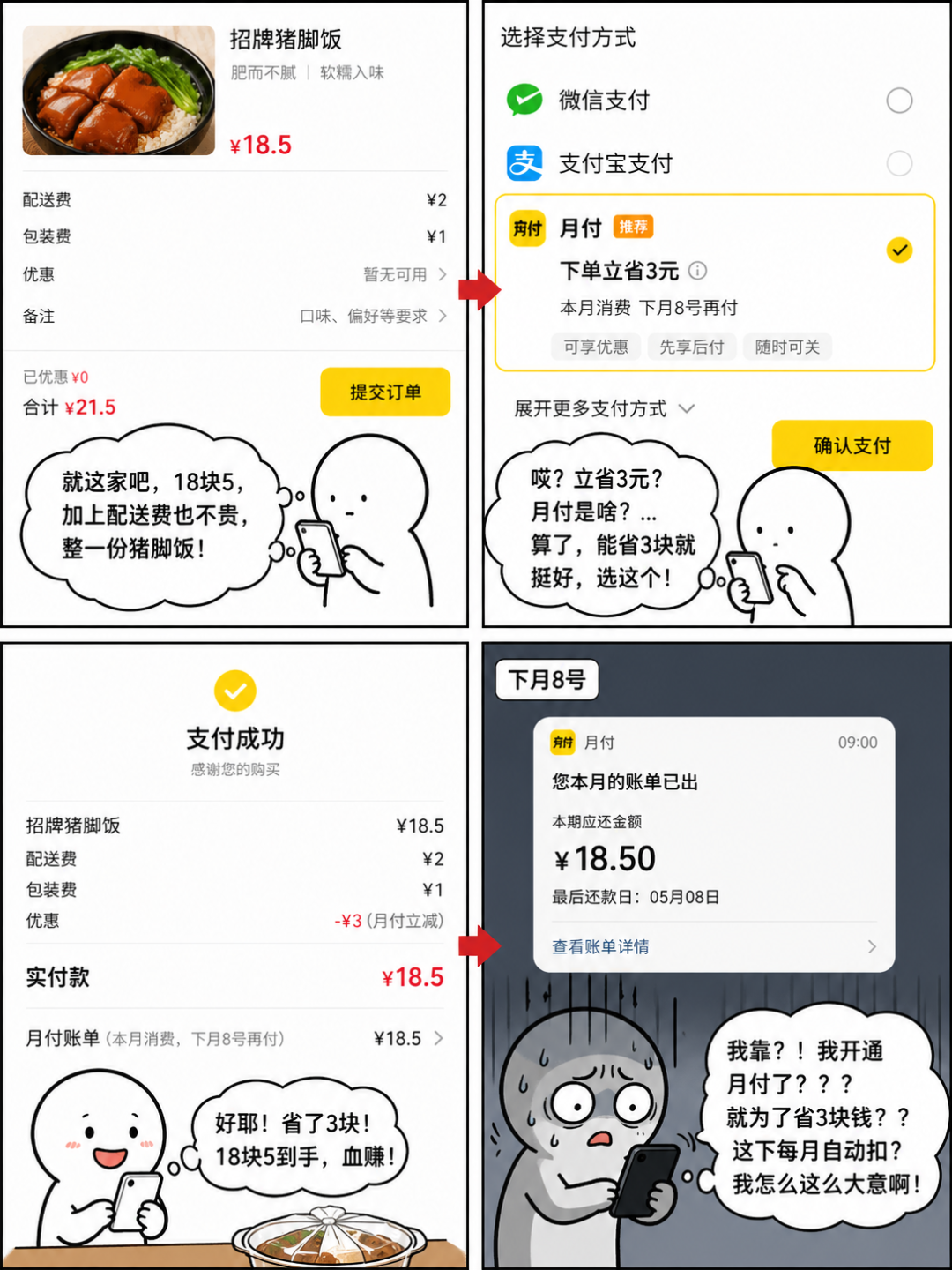
Various apps will also kindly pre-select these toffees for you, then warmly pop up a window telling you "Save 5 yuan on your first order," and we foolishly always fall into these traps.
Until we wear the clothes we bought, the mop we added is already in use at home, and the pork knuckle rice has turned into fat on our bodies, we don’t even realize that we have borrowed money from various platforms…
To be honest, until I wrote this article, I didn’t even know that a certain Baibiao wasn’t the default payment method of a certain Dong, and could be switched by sliding down one page.
This isn’t really our fault for being careless. A few years ago, even a senior executive specializing in network security at Ali publicly criticized his experience of being induced into opening a loan.
If even a tech-savvy internet executive can stumble into this maze, it’s no surprise that ordinary people are tricked.
This kind of routine-based inducement to borrow money is terrifying. Just search for any keyword like "Bei," "monthly payment," or "tiao" on a certain internet complaint platform, and you’ll find tens of thousands or even hundreds of thousands of complaints.
Some mothers were having the childcare subsidy recently issued by the state directly used to pay off a certain platform’s bill.
Some elderly people were induced into opening a credit line while using their phones to pay electricity bills, and only realized they owed money after being overdue.
You think you’re just eating a bowl of pork knuckle rice, but you’ve quietly taken out a loan.
This rogue behavior of packaging serious financial credit as a childish payment button has finally come to an end.
A few days ago, the People’s Bank of China and seven other departments jointly issued the “Administrative Measures for the Network Marketing of Financial Products,” preparing to crack down on these internet barnacles on September 30th.
Article 12 of the new regulations states: “Non-bank payment institutions shall not include loans, asset management products, and other financial products in payment tool options, nor shall they provide marketing services for loans and asset management products.”
What does this mean? As we mentioned earlier, in the past, when you paid for something, bank cards, balances, “Bei,” “monthly payments,” and “tiao” would all be neatly arranged on the payment page, and these credit products often ranked first.
It looks like a normal payment option, no different from a bank card, but once you choose this payment method, a set of automated processes is triggered behind the scenes.
After September 30th, “Bei,” “monthly payments,” and “tiao” must be strictly separated from bank cards and balances, cannot be mixed together, cannot be pre-selected, and cannot be ranked first.
Of course, this doesn’t mean you won’t be able to use these credit products in the future. If you really want to use them, you can create a separate window on the payment page for users to manually select, instead of using them by default.
Don’t look at it as just a change in the app’s UI interface and adding a few more confirmation steps. In a way, it has fundamentally overturned the financial routines of internet giants over the past decade.
For a long time, large companies have leveraged their control over high-frequency daily consumption scenarios (such as hailing taxis, ordering takeout, and online shopping) to seamlessly embed credit tools into the checkout process, inducing users to overspend with extremely low thresholds and thereby earn high profits.
If these credit transactions are fair, open, and voluntary commercial acts, it could be said that adults are willing to take the risks.
But in order to make you overspend without being aware, they not only manipulate the UI on the payment page, but also play word games in marketing.
Think back, just like the small tricks in payment, almost all loan advertisements play the same trick. They will never tell you the true annualized interest rate in a prominent place. They will always find ways to play word games with you: “Pay next month for this month’s use,” “Daily interest as low as a cup of milk tea,” “Only 3 yuan per day.”
It seems very light and cost-effective, but if you actually take out a calculator, you’ll find that the actual interest rate behind it is often much higher than a normal bank loan.
Some installment payments even use the gimmick of “zero interest for the first period” to trick you into getting on board, and by the time you realize it, you’ve been trapped by high comprehensive costs.
Some installment payment platforms even allow you to use minimum repayments to continuously amplify your consumption desire at the beginning, and then directly require full repayment after a period of time, ultimately leading borrowers to be unable to repay, falling into a debt spiral, and eventually being crushed by snowballing interest.
This new regulation is a slap in the face of these word games.
The authorities have also directly blacklisted a batch of “loan jargon.” If anyone dares to use terms like “zero threshold,” “instant approval,” or “zero cost” to deceive people in advertisements, they will be in violation.
Moreover, you must clearly state how much interest the money is, and what the consequences of overdue payment are, just like the warning on cigarette packs: “Smoking is harmful to health.”
The trick of luring you in with a “zero interest for the first month” and hiding high fees behind it will no longer work.
Not only that, the new regulations also severely punished those pesky pop-up windows and algorithmic recommendations.
For example, for SMS marketing, users must be allowed to unsubscribe directly.
Pop-up ads have also been greatly reduced and must provide a genuine one-click close function.
The new regulations clearly state that the “X” for closing pop-up ads must be a real “X” that can close the page, not a nano-level button that requires a microscope to find, nor one that downloads a whole package of rogue buttons when you click it.
The reason why the new regulations are cracking down on these marketing routines is not only because they are annoying, but also because these boundless inducements are breeding huge social risks.
Looking at a few more pieces of information on a certain complaint platform, you’ll find that the entire internet credit process is filled with the shadow of violent debt collection.
When platforms, in order to acquire new customers, use various UI deceptions and pop-up inducements to recklessly lower the threshold for borrowing money to a bottomless level, what often comes is people who simply have no ability to repay. How should these overdue loans be recovered?
In 2017, Qudian’s prospectus already clearly stated that Qudian would use SMS and automated voice calls to collect debts. If the collection was unsuccessful, Qudian would make manual phone calls to borrowers and, if necessary, would go to their homes to collect the money in person.
Nearly 10 years have passed, and looking at the complaints in recent years, you’ll know that “violent debt collection” has never disappeared. In this magical cyber era, people who understand the internet even treat “violent debt collection” as a dark joke.
According to a previous investigation by People’s Daily, only 5.9% of Generation Z, who are often joked about for “overspending,” are truly “overspending.” A full 55.3% are “careful spenders.”
This means that most of those who can score and rank debt collection companies online, and who can figure out the rules and push the limits with platforms, are the fastest young people. Those who are truly forced to the brink of desperation by debt collection are often unable to speak out.
Those who are easily targeted by algorithms, lured by “0.03% daily interest,” and quietly opened credit lines through default selections on payment pages are often the elderly, delivery drivers, and migrant workers who have just arrived in the city.
Many of our readers have been tormented by “Bei,” “monthly payments,” and “tiao,” and often only suffer small losses, pay a little extra interest, or close dozens of switches on third-level pages.
But in the places we can’t see, those who can’t switch payment methods, who completely didn’t realize that converting “0.03% daily interest” to an annualized rate, and their entire families have paid for the profits of internet finance for many years.