U.S. Navy's First MQ-25A "Stingray" Carrier-Based Refueling Drone Completes First Operational Configuration Flight
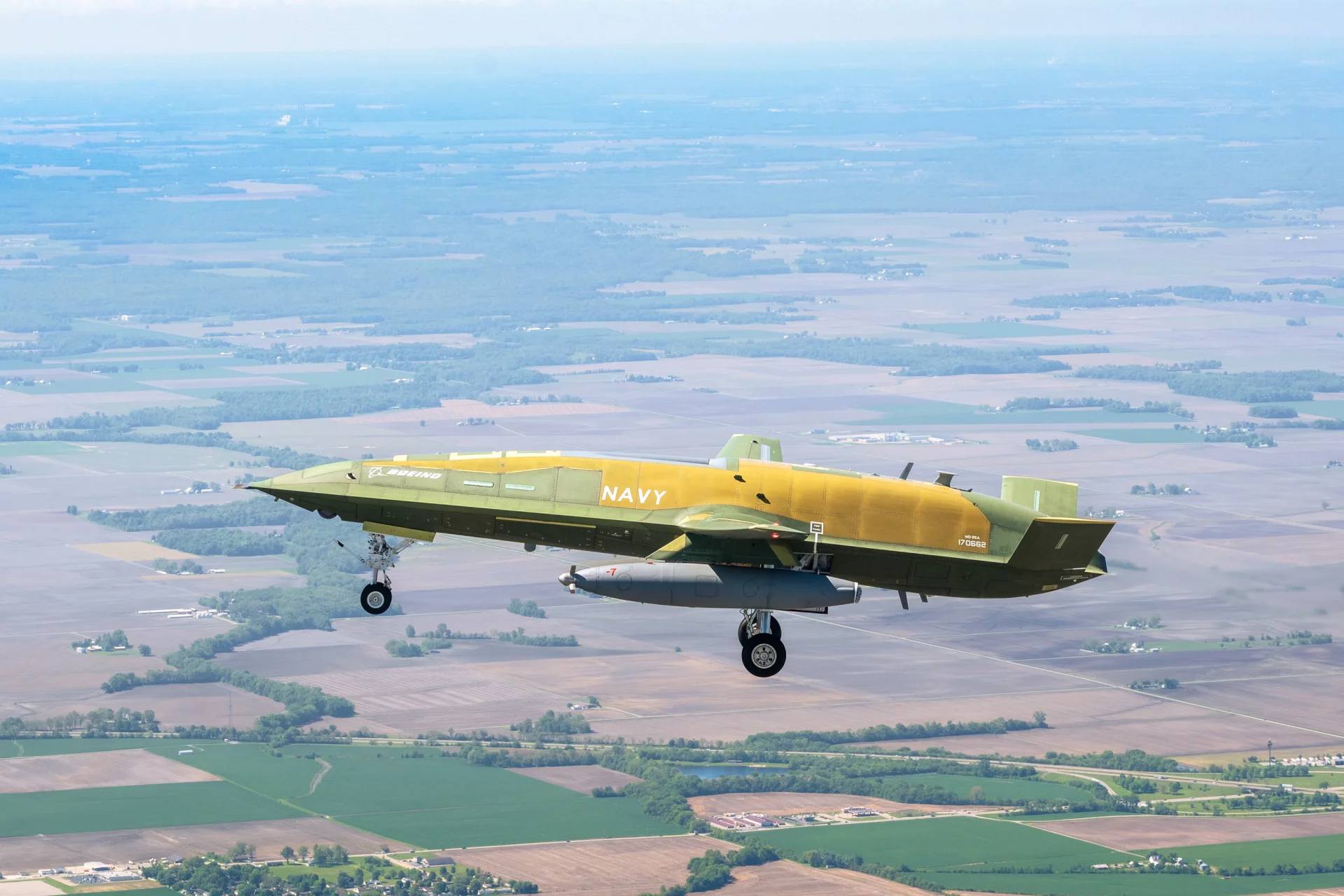
The U.S. Navy's next-generation carrier-based unmanned refueling aircraft, the MQ-25A "Stingray," recently completed its first flight of an operational configuration aircraft, marking a key step towards future carrier air wing refueling capabilities. On April 25th, the drone, manufactured by Boeing, took off from MidAmerica Airport in Mascoutah, Illinois, and completed a two-hour test flight over southern Illinois.
The MQ-25A "Stingray" originally stemmed from the U.S. Navy's "Unmanned Carrier-Launched Airborne Surveillance and Strike (UCLASS)" program, positioned to fill the gap in carrier-based aircraft aerial refueling capabilities. After the retirement of the Grumman KA-6D "Intruder" and Lockheed S-3B "Viking," the aerial refueling mission for carrier strike groups was long-term undertaken by the F/A-18E/F "Super Hornet" using a so-called "buddy refueling" mode, where fighter aircraft carried auxiliary fuel tanks and refueling pods to refuel other aircraft. While this practice maintained the combat radius of the carrier air wing, it also meant that a large number of frontline combat aircraft were occupied with auxiliary tasks, while also accelerating the consumption of airframe life. Upon entering service, the MQ-25A is planned to release the combat potential of the F/A-18E/F through a dedicated unmanned refueling platform, and extend the strike range of carrier-based aircraft without increasing pilot risk.
According to plans, the U.S. Navy will assemble a fleet of 76 MQ-25A aircraft and deploy them on all types of U.S. aircraft carriers, specifically responsible for providing aerial refueling for carrier-based fighters and other fixed-wing platforms. The first flight was of the first airframe produced to operational standards, its appearance similar to the T1 technology demonstrator previously used for land-based testing, but with multiple improvements targeting actual combat in its structure and systems.
In terms of size, the MQ-25A remains consistent with the T1, with a length of approximately 15 meters and a wingspan of approximately 23 meters. Its footprint on the aircraft carrier deck and in the hangar is comparable to the F/A-18E/F "Super Hornet," making it easy to integrate into existing takeoff and landing and deck scheduling systems. In terms of power, the MQ-25A is equipped with a Rolls-Royce AE 3007N turbofan engine with a thrust of approximately 10,000 pounds, giving it a combat radius of approximately 500 nautical miles (approximately 575 miles/926 kilometers), capable of performing refueling missions at high subsonic speeds, with specific cruise speeds not yet publicly disclosed.
Compared to the technology demonstrator, the MQ-25A showcased this time is a formal configuration that meets military combat specifications and has the full capability to perform actual missions. The airframe adopts a new structural layout, with an internal mission compartment, installing an integrated electro-optical/infrared (EO/IR) turret for intelligence, surveillance, and reconnaissance (ISR) missions, while retaining a folding wing structure to adapt to the limited space for parking and lifting on aircraft carriers. To adapt to catapult takeoff and arrested landing, the aircraft adopts a "carrier-enhanced" landing gear and airframe reinforcement design, and adds a corrosion-resistant coating required for long-term use in the carrier environment to resist the high salt mist environment at sea. In addition, the MQ-25A integrates satellite communication and combat software systems to provide a foundation for remote command and control and interconnection with the fleet network.
During this first flight, which was still in a green factory primer coat, the MQ-25A was remotely controlled by a joint flight control team from Boeing and the U.S. Navy, with a Boeing-owned TA-4J "Skyhawk" trainer and a Navy UC-12M "Huron" aircraft serving as chase and support platforms. The main objectives of the first flight included verifying the unmanned aircraft's autonomous operation capabilities during ground taxiing and takeoff/landing phases, testing the stability of the flight control system, monitoring the actual performance of the Rolls-Royce engine, and checking the integration of the command and control link and avionics system.
Rear Admiral Rossie, who is responsible for the U.S. Navy's Unmanned Aviation and Strike Weapons Program Executive Office, said that the first flight of the MQ-25A is a milestone achievement for the Navy and Boeing team, and is also an important step towards the future carrier air wing. He emphasized that this flight validated the U.S. Navy's progress in building carrier-based aerial refueling capabilities, and that the system will significantly enhance the fleet's operational radius and overall lethality in the future.
The entire MQ-25A system will not only be viewed as a "aerial refueling tanker" in the future, but is also expected to become one of the core nodes of the carrier-based unmanned system, providing a certain degree of intelligence surveillance support and network support capabilities while ensuring the range of combat aircraft. With the advancement of subsequent sea trials, shipboard takeoff and landing tests, and collaborative training with existing carrier-based aircraft, the MQ-25A is expected to gradually form initial operational capabilities within this decade, reshaping the composition and operational mode of the U.S. carrier air wing.