The First Generation of College Students “Raised” by ChatGPT is Graduating
The first cohort of university students who studied alongside ChatGPT are about to graduate. Four years ago, generative AI was a novelty; now, it’s a default tool for many students writing papers, researching, completing projects, and revising resumes. For this generation of American graduates, AI isn’t extra help, but a part of university life.
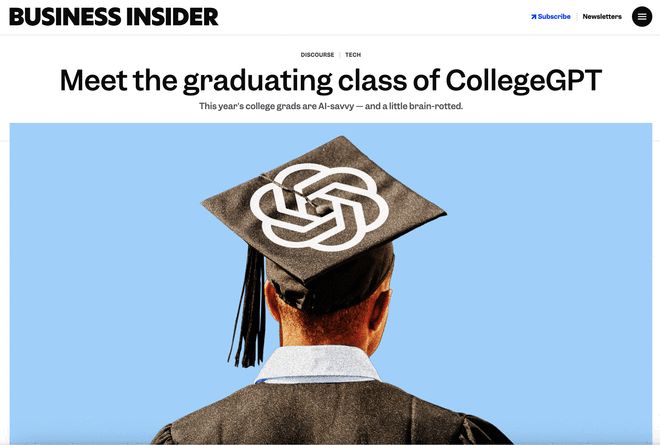
This is why *Business Insider* calls them the “CollegeGPT Generation.”
But what truly deserves questioning isn’t whether they’ve used AI. Resumes can be polished, portfolios packaged, and classroom discussions temporarily propped up by AI – all within the bounds of academia. The real test begins when they enter interview rooms and offices: can they judge problems, take responsibility for outcomes, and articulate their own thoughts when there are no standard answers?
This generation has been raised by AI, but has it fostered ability, or dependence?
I. “Einstein” Disappeared, But “Proxy Services” Have Proliferated
22-year-old Advait Paliwal was a computer science student two years ago. He conducted a controversial experiment, developing an AI tool called “Einstein.”
This wasn’t just a chatbot. By entering campus network credentials, Einstein could log into mainstream US university teaching management platforms like Canvas, automatically download course materials, understand assignment requirements, and even attend online lectures, write papers, and submit assignments on your behalf.
Paliwal initially intended to help friends overwhelmed by coursework, but the tool quickly became popular, peaking at 100,000 users. Eventually, Canvas’s parent company sent a lawyer’s letter, and Einstein was forced offline.
But Paliwal began to reflect: “If AI can autonomously complete all academic work, what is the value of education?”
This is the question the graduating class of 2026 must face. A Gallup poll last year showed that over half of American universities explicitly prohibit the use of AI. But the ban hasn’t stopped reality: over half of students use it weekly, with 20% using it daily. The latest statistics from plagiarism software Turnitin are even more direct: the number of papers flagged as “80% or more AI-generated” has increased fivefold in three years, from 3% in 2023 to 15% in 2025.
“A degree is just a degree, how you get it doesn’t matter,” a Reddit user commented, voicing the collective sentiment of this generation of American university students.
II. From “Knowledge Transfer” to “Replacing Thought”: Why AI is Radically Different from Search
Behind Paliwal’s question lies a deeper issue: AI is changing how humans use their brains.
Many believe AI tools are simply an upgrade to search engines, like previous generations moving from library indexes to Google, and from paper encyclopedias to Wikipedia. But this analogy overlooks a fundamental difference: search engines change the efficiency of “finding information,” while generative AI changes the subject of “processing information.”
In the search era, the tool plays the role of a porter. No matter how much information you find on Google or Wikipedia, you still need to read, filter, synthesize, and complete the logical connections in your mind. This friction of thought always exists, and the brain’s executive control system must be fully engaged.
In contrast, generative AI has evolved from an assistive tool to a central agent. It doesn’t give you a pile of building blocks to build a house; it delivers a beautiful finished home directly. When a student enters a prompt, AI instantly completes semantic association, logical reasoning, and other core functions that originally belonged to the human brain.
This complete takeover of the logical construction process leads to the disappearance of the “cognitive loop.” And when this outsourcing of thinking spreads from written assignments to face-to-face communication, even active offline classrooms begin to malfunction.
III. The Eerie Silence of a Yale Seminar: Brains “Smoothed Out” by AI
In a small seminar at Yale University, a student named Amanda observed a disturbing scene. When the professor posed a challenging question about the reading material, the room fell silent. Then, she saw the student to her left typing furiously on their computer – not taking notes, but feeding the question to AI.
“Now, everyone sounds the same,” Amanda lamented.
She recalled that freshman seminars were once filled with quirky, radical, and even naive but highly individual perspectives. Now, students sound like AI-generated parrots. They no longer try to understand the material, but pursue a definitively correct platitude.
This phenomenon is called outsourcing of thought.
A study published in *Trends in Cognitive Sciences* by the University of Southern California provides an academic explanation for this phenomenon. Researchers used large language models to model probability distributions across massive cross-cultural texts, finding that LLMs are essentially based on statistically predicting the next most likely word. By comparing AI-generated text with original human text from different cultural backgrounds, the researchers found that AI output tends towards the statistical median, compressing human cognitive diversity in three dimensions:
* Language: Sentence construction becomes highly standardized and bland. * Perspective: AI tends to output so-called “WEIRD” viewpoints (Western, Educated, Industrialized, Rich, and Democratic), and this singular perspective is eroding cultural diversity. * Reasoning: Students no longer build their own logical chains, but directly adopt the steps provided by AI.
Jessica, a senior at Yale, feels the same way. She admits she’s become lazier: “My work ethic is much worse than it was in high school. Sometimes I want to comment, but I don’t know how to organize my thoughts, so I let AI help me ‘sound more coherent.’”
The result is that classroom discussions are becoming more fluid, but increasingly sound like the same person speaking. They can instantly provide a perfect answer, but struggle to engage in genuine, independent thought without a screen.
IV. The Job Market “Truth Serum”: A “Lost Generation,” or the Dawn of “Super Individuals”?
As this cohort of graduates with AI-polished resumes enters the job market, a contentious debate has erupted.
On one side, there are warnings from employers.
On X (formerly Twitter), many HR professionals openly state that this generation of graduates has been spoiled by AI. X user NextPluse shared a typical case. A recent graduate’s resume claimed expertise in everything and full-stack development, even claiming to have single-handedly managed both front-end and back-end projects. But when asked to modify code on the spot, they were lost. “AI masks the emptiness of the underlying technology,” NextPluse lamented. “It’s become a crutch, not an aid. When it comes to teamwork and complex requirements, a recent graduate who can only direct AI is helpless.”
Investor Cha Li’s statement is even more blunt. He complained on X that he recruited a batch of high-quality recent graduates in the first quarter of 2025, but had to let them all go by the second quarter. The reason hit a nerve: without AI, they had almost lost basic work skills. PPTs were beautiful but logically hollow, videos had a cinematic quality but lacked understanding of on-site composition. His conclusion was stark: “AI has eliminated entry-level jobs, and the recent graduates who can only use AI to complete entry-level tasks have been eliminated along with them.”
While it’s too early to say whether these cases represent a systemic trend, the anxiety they reflect is spreading among employers.
On the other hand, another voice is defending the power of the tool.
In the heated debate about AI’s impact on professions, many seasoned professionals see the potential for a broken educational framework. In recent real-world testing in the management consulting industry, cases of using AI as an intelligence lever are frequent, and have even become a new assessment standard for junior analysts at leading firms. As blogger HuangMing put it, AI has shattered the traditional ladder-like learning process, but this isn’t necessarily a bad thing: “Previously, you had to learn from 1 to 10, now you can directly find the right hammer to solve a nail.” He pointed out that this generation can bypass tedious tool operations and enter higher-level areas of demand judgment, business understanding, and aesthetic choice.
There’s also support for the criticized young people who can’t live without search and AI. As netizen Mr Panda said, “We were also criticized by our predecessors for saying we couldn’t code without Google.”
Many supporters also believe that being able to use advanced tools is a core competency in itself. If you can quickly get positive feedback using AI, and thus stimulate enthusiasm for solving real business problems, this is the first step towards becoming a “super individual.”
The core of this debate isn’t whether or not to use AI, but who is in control.
X user NextPluse believes: “It’s okay to get some positive feedback early on, but you still need to be solid and master how and why things are done.”
As Creative Marbles Consultancy analyzed, as routine knowledge-based work is compressed by AI, what truly gains value are human strengths such as judgment, creativity, and adaptability.
The job market mirror reflects not the strength or weakness of AI, but how much independent thinking remains after stripping away the algorithmic shell.
V. Reconstructing Education: Reclaiming “Friction of Thought” in the AI Frenzy
Feedback from the job market is returning to campuses. Faced with students’ increasing reliance on AI, many universities are reintroducing elements into teaching that cannot be used with AI.
“The dilemma for educators is how to let students use tools without being enslaved by them,” says Yale University philosophy professor Shin Seon-ju.
To address the intellectual inertia caused by AI, many top universities have begun a seemingly backward teaching adjustment:
* The Return of the “Paper and Pen Era”: Since it’s impossible to verify whether assignments behind the screen are the student’s own work, professors are moving exams and important papers back to the classroom. Handwritten papers and timed closed-book exams are becoming mainstream again. This physical disconnection is meant to allow the brain to undergo that painful but necessary logical reasoning process without assistance. * The Revival of Oral Exams and Debates: Ancient assessment methods like recitation and oral exit exams are making a comeback at universities like Yale and Bard College. Instructors strip away AI-enhanced rhetoric through face-to-face questioning, reaching the deepest level of student cognition. * Redefining “Homework”: A MIT study found that students who over-rely on ChatGPT to write papers show obvious degradation at the neurological and behavioral levels. Researchers found that when participants were asked to use AI to complete writing tasks, activity in brain regions responsible for executive control and deep semantic processing decreased significantly. But Duke University student Matthew Xu demonstrated another possibility. He helped develop an application called Turbo AI, which can convert classroom notes into blogs, flashcards, and other review tools; he also uses the application to deconstruct historical concepts. As Matthew Xu said, “If AI takes over the entire assignment and does everything, that’s obviously cheating. But this is different from AI helping you think.”
At the heart of these changes is the reintroduction of friction into the learning process.
Former English teacher Daniel Buck believes that learning often happens in the boring, struggling gaps of thought. If AI instantly provides a perfect answer, students lose the opportunity to form their own understanding.
Universities are striving to reach a consensus: universities are no longer simply knowledge distribution centers, but protected mental gyms. Here, students can make mistakes, write awkward but original sentences, and engage in inefficient deep reading. Only by preserving this spark of independent thought during university will they be able to advance from AI’s puppets to true masters when they enter the job market.
VI. Conclusion: Is AI an Aid, or a Crutch That Causes “Proactive Disability”?
In the “CollegeGPT” era, should we reject AI outright?
Certainly not. As Lynn Pasquerella, president of the Association of American Universities, said, AI makes personalized tutoring accessible and lowers the barrier to knowledge acquisition to the lowest level in history. It can be a life preserver, or a heavy shackle. The key is whether you’re using it to “avoid thinking” or to “accelerate evolution.”
Essentially, AI provides the safest, most error-free answer: correct, fluent, and decent, but uniquely lacking a soul. In the future job market, the most scarce resource will no longer be finding standard answers, but asking irreplaceable questions, and adhering to your own judgment in a world where everyone conforms.
Those moments of awkward language organization in class, logical struggles between pen and paper, and repeated debates with complex literature in the late night – seemingly inefficient, but precisely etching your own fingerprints onto your brain.
The graduating class of 2026 stands at a crossroads. They are the most knowledge-accessible generation, and also the first true AI digital natives.
From the plagiarism of the 1960s, to the internet search of the 1990s, to today’s generative AI, technology tools are constantly evolving, but the demand for independent thinking has never changed.
For the graduating class of 2026, the real competition isn’t about “who’s better at writing prompts,” but whether you still have eyes that can penetrate the noise and identify real problems when the power is turned off and the screen goes dark.
After all, in a world where “everyone sounds the same,” the person who dares to say “I don’t think so” is the most irreplaceable.