German Aerospace Center's Morphing Wing Completes First Flight, Validating Adaptive Flight Capabilities for Drones
The German Aerospace Center (DLR) has successfully flown a prototype aircraft with morphing wings, a technology designed to mimic the adaptive flight capabilities of birds and fish. This innovation aims to improve aircraft efficiency, maneuverability, and stability by allowing the wings to continuously change shape during flight, offering advantages over traditional rigid wing designs with separate control surfaces.
This project, led by the German Aerospace Center (DLR) and codenamed morphAIR, aims to introduce streamlined adaptability similar to that found in birds and fish into the realm of aviation, making aircraft more efficient and easier to control. In nature, flying and swimming creatures often make extremely precise, continuous adjustments across their entire wing surface or body; birds can vary in wingspan, camber, and twist, while fish achieve efficient propulsion and steering through coordinated movements of their torso and fins. In contrast, traditional aircraft rely on rigid wings and separate control surfaces such as flaps, ailerons, and rudders to change attitude. This segmented structure increases mechanical complexity, weight, and maintenance burdens, while also creating noise and additional aerodynamic losses.
For decades, this fixed-wing plus separate control surface structure has been the industry standard not because it is perfect, but as an engineering “compromise.” An airfoil suitable for takeoff is not suitable for cruise, and one suitable for cruise is detrimental to landing; a wing shape suitable for a particular speed, altitude, or maneuver often becomes suboptimal in other conditions. Existing commercial aircraft wings are designed around multiple typical conditions with a “jack-of-all-trades” approach: performing “adequately and not poorly” in as many scenarios as possible, rather than being optimized for any single scenario.
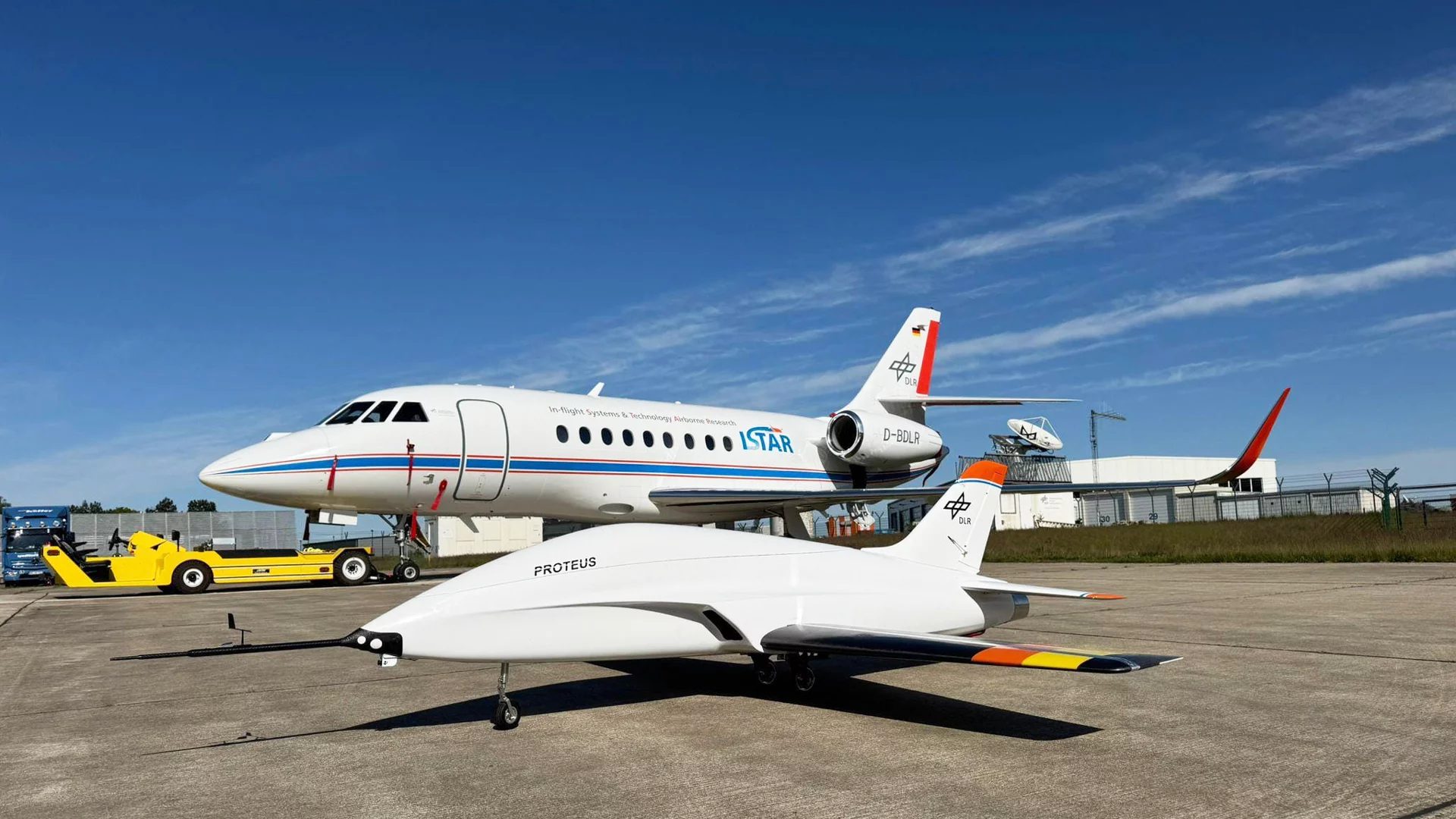
DLR is attempting to break this compromise by engineering adaptability into the wings themselves. In the morphAIR concept, the wings can actively deform during different phases of flight: achieving higher lift during takeoff and landing, reducing drag during cruise, increasing responsiveness during turns, and enhancing stability in turbulence. To this end, DLR installed a new morphing wing on an unmanned test aircraft named PROTEUS, conducting comparative tests with a traditional wing to verify the system's airworthiness and integration effects.
The morphAIR wing is made of all-fiber reinforced composite materials, with its trailing edge incorporating a “morphing segment” capable of continuous deflection. This section utilizes DLR’s independently developed hyperelastic trailing edge morphing system, HyTEM, which achieves smooth deformation without noticeable lines or gaps. Martin Radestock, project leader at DLR’s Institute of Lightweight Structures, explains that this concept replaces traditional flaps and ailerons with multiple small actuators distributed across the entire wingspan. These actuators can finely adjust the airfoil profile at ten locations without creating segmented gaps on the wing surface, thereby reducing profile drag and improving overall aerodynamic performance and flight dynamics while changing lift, induced drag, and control moments.
The true potential of morphing wings can only be unlocked through intelligent control systems. DLR has developed an AI-assisted flight control system specifically designed for the highly variable wing surface movement characteristics. During flight, adaptive algorithms continuously monitor the aircraft’s actual response and compare it to a trained reference model. Once an anomaly is detected, such as turbulence, local damage, or a failure of an actuator, the system will reallocate control commands to various parts of the wing surface in real-time to maintain stable flight. This algorithm has also been trained in simulated failure scenarios, capable of identifying and compensating for failure modes that could lead to serious loss of control in traditional fixed-wing architectures.
In terms of perception, DLR has also adopted an ingenious approach. The team did not install a large-area sensor matrix on the wing, but instead developed a method to infer the entire wing’s aerodynamic pressure distribution from a small number of measurement points. With this reconstruction technique, the flight control system can “sense” the airflow state around the wing surface in real-time and holistically, comparing the reconstructed pressure field with the expected state, automatically identifying local disturbances, and responding and suppressing them before they amplify.
With the combination of morphing wings, AI flight control, and pressure field reconstruction technology, the morphAIR wing, in a sense, possesses the ability to “feel” and “think” about its own flight state, and has been described by researchers as one of the most promising attempts to date to replicate the adaptability of bird wings. Currently, the flight tests of the PROTEUS drone equipped with this technology have primarily verified the system’s basic airworthiness and the integration and coordination of its subsystems, laying the foundation for further optimization and expansion of applications.
Although it is unlikely that similar morphing wings will enter large commercial passenger aircraft in the foreseeable future, their prospects in the drone field are promising. Next, DLR plans to conduct further test flights on a PROTEUS architecture with a total mass of approximately 70 kilograms to demonstrate the feasibility of extending the technology to larger platforms. DLR has previously released a test flight video showing the wing’s real-time deformation during flight, and the public can view this new generation of variable surface technology in action through related links.